
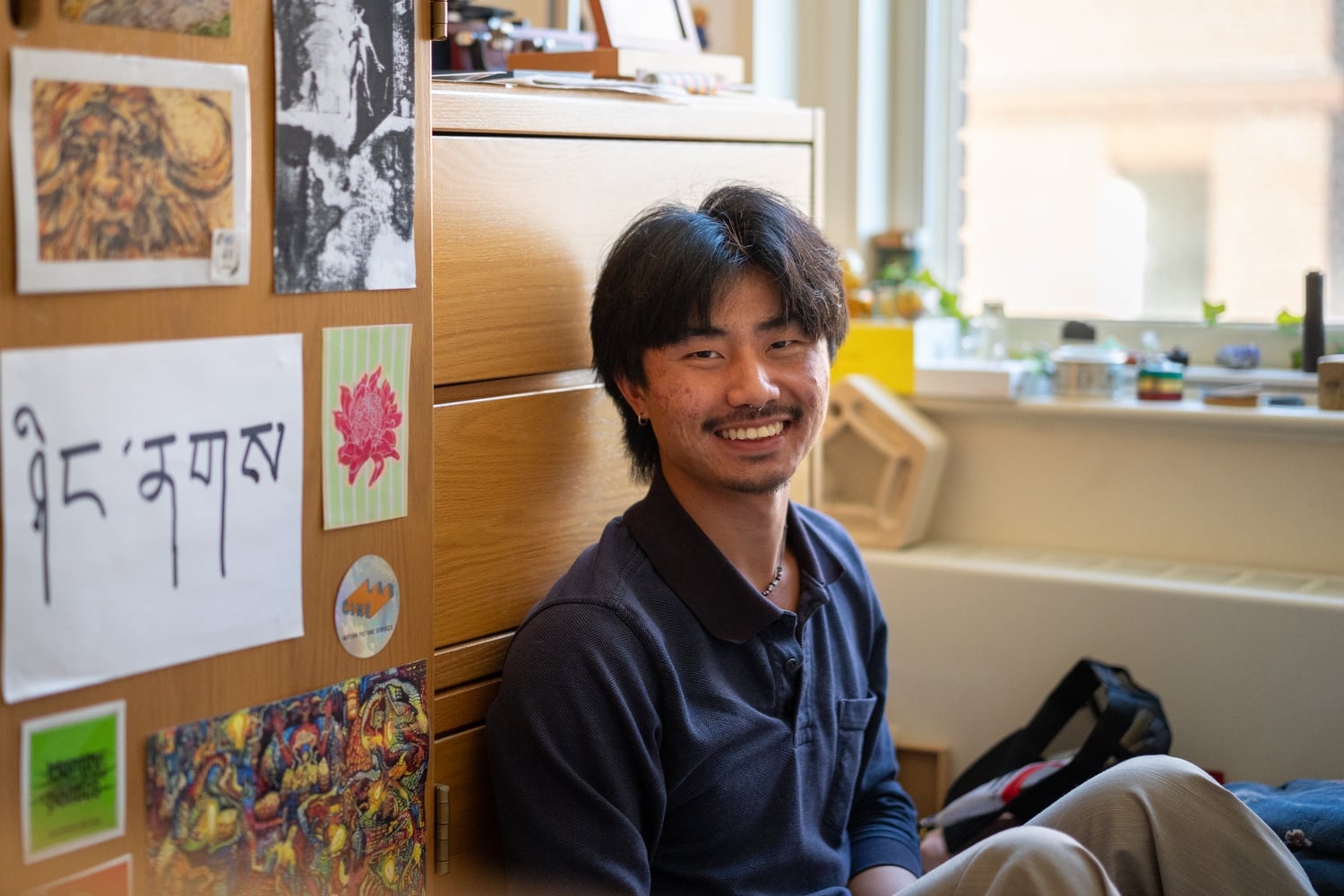
Most Chill: Forest Moua
For lack of better words, Forest Moua is just pretty chill.
There are times in a journalist’s life when it becomes necessary to question the premise we’ve been given, to interrogate the facts of a case, to discover that things are not as they seem.
This, I’m afraid, is not one of those times. It takes me not three minutes to decide that Z. Forest Moua ’27 is indeed the Harvard Class of 2027’s chillest senior.
On a sunny Monday afternoon in early November, we meet inside his Adams House suite and, instead of futilely attempting to identify any one chill trait he embodies, discuss what being the Most Chill actually means. I’m not sure we get very far or say anything very original, but we agree that this didn’t matter so much, and that the pleasurable hour and a half we converse is as good an indication of chillness as anything we might have said, anyways.
Forest is one of six occupants of a large suite in Claverly Hall. Incidentally, it is my second time in the suite. I had, semi-invited and largely unwittingly, stumbled into a River Run party there some six months prior, a fact I only realize only after entering. It is also my second time meeting someone named Forest. The first Forest, an extremely buff, piercing-happy dude a year older than me in high school, was most well-known for his weed habit and holds the dubious honor of being the first person to take me to a gym. Which is to say, my associations with Forest Moua were rather muddled.
Forest’s room, though quite small, is so well-decorated that I will not do him the disservice of attempting to describe it in full. Suffice to say it is appropriately chill, with a truly impressive array of posters displayed at perfectly regular intervals, trendy (and presumably thrifted) coats dangling artfully yet haphazardly, and a similarly diverse assortment of vinyl records adorning the walls (records that were, naturally, not performative). A small record player rests atop the dresser. When I comment upon the unfamiliar yet enjoyable music coming from it, he asks me to pick one from his collection to play. I select “There Goes Rhymin’ Simon.” Forest also offers me tea.
Like his room, Forest himself looks Most Chill. A bead necklace dangles just inside his collar, and several bracelets of various cloths and beads hang at his left wrist. His other wrist bears a small, gold-framed wristwatch with a leather strap. His tan pants are flowy without drooping; his navy blue henley chic without being preppy. Both his ears are pierced, as is his septum, which is perhaps the only thing he shares with the Forest of my high school years.
Minh-Hoang Hans Bach-Nguyen ’26-’27, one of Forest’s closest friends, says Forest’s chill is rooted in finding “meaning in everything.” I imagine that everything in his room — the records and the posters and the jackets and the necklace — probably has some incredibly meaningful personal backstory that speaks in some way to chillness. But to ask about any one item feels inadequate to explain the totality of his chillness — losing Forest for the trees, as it were. So, I do not ask about the records or the posters or the jackets or the necklace. I put down my pen and ask what, really, is the essence of chill?
Poetry, we agree, is pretty chill. Forest’s belated father, Pos Moua, was a famous poet, publishing two collections, “Where the Torches Are Burning” and “Karst Mountains Will Bloom.” There is a poem in Karst Mountains titled “Poem No One Likes.” It begins “For my son Forest // I want to write / a poem / that you may not like // it is a poem / you might want to / tear into pieces // because it is a poem / about death / & goodbyes.”
Forest Moua reads “Poem No One Likes,” written for him by his late father Pos. | Recorded by Wyatt J. Meyer
Forest remembers his dad taking him to his back porch at the family’s home in Merced, California, to read the first draft aloud to him. They both cried. Pos passed away in 2020, the year after Karst Mountains was published.
Forest didn’t write poetry growing up. But after his dad died, Forest began to write, and has continued to do so. He wrote a poem in response to “Poem No One Likes” titled “A Poem I Like About A Poem No One Likes.” The concluding lines are: “When I feel as though there is no more to like about / Being alone in the backyard or in the street with // Tears welling in my eyes, I read a poem that no one / Likes but me, & come to stop by & say hello.”
Forest Moua reads “A Poem I Like About A Poem No One Likes,” which he wrote in response to his father’s poem. | Recorded by Wyatt J. Meyer
His family is chill, too. Forest is Hmong, an ethnic group of Southeast Asia. His senior thesis — the product of a concentration in Anthropology and Art, Film and Visual Studies — centers on three generations of his female relatives in Laos. These women, Forest tells me, are beautiful singers. Forest’s poetry follows that lyric tradition. “The reason I write is because I can’t sing,” he says.
But like family, individuality is also chill. “Maybe it’s a father-son thing,” he says, “but even after he’s passed, I try to be a little counter to him.” Pos used to tell Forest never to care what people think, but Forest does the opposite. He finds that being attuned to others is more freeing than relinquishing their gaze.
In conversations, (which, amongst his roommates, sometimes stretch for hours) he thinks about tone. “Everyone says something, but doesn’t exactly mean what they say,” he adds. A person’s tone communicates what’s unsaid: their engagement, their investment, their feeling. In all interactions, he says, “you have to dance with someone.”
Nature — unavoidably, given his name — is chill. Forest is not the only Moua whose name borrows from the outdoors. In Hmong, Pos means “thorn.” Forest’s eldest brother is named Lewg (“dewdrop”) and his middle sister Luna Hlee (“Moon moon”). For the last four years, on his birthday, Forest finds a body of water and skips rocks until he hits the number of years he’s turning. On his 21st birthday, he skipped rocks 21 times somewhere in the Rocky Mountains just west of Boulder, Colorado. I wonder aloud how someone could count upwards of 20 skips. “It’s not about exactly 20 times,” he says. “It’s a feel thing.”
(Having covered nature, relationships, and most of art, I ask what is not chill. “Picky eating,” Forest says. “All that tells me is that you want to live in a narrower world.”)

The most counter-intuitive chill trait we discuss is performance. I, feeling quite radical, suggest that “chill” has been co-opted to mean the ritual, practiced uncaring of nonchalance, and that this redefinition misses the mark. Being profoundly affected, rather than unaffected, is the chillest thing we can be! (I subsequently learn that each of the last three “Most Chill” senior superlative profiles had written more or less precisely about this idea, but without my self-righteousness.)
Forest goes a step further. “The self is always constructed,” he says. Imitation, projection, and performance aren’t uncool methods of assimilation — they’re ways to experiment with being, and they are supremely chill. The dialectic between “who I am” and “from what I come” forms the self. Forest remembers his dad’s words. “The world outside of me informs the world inside of me, and vice versa.” The informing is the self.
“Does that make chillness a process rather than a fixed state?” I ask.
“Yeah, I guess so,” he says.
“Cool,” I reply.
We talk briefly about the future — Forest doesn’t have defined plans, but has applied to several post-graduate fellowships which he hopes will allow him to “just write and work on film.” We talk about other things, too, a fair number of which revolve more around my life than I initially intend. The grace and attention that make Forest a delightful conversationalist also make him an ornery interviewee — he keeps turning my questions on me (which is in a strict sense not the point of a profile, and in another sense precisely the point of this one). Forest also insists I be in some of the photos. (Fortunately, I am not the Class of 2027’s chillest senior, but let it be known that he asked.)
Forest wishes me goodbye and says he hopes we cross paths again. I am no poetry buff, but I am reminded of a favorite line from Richard Price. “A lifelong friend / for half-an-hour,” he writes, and I suppose that is pretty chill, too.
—Associate Magazine Editor Wyatt J. Meyer can be reached at [email protected].