
Do Harvardians Dream of Quincy Grille?
The history of Quincy Grille is rife with lively (and, at times, illicit) tales of late nights, greasy burgers, and community bonding. Today, following a series of controversies, the student-run, late-night refuge has reopened. Can it live up to its storied past?
Updated February 27, 2026, at 12:01 p.m
ittle satisfies the drunk, high, and dreary quite as well as deep-fried chicken tenders, milkshakes, and curly fries. Such is the public utility provided by Quincy Grille, the late-night eatery and veritable institution of The People’s House that draws patrons from across the Yard with grease, salt, and an emanating warmth reminiscent of a countryside diner.
As far as this writer can determine, ever since New Quincy opened in 1959, there has been, if not Grille proper, at least the instruments and infrastructure with which business-minded Quincy residents could sell such patriotic fare as cheeseburgers and hotdogs to budding alcoholics and cramming students late into the night.
Running the Grille is not a trivial commitment. Current Quincy Grille co-managers Caleb A. Hultmann ’27 and Drew B. Henderson ’28 each spent over a hundred hours during the fall 2025 semester cleaning and repairing equipment in preparation for opening day. The Grille abruptly shuddered midway through the spring 2025 semester (pity the stoner).
In addition to staffing issues, the BoardPlus payment system wasn’t online for most of the year, meaning that when students swiped their IDs, their accounts were never charged, steadily draining Grille funds.
The previous managers did not respond to The Crimson’s request for comment.
The new managers say they had to secure a loan from the house administrator to fund a new fridge and freezer and initial inventory. They found their doyen line-cook in the meticulously tattooed Texan Anna K. Burgess ’27, who began working at the Grille her freshman year. The Grille opened in mid-November, but staffing shortages and a slew of University holidays made it difficult to keep regular hours.
“It was a really hard time building back up that rolling community of ‘Quincy Grille is open, nine to one, every day,’” Hultmann says.
This semester, the co-managers were determined to open immediately, selling their first fry box on Jan. 30 — the first Friday of the spring semester. I visit the Grille on the night of Quinski — a ski-themed party run by the Quincy House Committee — which brings the busiest night for the Grille yet of the year. I see hordes of freshmen — many of whom have never even heard of the Grille.
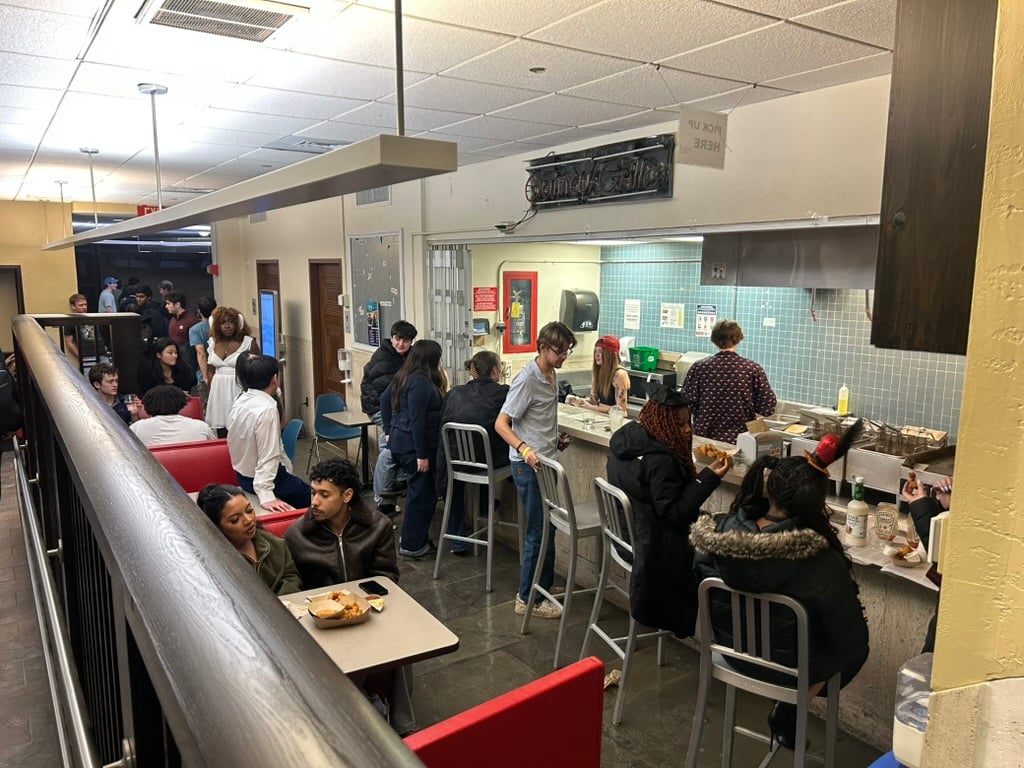
“You have to pay?” a freshman friend once asked me. Indeed, many partiers also have trouble with the paying part — but more on account of the difficulty of fumbling an HUID from your wallet when you’re seeing two of them. (God knows how anyone manages the QR-code payment option.)
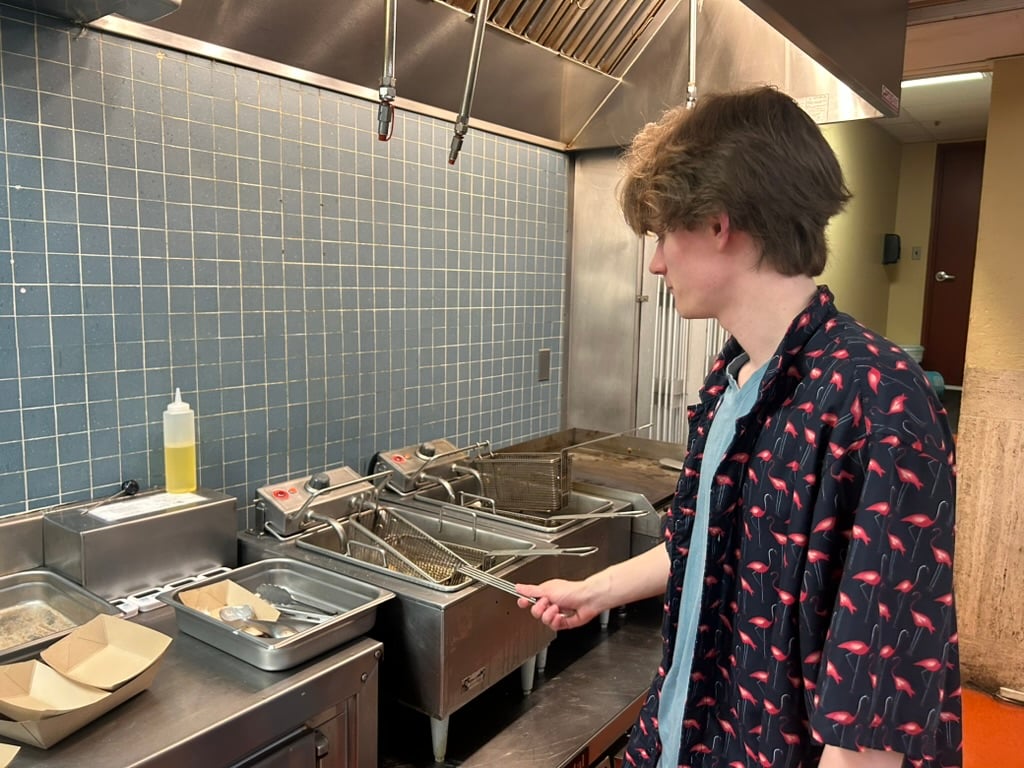
I sit at the bar, watching Hultmann move about with ease, tossing handfuls of frozen tenders and triangular breaded-mac’n’cheese pouches into the dimmed oil of the deep fryers. Caleb wears an unbuttoned flamingo-patterned shirt that seems more appropriate for “Quin-waterski” as he deals with inebriated customers that struggled to find the laminated menus strewn on the counter. Paramore and Blink-182 play from a JBL speaker, serene against the methodical din of fast food.
Hultmann’s blocking group is hanging around the Grille, including Jacqueline E. Metzger ’27, one of the Quincy HoCo chairs, who is annoyed that I didn’t partake in the “canon” freshman experience of Quinski, and Sarah F. Li ’27, a Crimson Design Chair who designed the menus and is currently drafting T-shirts that showcase the iconic, yet currently broken, neon “Quincy Grille” sign. Li and I contemplate the proper color for the T-shirts as I sip a strawberry milkshake — not pink, but very refreshing.
“Does it have the right amount of strawberry flavor?” Hultmann asks me between orders. “The shake could use more strawberry,” I tell him, “but how to keep the strawberry syrup from making it too sweet?”
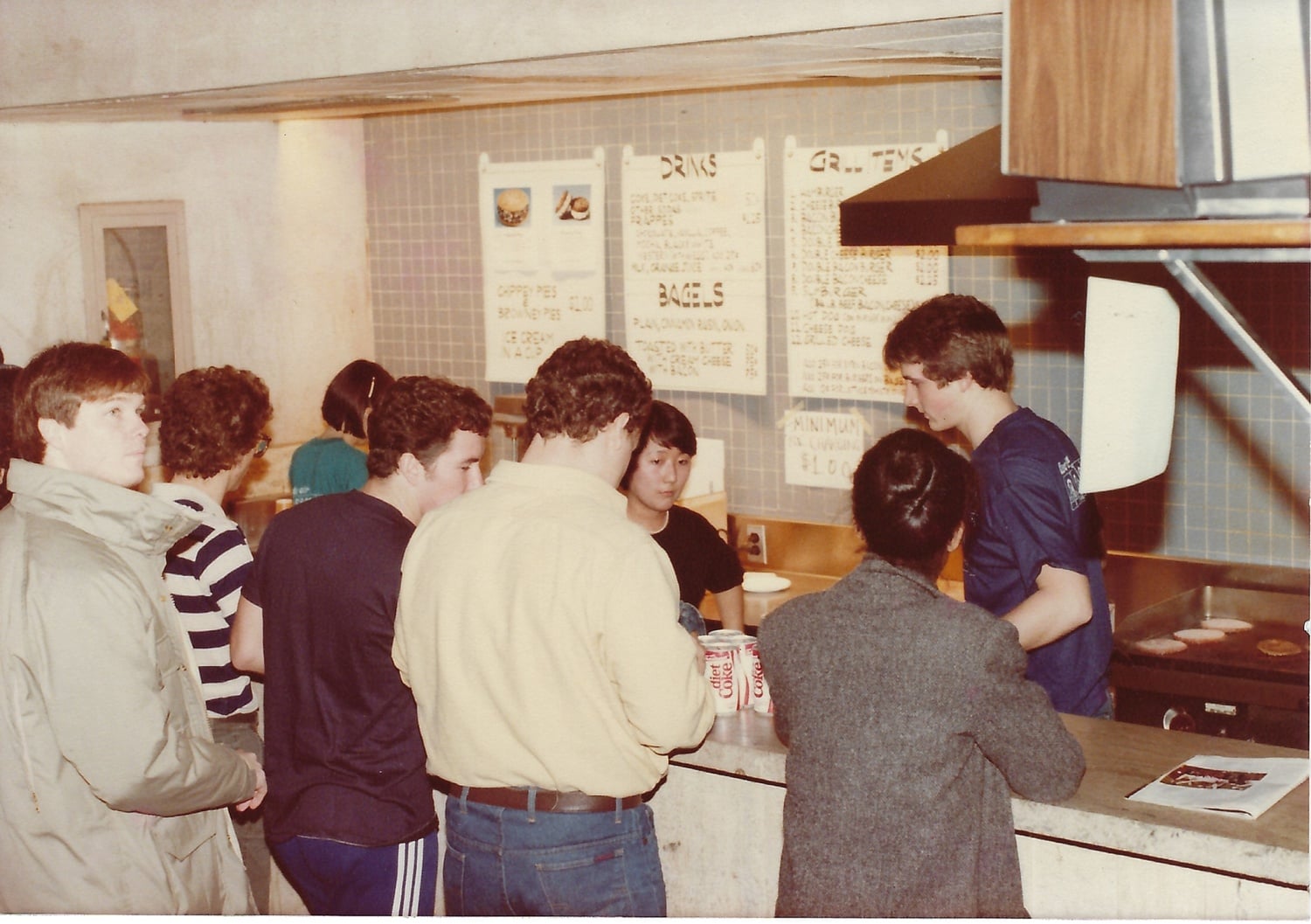
I show Li a picture of the navy and teal T-shirts the Grill used to hawk for six dollars apiece back in the 80s — an age when ordering custom t-shirts in Cambridge meant visiting the corner printshop on Hampshire Street, and years before the aristocratic “e” was appended to the name of the People’s Grill.
“A clear, clear error, I mean, there’s just no question,” John M. Lutz ’84 says of the addition. “I just can’t even imagine what would induce them to do that.” (The name change seems to have occurred between 1990 and 1995.)
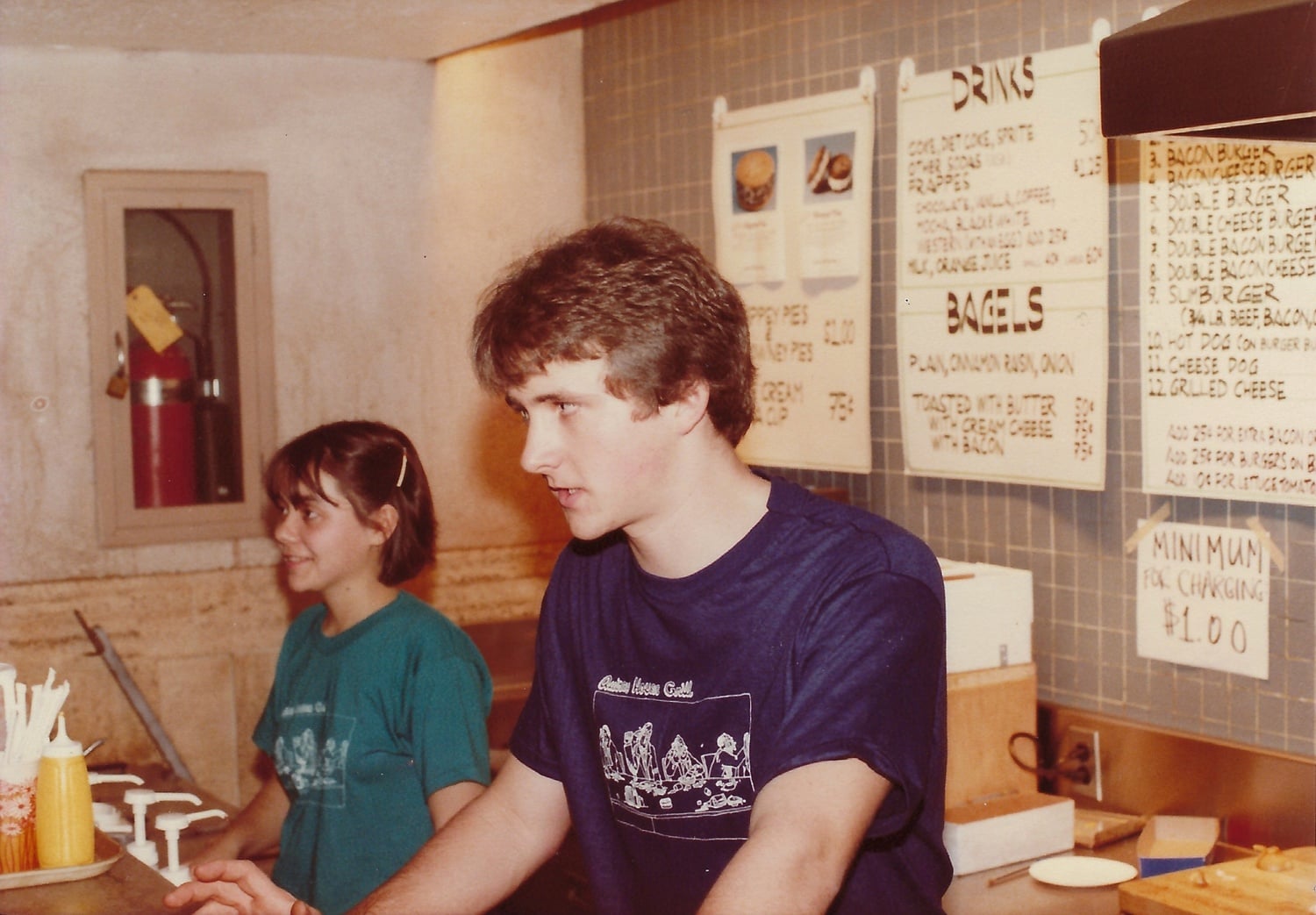
Lutz, incidentally a linguistics concentrator, managed the Grill with his Quincy blockmates Peter S. Kirby ’84 and Paul M. Manina ’84 in 1983.
When the group arrived in Quincy in the fall of ’81, the Grill was thriving under a well-liked management team. However, stewardship of the Grill was soon passed on to an “interesting bunch,” as Kirby puts it, that “did not seem to have any natural appeal.” The blockmates once came upon one of the new managers sitting at the counter, mashing beef in their hands like “something out of the Texas Chainsaw massacre,” Manina tells me. Their reign did not last long.
Encouraged by the original, more successful, managers, the trio applied to become managers themselves. Come January of ’83, the Quincy Grill reopened for business under the rule of this Harvardian triumvirate. Innovative advancements characterized their tenure. Large posterboards broadcasted a menu of cheeseburgers, hotdogs, frappes, and bagels (surprisingly hazardous to prepare). Wendy’s, then a nascent restaurant chain local to Lutz’s home state of Ohio, inspired graphics depicting single, double, and triple cheeseburgers.
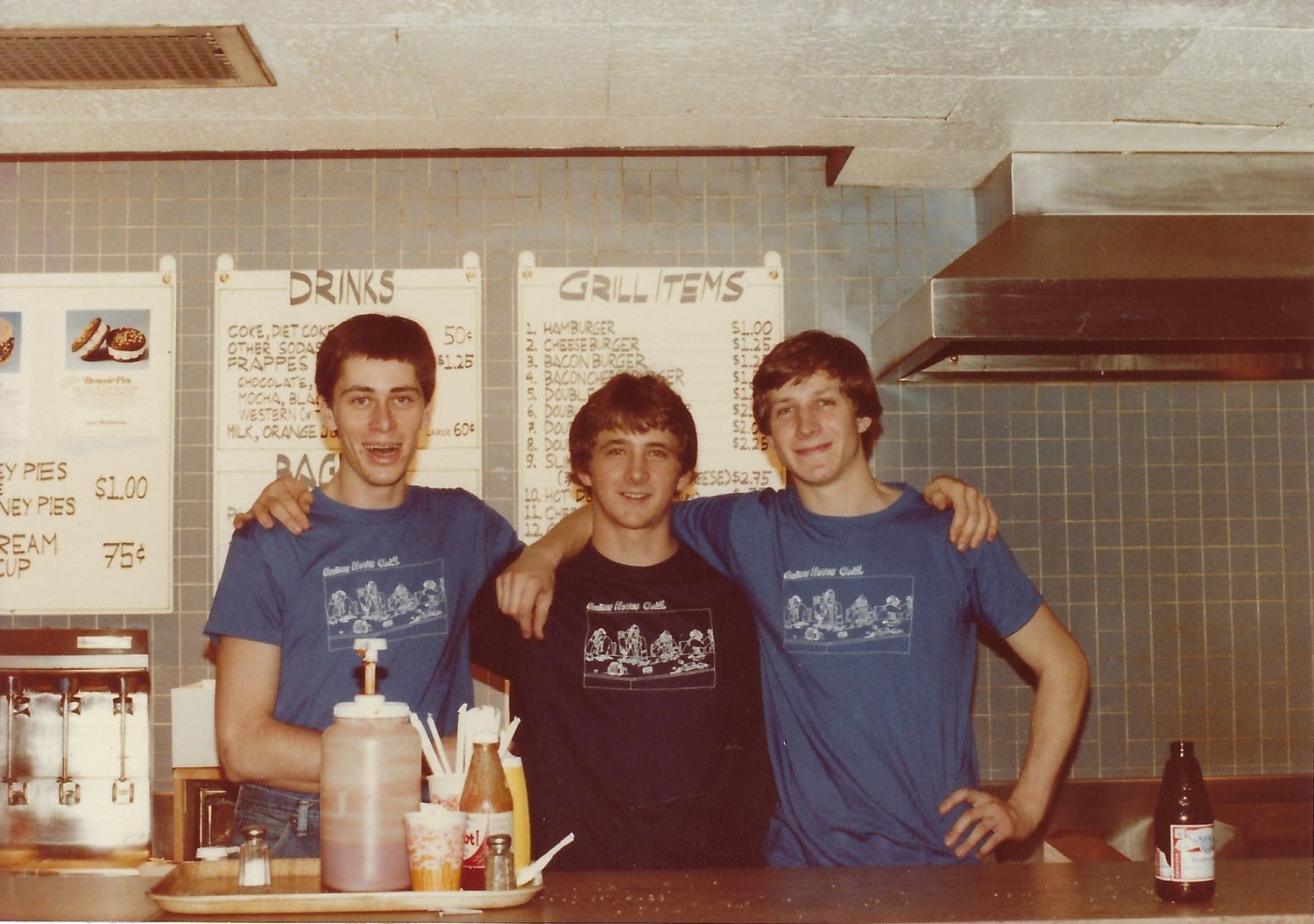
Kirby bought an early IBM PC and coded a program in BASIC to keep track of Grill tabs. A dot matrix printer rendered official-looking “grill slips” that informed debtors of their outstanding obligations. Every two weeks, whoever had accumulated the highest tab (the “slim guy”) could expect a free “slimburger” as a reward for his loyalty — though this did not, of course, release them from their obligation to pay their tab.
The “slimburger” came with three quarter-pound patties of beef, as well as bacon and cheese; the fatty “Q-delux” came with bacon, cheese, and a fried egg. House Master — the term previously used for Faculty Deans — David A. Aloian ’49 told The Crimson in 1983 that “Quincy makes the best hamburgers in town.”
An abundance of fifty-cent add-ons (bacon, cheese, cream-cheese, etc.) and a restrained simplicity to the menu ensured profitability. One could not, for instance, get fries with your burger. (Upon returning to the Grill soon after graduating, Lutz, Manina, and Kirby were horrified to discover deep fryers had been installed in their absence, “a bridge too far when we were trying to be simple,” as Lutz puts it.)
Beer wasn’t on the menu, but for a dollar, you could in short order find yourself holding the stubby neck of an amber-bottled Budweiser (and for a dollar-fifty, an imported Molson). Beer sales actually made up only a small portion of sales, but with good margins. The group also recalls visits from senior administrators (in the capacity of customers) who, while awaiting their order, would silently observe students nursing beers at the Grill counter.
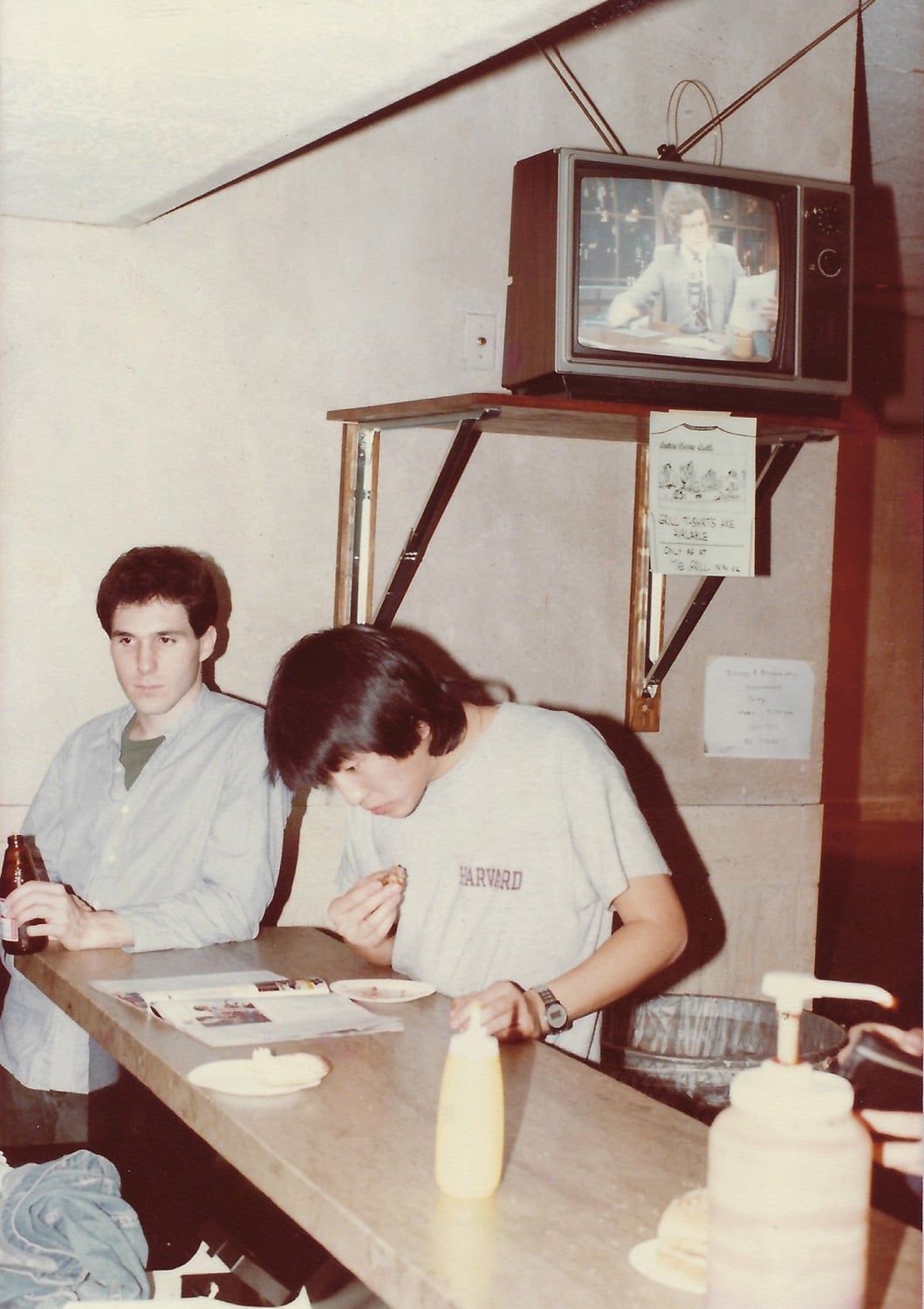
Manina used his position on HoCo to influence the purchase of a large color television set, ostensibly for general use, but in practice, almost exclusively to be found under the care of the grill managers. At the time, TVs in dorm rooms were uncommon, and so Quincy residents gathered around the flat top of Quincy Grill to watch David Letterman, the Boston Bruins, and M*A*S*H, while others congregated around the nearby foosball tables.
The Grill in the eighties was at the heart of the House’s community, a massive center of social gravity. That’s the feeling Hultmann and Henderson are trying to rebuild now. Though the menu has changed — “I’m pretty sure I didn’t even know what a quesadilla was,” Lutz says — the fundamental character of the Grille remains true.
Still in debt, Hultmann and Henderson are treading lightly, keeping their menu ambitions checked and staying focused on more mundane problems, like getting the TV hooked up again, scooping vanilla ice cream from three-gallon jugs, and fixing their iconic neon sign.
“We’ve got lots in store for building community,” Hultmann says. “We are The People’s House, we are The People’s Grille.”
— Magazine writer Andrew W. Shlomchik can be reached at [email protected].