
Jerold Kayden Has Built a Life Out of Cities and Music
Jerold Kayden's love of music led him to get a ride to the airport from Oprah Winfrey and join Michael Jackson on his first solo international tour. Yet the Graduate School of Design professor's career interests have remained focused on the "built environment."
hen I meet Harvard Graduate School of Design professor Jerold S. Kayden ’75 in his office in Gund Hall for the first time, I immediately notice the buildings on his desk.
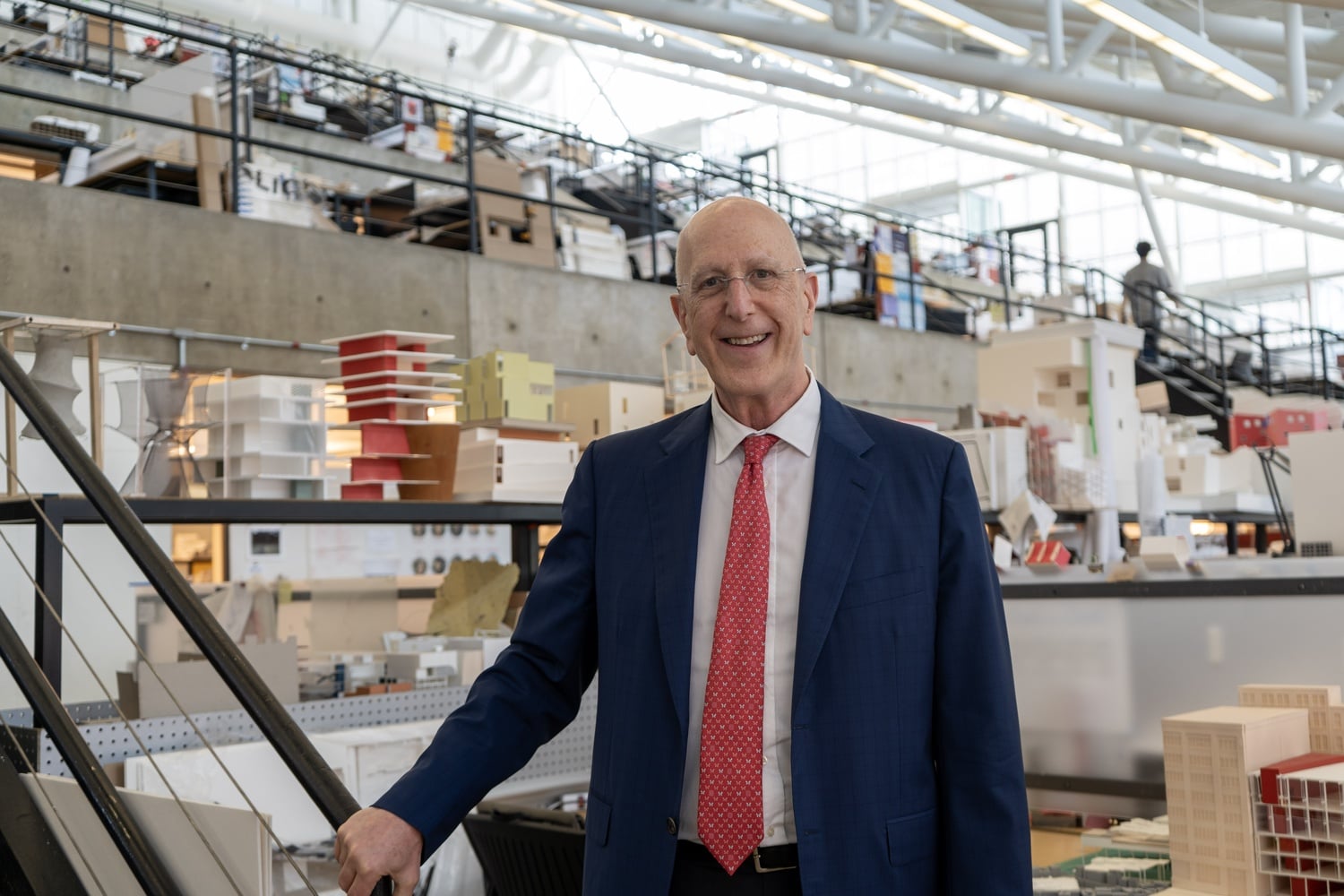
Kayden keeps four models on the center table in his office: two of the Seagram Building, one of Lever House, and one — a startling crimson cube — of a sculpture by Isamu Noguchi. All of the original structures are in New York City, a place where Kayden has advocated for years on behalf of privately-owned public spaces — areas that are open to the public despite technically being private property.
A lawyer and urban planner, Kayden founded the GSD’s Master in Real Estate program and has drafted and defended housing, real estate, and land-use legislation everywhere from Nepal, Ukraine, and Washington state to right here in Cambridge. He is currently serving as outside counsel for the city in an ongoing lawsuit involving its inclusionary zoning policy.
Kayden traces his love of cities back to his first year at Harvard, when he took a first-year seminar on urbanization. The butterfly effect of that one course, he says, is “remarkable.”
“It just shows what can happen even early on in a freshman seminar at Harvard,” he tells me.
Kayden’s desire to continue studying cities led him to pursue a special concentration in “urban policy implementation” — a title he now says is ridiculous. “I did not want my degree to be in urban studies. I thought that was too sort of plain, vanilla, bland,” he says. “And I look back at that, and I say to myself, I got a degree in urban studies.”
Over the course of multiple hourlong interviews, I learn that Kayden’s life has been far from bland. And it is not only his work in the urban environment — his life has been equally defined by a love of music, a combination Kayden credits to his parents. (His mother was a composer, his father, a real estate lawyer.)
As a Harvard undergraduate, Kayden spent much of his time outside class playing the trumpet. He performed with the Harvard Radcliffe Orchestra, the Bach Society Orchestra, in the pit at Gilbert and Sullivan shows, and semi-professionally in the Boston area. He was also part of a group tasked with playing at the inaugural ceremonies of new Harvard buildings, including several familiar to students today, such as the Science Center and Gund Hall, where his office now sits.
It was while he was president of the HRO in his junior year that Kayden first conceived of Learning from Performers, a program he founded to bring celebrity artists to Harvard’s campus to teach master classes. You do not have to be a musician to recognize some of the names the program has brought to campus: Lin-Manuel Miranda, Robert Redford, Tina Fey, Quincy Jones, among others. The program celebrated its 50th year this past January.
Jones, a record producer and composer, is best known for producing Michael Jackson’s “Thriller,” “Bad,” and “Off the Wall” albums — to Kayden, he became a close friend and collaborator, thanks to the Learning for Performers program. For a time, the two discussed turning the concept into a nationwide company.
While the company never materialized, Kayden acknowledges that his friendship with Jones offered him the opportunity to connect with celebrities at a level most people can only imagine — from getting a ride to the airport from Oprah Winfrey to joining Michael Jackson on his first solo international tour.
“Quincy called me up and said, ‘Michael has asked me to go with him because he’s shy and he wants me to handle the press. Do you want to come along?’” Kayden recalls. “I said, ‘Yes, I do.’”
He credits these experiences with giving him the ability to feel comfortable around anyone. “I mean, would you be nervous if you met Beyonce?” he asks me. (The answer is an obvious yes.) “Probably before all this happened, maybe I would have been,” Kayden reflects. “But, you know, several years later, it would have been totally fine and fun.”
Music remains a part of Kayden’s life. A graduate of Juilliard College’s pre-college program, Kayden now serves on the school’s Board of Trustees. Juillard President Damian Woetzel credits him with fostering an alumni community and advancing the school’s goal of becoming tuition-free. “He’s been really, really valuable at Juilliard in that way,” Woetzel says.
Kayden has also continued to compose, writing the theme that played at the inaugurations of two Harvard presidents: Lawrence S. Bacow and Claudine Gay.
According to University President Alan M. Garber ’76, Kayden is “very much dedicated to Harvard.” Garber credits him with providing “astute observations” about the GSD and helping ensure the success of its Master in Real Estate program.
On a more personal level, Garber says he has Kayden to thank for helping him and his wife find a used piano for their daughter.
“The time that he put in to help us find it and to help us purchase it was significant,” Garber says in an interview. “It was pure generosity on his part, and a real gift to us, because that’s a piano we still have, and it’s a wonderful instrument.”
Despite his love of music, Kayden realized early on that he lacked the skill to pursue it professionally. “To be immodest,” he jokes, “I’m really good. I’m very musical, but I was not a good enough trumpet player.”
Instead, after graduation, he doubled down on cities.
Kayden went on to earn two more degrees from Harvard: a Master of City and Regional Planning at the GSD and a law degree from Harvard Law School. It is a combination he has leveraged to shape urban policy across the globe — always with an eye towards the “built environment” to make the world a better place.
“I can’t think of a more noble mission,” he says.
Kayden speaks about his life with the easy candor of someone accustomed to talking to reporters. In the course of writing this profile, he shares a link to an interview he recently did for Future of the American City, a GSD-created podcast as well as a link to his appearance in the 2008 documentary film “Deathbowl to Downtown” about New York City street skaters — which he writes he shared “for amusement.”
While Kayden is generally candid, open and responsive even to tough questions, there is one subject he is less open to talking about. In March 2024, GSD associate professor Bing Wang sued Harvard, Kayden, and GSD Dean Sarah Whiting, alleging that Kayden had discriminated against her for years on the basis of her race and gender, and that the University had failed to act.
Wang, an Asian woman, alleges that Kayden interfered with the timing and name of her courses, omitted her name when discussing her courses with other faculty, and expressed a “discriminatory” desire to eliminate a planned course on real estate in China. Harvard has disputed the claims in court, and the case is still being litigated.
When pressed, Kayden cites University policy against speaking about ongoing litigation. “Harvard University is defending itself and me and Dean Whiting in this lawsuit,” he says. “Harvard also has a policy of not commenting.”
A University spokesperson declined to comment on ongoing litigation.
A spokesperson for the GSD declined to comment for this piece, citing a policy against commenting on both ongoing litigation and personnel matters.
Though he will go on sabbatical next year, Kayden remains a professor at the GSD — where he has received the school’s Teacher of the Year award. Former FAS Dean of Arts and Humanities Robin E. Kelsey, who co-taught a General Education course with Kayden, says that as a teacher he can be disarmingly both “good humored” and blunt. “He’s a person with a wonderful and sometimes wonderfully wicked sense of humor,” Kelsey says.
I find myself laughing more than a few times while speaking with Kayden — like when he talks about keeping pace with Ukrainian ministers in the 1990s, when he was helping the country draft private real estate laws following the fall of the Soviet Union.
“We would joke around,” Kayden says. “I would say to them, ‘Look, I know that you’re a KGB agent, and you know that I’m the CIA agent, so let’s work together.’”
“There was a lot of drinking,” he adds, though he clarifies that he is not referring to himself. “You learn how to not get drunk at conferences, when you are asked to toast and drink, you know, 20 times in a row.”
Kayden is not the type of man to be modest about his life. He is honest about the scope of his accomplishments. He told me multiple times about the legislation he had drafted on behalf of foreign governments — and the framed letters of gratitude he had received from presidents as a result, along with the individual pens they used to sign certain bills into law.
But when I ask him what he has taken away from years working alongside those in positions of power, it is the people, not the power, that he focuses on.
“At the end of the day, people are people,” Kayden says. “If you have a real curiosity about people individually, as well as policy and governments, you’ll be more effective. You’ll also have a more interesting life.”
“And I can’t emphasize enough how important it is to be curious and open to other ideas,” he adds, “That’s a lesson that we all can learn.”
—Magazine writer Sebastian B. Connolly can be reached at [email protected] or on Signal at sbc.23. Follow him on X @SebastianC4784.