
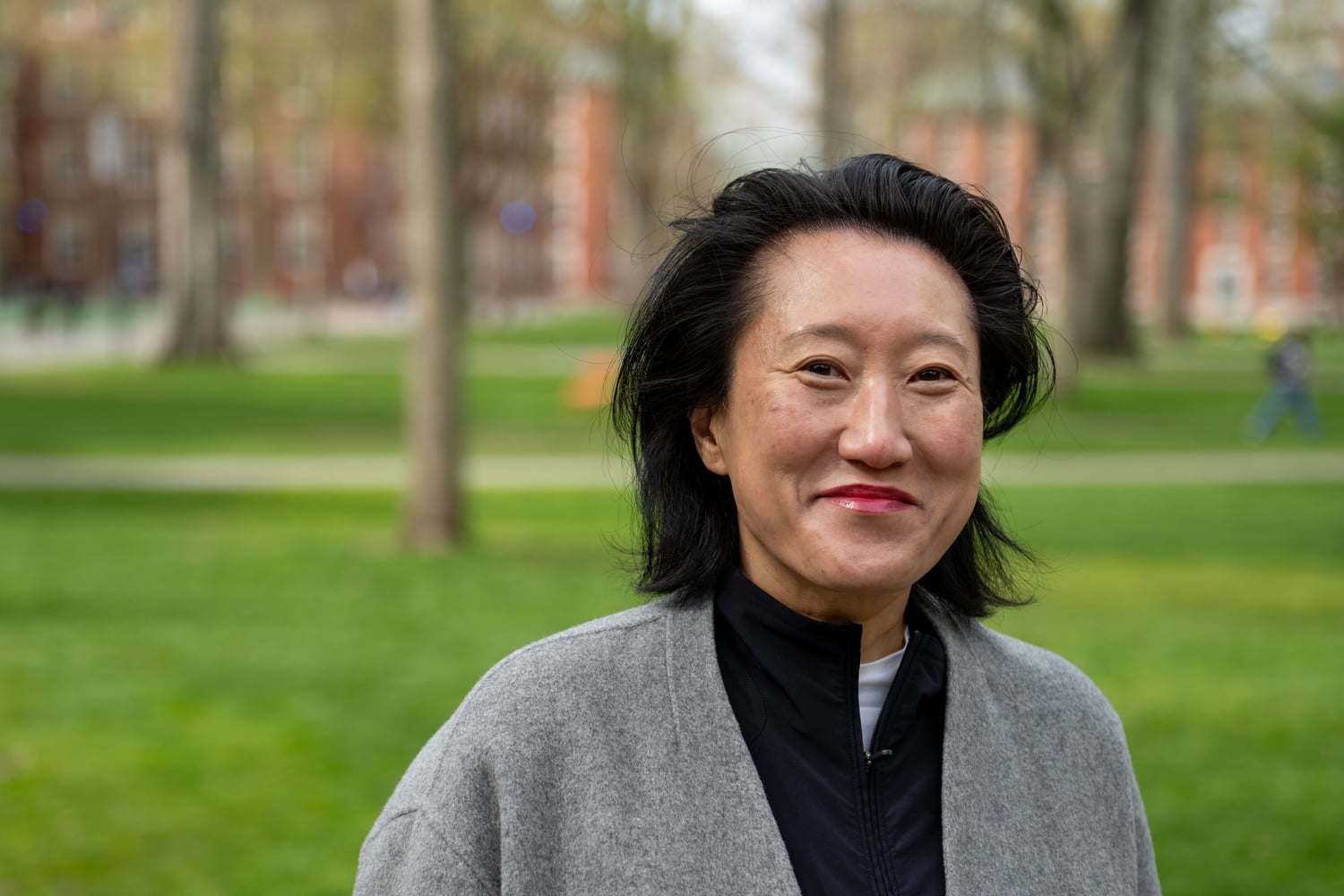
Fifteen Questions: Bo-Mi T. Choi on Critical Theory, Dreams, and Harvard
The Social Studies lecturer sat down with Fifteen Minutes to discuss her perspective on the University she’s preparing to leave.
Bo-Mi T. Choi is a lecturer in Social Studies. This interview has been edited for length and clarity. A spokesperson for the University did not respond to several comments made throughout the interview about Harvard’s state and future.
FM: You teach critical theory — for a general audience, what is critical theory, and what can it be used to do?
BTC: Critical theory is basically a set of modern philosophical ideas and concepts that help you better understand the complex and intransparent nature of the so-called capitalist world that we live in. And it allows you to contextualize your own position within it, and reflect about what isn’t working, and maybe figure out where we would like to go from here.
FM: You’re also very interested in science and technology, and how that impacts democracy and humanity in general. How have you used critical theory to explore those topics?
BTC: Critical theory has taught me how to think about any sort of social phenomenon. Being a person of the 21st century, we are inundated with new technology, and we are absolutely at the precipice of, I think, some sort of new historical moment because of this new digital technology.
And so, having been trained in this tradition, I started thinking in terms of, what are our historically adequate responses to this new technology, and what are people’s experiences?
It’s misaligned, actually, with certain things that people purport to do towards human flourishing. It’s always to check against the people who produce this technology, and really hold them to account in terms of what they’re saying that they’re doing — is that actually good for all of us?
FM: What do you mean by human flourishing? What does that look like for you?
BTC: The tradition that critical theory is anchored in is definitely from the 18th century. It’s Eurocentric, in the sense that it is Enlightenment ideas, but it’s basically norms and values that in some ways, our world still lives by, if we still believe in freedom and democracy and this idea of human dignity and the individual. Those are all historical achievements that humanity fought for.
I’m not saying there aren’t also the darker sides of the Enlightenment. And critical theory is particularly inclined to actually question those darker sides. Colonialism, postcolonialism, the way in which gender oppression has happened, and then obviously racial inequality. But they’re all coming out of that deeper critique into, what is this reality, and how has it been created and produced historically? What sort of imagination do we have about where we want to go?
As flawed and blind the tradition itself is, what I like about critical theory is ultimately its internal mechanism of self-reflection, it’s always to account for your own possibility. How is it possible that I can criticize these things? It’s also because I’m a product of the time period, of everything that has preceded. So it gives you also some sort of built-in humility: understanding your own becoming and how your values have been shaped by the environment and by the historical moment.
FM: What would you say is the most impactful piece of technology that we’re grappling with today?
BTC: Definitely algorithmic technology, just because it absolutely influences how we think. If you think about, say, technology in the 19th century, it’s material, mechanical. And when you look at it from socioeconomic perspectives, it’s about the automation of manual labor. And what’s happening with AI and digital technology is an automation of intellectual labor, and that will have all kinds of consequences. It will affect how we think and how we perceive the world.
FM: I know that you will often ask your students if they still have dreams. Why do you do that?
BTC: Personally, because I am somebody who dreams a lot. I do feel I take great pleasure in dreams, and have resisted this whole idea of the binary between reality and the pleasure principle.
It’s not “dream” as the sheer escape from reality. “Dream,” more, in that tradition of critical theory, about being able to imagine a better future.
I do sense in your generation, there’s this very interesting contradiction or tension. On the one hand, there’s a certain wisdom around you — that you understand what’s important in life, and there’s some clarity around that. For instance, you don’t buy into the American dream, because clearly the material reality does not support that.
But then, on the other hand, there’s also that sense of some nihilism, maybe, in the face of all these existential challenges. I think the big moment I had was a couple years ago when I was at the end of my sophomore tutorial, Social Studies 10B, where I was asking, “so what have you learned? How does social theory help you to understand this world or navigate this world?”
One student said, “everything is historically and socially constructed. Nothing is real.”
And I was very shocked, because the first part made sense to me — yes, everything is historically and socially constructed. You’ve learned now to think in that way. But the inference — “nothing is real” — how did you get from this premise to this conclusion? Just because something is constructed does not mean it isn’t real.
It was like a wake-up moment for me, because I was like, “okay, I need to teach this differently.” Because the way I experienced social theory or critical theory when I encountered it as a young person, was actually as a form of liberation. The categories that we think are natural and are internal, and this is a reality that you cannot change — when you start tweaking how you look at the world, like Nietzsche’s notorious perspectivism, what perspective, what lens you use, will, in fact, create the world for you.
That sense that something is constructed just means you need to appreciate change, that everything changes, nothing stays the same. And if there’s one cosmic universal law, it’s that things keep changing.
For some reason as humans, we have the tendency to hold on to certain ideas as if they’re eternal. And I do think that’s when the disconnection happens: when everything around you changes, but you hang on to certain ideas, and it doesn’t line up with reality. That’s when people start suffering.
FM: You are also a clergy member at the Kwan Um School of Zen. What does that role entail?
BTC: Basically just a lot of meditation practice.
I started teaching in Social Studies in 2004 when I was still a graduate student.
I was just finishing my dissertation, but also started teaching in Social Studies, and that same year — actually, the same month, September 2004 — I moved into the Cambridge Zen Center.
Now it’s over 20 years, both that I’ve been doing critical theory and also Zen practice.
A lot of people ask me, “how come you do Zen Buddhism? Didn’t Adorno hate Zen Buddhism?”
But what I have discovered in the 20 years is basically how they point to very similar things.
The critical theoretical tradition of the Frankfurt School coming out of a Marxist tradition — it’s a philosophy of the senses. It’s very material in the sense that Marx, the young Marx in particular, in the economic and philosophic manuscripts, talks a lot about the aesthetic dimensions of human existence — not just like things have to be pretty, but literally the sensory dimension.
And Zen practice itself is very embodied. Meditation is a very embodied practice. And so those two things seem very similar.
In the Zen parlance, the direction is to alleviate suffering, and at its best, critical theory is also a philosophical-slash-social, political, way of thinking about how to alleviate suffering.
So what does it involve that I’m clergy? It just means structuring my life around a certain direction, like a vow to alleviate suffering and to help the suffering world. That’s all.
FM: You also have been advising the Harvard Undergraduate Meditation Club for quite a while. How did you get involved with that, and why have you stayed involved?
BTC: I was asked in 2009 if I wanted to step up as a faculty advisor. It started out as a Buddhist club — the Harvard College Buddhist Club — and I stepped up because I happened to be a dharma teacher in training at the time.
And the Harvard Meditation Club has been a revelation, because it’s also, in some ways, encountering Harvard students in a radically different context, which is not academic, which is explicitly spiritual.
FM: What would you say to a Harvard student who was interested in making meaning in an increasingly digital, or virtually connected world?
BTC: My first advice would be: if you’re unhappy, take that seriously.
And if this question of “why” comes out, you should take it seriously, and then find some sort of context in which you can explore it with other people.
To create community takes effort, and it’s as simple as showing up. It’s showing up for yourself, and for other people, and for the things you deem are important.
And this whole idea that you can do everything and be everything for everybody, and that you can have it all — it’s just total, excuse my French, I think it’s bullshit.
True freedom is knowing where your limits are, and then to do the things within that ballpark. Then you can really do something. Because if you have too many possibilities and choices, it actually creates a sense of unfreedom and stuckness.
FM: You are leaving Harvard after many many years. Why did you make that decision, and what’s next for you?
BTC: I’m part of what I call the intellectual proletariat, which is non-ladder faculty.
I started in Social Studies as a grad student. And then once I got my PhD, they offered me a lectureship. And back then it was three years. And after that time passed, I left. That was 2011.
I ended up working on this documentary film project in Vienna, called the Vienna Project, with a professor here at Harvard in art history, Joseph Koerner. That’s where I learned film production.
After the project was done, I had also a lot of contacts in Europe and I worked as a freelance multimedia producer and film producer. And then in 2020, I was in Germany and stuck in the lockdown in Covid, when somebody in Social Studies reached out and said I should reapply. And I had no plans to return to Harvard, but I had nothing else to do, so I sent in my application.
I realized during the interview how much I missed intellectual stimulation. And so I returned in the fall of 2021, and just really loved being back.
But I could feel a lot of institutional crisis happening, within the program, but also with Harvard. And the fact is, again, I came in as a lecturer, and I would clock out eventually.
I thought I would panic after I had that conversation with the powers-that-be. That was last October. I felt, actually, very, very calm, in a weird way. It was almost like this little voice was like, “oh yeah, this is a sign for you to do something, to move on.” And it felt, actually, quite right. I just didn’t know what it would be.
But lo and behold, literally two weeks later, after I was like, “I have eight months to figure out what I want to do with the rest of my life,” I was introduced to a film executive who worked for over two decades in the Korean film industry.
We sat down, and he was telling me about some sort of dream he had.
He would like to produce this film about this Korean Zen master.
He asked me if I wanted to get on this project and since last fall, I’ve been traveling to New York and negotiating all these next steps. And it looks very good. And I will start in September.
I also want to return to a book project that I started two years ago. And I was working on it for a year, but last year I just totally fell off it because of all this work at Harvard. That’s the synthesis of the last 20 years, that I’ve done into my Zen practice and critical theory, and just trying to see where the intersections are.
I probably wouldn’t have chosen to leave Harvard if it weren’t for the time cap. But now I’m actually kind of grateful for the way it happened, although I do think the time cap is a horrible, horrible, quite inhumane sort of system. I’m handling it okay. I never had this huge attachment to being an academic. But I know for some people it’s their livelihood, it’s their calling.
One thing that I’m seeing at Harvard, that I’ve seen having been affiliated with this place for over 20 years and seeing its trajectory — it’s really lost its path. The running joke is, Harvard is a hedge fund with an education branch, and it is treating higher education as purely transactional. But there are realms in life that are not transactional, and teaching and learning and research is actually not. When you have the thorough commodification of higher education, this is what you get. You have a bunch of financiers and administrators who hold all the power and call the shots, and take the institution in a direction that’s not in its own interest.
In Zen, we have a saying which I find very helpful in terms of making ethical decisions: correct situation, correct function, correct relationship. All the three axes have to align. So in this case, correct situation would be, this is an academic institution. The correct function is teaching, learning, and research — close-up, that’s its function. And the relationship is between teachers and students, and administrators helping that mission to happen.
Clearly, the function has become the accumulation of abstract capital — i.e. the endowment — and most decisions are made from that. It’s not investing in the people at Harvard. It’s not investing in its mission and in its values. It’s investing in capital, and I think it’s wrong.
Harvard is a microcosm of what’s happening on the larger scale in the world — the dysfunctions in terms of these so-called bourgeois liberal institutions. And maybe it’s time to really radically rethink what a university is.
AI is already a huge challenge in teaching, and it will continue to become a bigger challenge. So what we need now is new radical visions, new imaginaries, new dreams. And I’m not seeing that at all. It’s leadership everywhere just clamping down. It’s acting on fear rather than on possibilities.
If there is one institution that can actually afford to live by its values, it will be this one. And to see that it isn’t, it breaks my heart. I see my colleagues, who are all in precarious situations, giving their heart and lifeblood to their students, and students who are eager to learn, and who are just so bright, and the most beautiful, spirited human beings that you can meet, basically being, in some ways, sold out by this institution. Because I don’t think it’s in the interest of students to be in bigger and bigger classes.
I feel, still, very privileged and lucky to have had the opportunity to teach such motivated, really beautiful human beings. And students are so eager to learn, and to see them evolve in the three years I got to teach them — that will forever stay with me.
FM: You mentioned that you were at Harvard for a while, and then you left, and then you came back. Before you left the first time, did you feel like this was the case? Or not so much as it is now?
BTC: It was a different sort of atmosphere. Things feel darker now, just because of the political situation. Back then, it was the Obama era — Obama had just become president in 2008, so it just felt different.
We were not quite in this mire of digital social changes. I mean, it was starting. The iPhone had just been introduced five years before, but it was still the pioneering days when Meta could still get away with moving fast and breaking things. And now we have broken a lot of things.
The unionization has happened in the meantime, with the graduate student workers, but also the academic workers. There’s been a lot of shifts since then. This time around, it feels more momentous.
FM: How might the University change in the future to better encourage the kind of environment, the kind of collaboration, that you envision?
BTC: The first thing is just, go back to the basics. Go back to really prioritizing teaching and learning and research.
It’s just like when Adorno and Horkheimer, in the “Dialectic of Enlightenment,” talk about how the Enlightenment stopped reflecting on itself. And maybe it’s just now time for the University to reflect on its mission. And that reflection will be iterative, and it has to happen on various levels among administrators — and I know it’s happening. It’s starting to happen because the structures are not holding anymore, there’s a lot of discontent, and also just too much insecurity and fear. And it’s not good for people to live in fear and insecurity.
I find it amazing how much our lecturers work, even though they’re going to be thrown out on the street in a couple years. But it’s just about looking out for each other.
I have to say, Social Studies has a very special place in my heart. And I wouldn’t have come back to Harvard if it weren’t specifically for this program, because I do feel — as flawed as it is, with any sort of human institution — it’s still very viable and vibrant in terms of just people showing up for each other.
—Magazine Editor-At-Large Sophie Gao can be reached at [email protected]. Follow her on X @sophiegao22