HUCTW Reaches One-Year Deal With Harvard, Securing $2,300 Raises
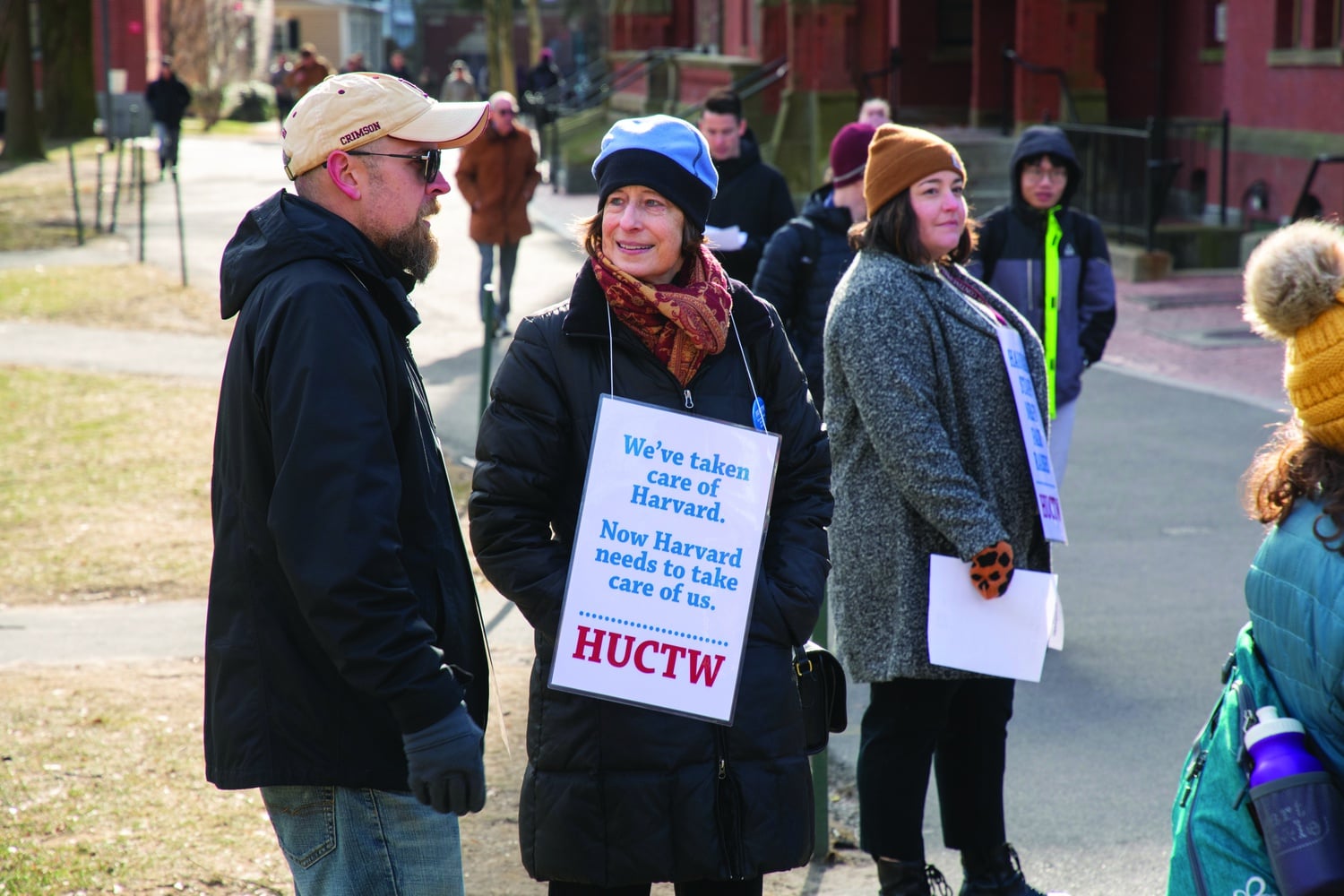
The Harvard Union of Clerical and Technical Workers reached a tentative agreement with Harvard on a one-year contract centered almost entirely on a flat wage increase, as union leaders opt for a short-term deal amid ongoing financial uncertainty on campus.
Under the agreement, most union members will receive a $2,300 raise to their base salary. The contract, if ratified in a vote scheduled for May 12-13, will take effect on July 1 and expire one year later.
The raise applies primarily to employees with at least one year of service and is adjusted based on the hours worked. For the typical 35-hour workweek, the increase amounts to roughly 3.1 percent — raising the average salary from $75,000 to $77,300. Employees with less than a year at Harvard will receive half that amount.
Unlike previous HUCTW contracts, which combined percentage-based and flat raises, the new agreement provides a uniform dollar increase regardless of salary level — a structure union leaders said is designed to deliver relatively larger gains to lower-paid workers.
But the contract’s most notable feature may be what it leaves out.
HUCTW agreements are typically negotiated over three or more years and include provisions on benefits, workplace policies, and long-term compensation. This deal, by contrast, is narrow — a “stripped down” version focused on quickly delivering pay increases, according to union organizer Carrie Barbash.
“The core of this contract is that it’s really focused on just getting some money in members’ pockets right away,” Barbash said.
Barbash said they chose not to pursue a three-year agreement, citing an unusually volatile financial landscape at Harvard. Federal actions affecting Harvard’s funding, shifting projections around the University’s finances, and uncertainty over policies like the endowment tax all contributed to the decision, according to Barbash.
“It is still a very challenging and uncertain time to be negotiating a contract,” she said.
Get The Crimson in your inbox.
Barbash said that past contracts involving more extensive packages have taken months to finalize, delaying wage increases for workers.
The strategy mirrors approaches the union has taken during previous periods of instability, including the Covid-19 pandemic, when HUCTW also negotiated a short-term contract before securing a longer, higher-value agreement the following year.
At the same time, HUCTW has continued to push back on Harvard’s portrayal of its financial position. University officials have pointed to budget deficits and external pressures to justify cost-cutting measures, including layoffs.
But Barbash said those deficits are largely tied to temporary disruptions and do not reflect Harvard’s long-term financial capacity.
“We disagree with the University about their financial situation — quite strongly,” Barbash said.
In particular, HUCTW has criticized the Faculty of Arts and Sciences’ projected $365 million deficit as misleading, pointing to its fiscal year 2025 report, which shows a deficit of just under $8 million. FAS administrators, however, have defended the projection in conversations with faculty, saying it reflects anticipated cost increases — including roughly $98 million tied to higher endowment taxes and an additional $262 million in planned capital expenditures.
Havard spokesperson Jason A. Newton wrote in a statement that the University was “pleased to have reached this tentative agreement as the 5,400 HUCTW workers are an integral part of the Harvard community.”
HUCTW is continuing negotiations over several major issues, most notably healthcare costs, which have risen sharply for workers in recent years. Barbash said delaying those discussions also reduces the risk that Harvard could seek to shift additional costs onto union members in the current round of bargaining.
The one-year timeline, Barbash said, will allow the union to return to negotiations with concrete financial data.
“What will be different is we will have more tangible information,” she said, “whether the University wants to portray it that way or not.”
—Staff writer Noah A. Ferris can be reached at [email protected]. Follow him on X @noahaferris.
Want to keep up with breaking news? Subscribe to our email newsletter
Have a tip for The Crimson? Share it confidentially