
When a Street Stops Being a Street
Nearly a year after the Cambridge City Council greenlit pedestrianizing lower Bow Street, the block closed to traffic and has since been a place of outdoor respite for students and locals alike.
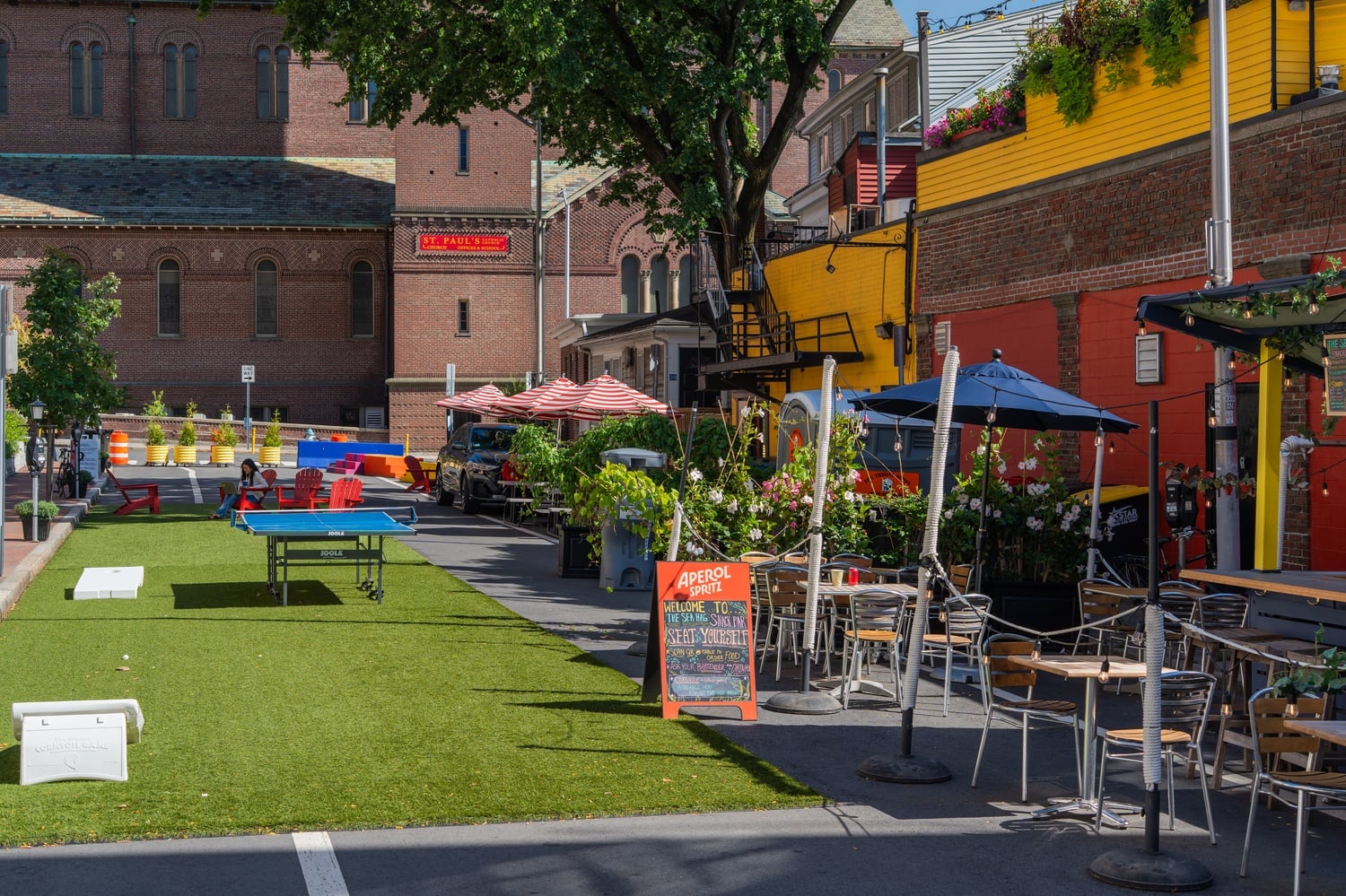
ffectionately dubbed “LoBo,” lower Bow Street is a one-block section extending from Plympton to DeWolfe Street. This summer, it received a makeover — fairy lights, turf, a ping pong table, cornhole, miniature plastic streetlights, and a portable toilet, surrounded by new potted shrubs.
Nearly a year after the Cambridge City Council greenlit pedestrianizing the block, the city launched the current pilot on June 18. The block is now closed to motor vehicle traffic, letting students and locals sip an Aperol spritz and eat outdoors.
Joe F. Liang ’29, a sophomore in Adams House, discovered the space after a fire alarm forced students outside. As students gathered on LoBo, a “king of the court” style “king of the court” style ping pong tournament began.
“I thought it was always there,” Liang remarks.
David B. Morse, a resident tutor in Adams, says he spends a lot of time on the street — eating lunch, talking with students, or just hanging out. Morse has been a fan of LoBo since the pilot began, hosting gatherings and Adams House study breaks on the turf.
“I think people really like it. I think it promotes community, which we’re all about in this day and age with AI,” Morse says.
The Sea Hag Restaurant & Bar is also making use of the block. A week after LoBo was pedestrianized, the Sea Hag opened a snack bar and patio space for patrons and passersby.
“My whole purpose in doing this kind of work of running restaurants is to be a third space,” says Karoline “Kari” M. Kuelzer, a longtime Harvard Square business owner. Kuelzer founded the Sea Hag in 2023, after several decades running Grendel’s Den Restaurant & Bar. She says her goal with the Sea Hag is in part to create a social haven.
“Grendel’s has always sort of been one, but we’ve been around for a long time, and there’s some limitations on what we can do there,” she says.
Though the Sea Hag has been able to host a wide variety of community events using their indoor space, Kuelzer is brainstorming events that could make use of the outdoor patio, including performances by student-run bands and a kickoff party featuring local jewelers and vintage shops.
“Having the lighting and the tables and the seating and just the general streetscape being more inviting has really boosted business overall,” Kuelzer says. “It gives a lot more visibility.”
Morse has noticed the difference — he says he had never thought thought about going to the Sea Hag until after the patio opened.
Kacper K. Migacz, a Harvard graduate student who bartends at the Sea Hag, says the outdoor space has brought a different crowd to the restaurant.
“It’s nice to have people outside. We have much more families, people with dogs coming about. It’s much more enjoyable out there,” Migacz says.
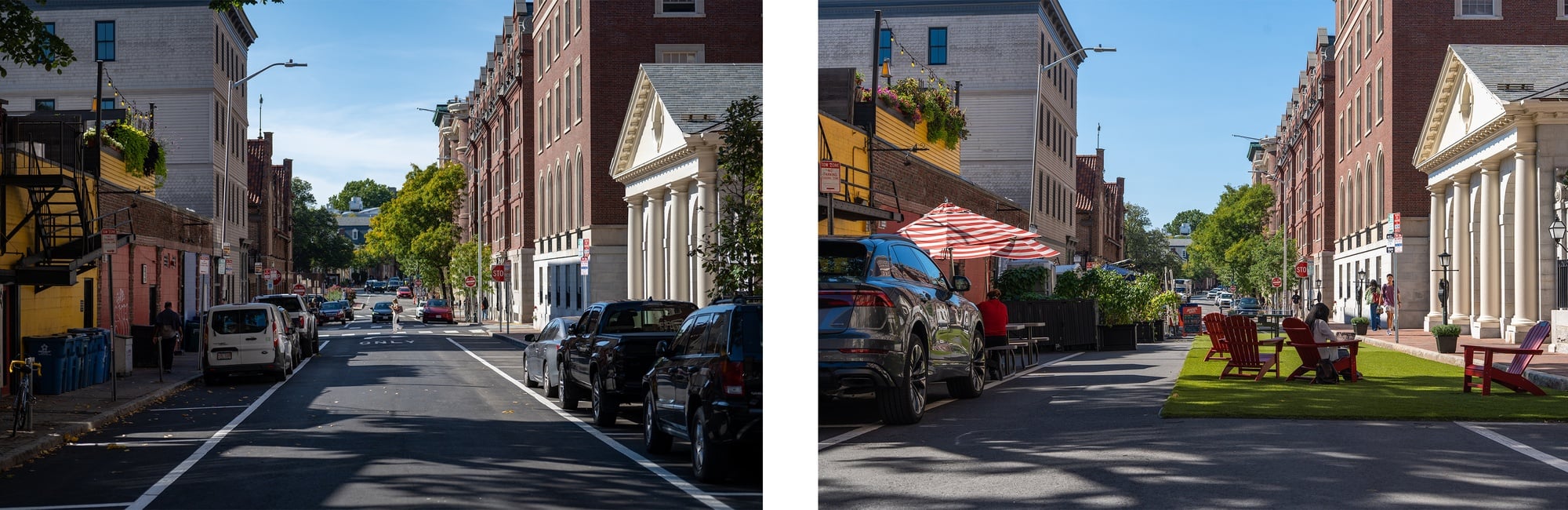
One of LoBo’s principal advocates is Denise A. Jillson, who has served as executive director of the Harvard Square Business Association since 2006.
“We wanted to approach it in a different way,” Jillson says. “Working with the neighbors and the university and the city to establish this as a green space using this turf.”
Another supporter of LoBo is Cambridge City Councilor Patricia “Patty” M. Nolan ’80. Nolan, who herself recently had a drink at the Sea Hag, says creating spaces like LoBo is a step toward encouraging human connection in Cambridge.
“People are craving community,” Nolan says. “They want places to gather.”
This year, the city had allocated$300,000 in its fiscal year 2026 budget to study the possible closure of a street in Harvard Square to vehicle traffic, including a broader transportation study and public outreach that would explore opportunities to create a car-free and pedestrian-oriented area in Harvard Square. However, in March, the city opted not to pursue the study.
“In lieu of this work, we will continue to explore opportunities for pedestrianization that are less impactful to the overall transportation network in Harvard Square,” Transportation Commissioner Brooke McKenna wrote in a memo at the time.
For two years, the space on Bow Street was closed off to visitors due to ongoing construction at Adams House. In her statement, McKenna wrote that traffic around the Square had not been impacted by the closures and identified LoBo as a promising candidate for pedestrianization.
According to Jillson, the idea garnered “general consensus among the neighborhood.”
After the Adams House ’ renovations were completed, Nolan and Councilor Jivan Sobrinho-Wheeler petitioned the city to turn Bow Street into a pedestrian friendly space for outdoor dining, community gathering, and pedestrian traffic. The City Council backed the proposal in September 2025, and Cambridge launched the current pilot in June.
LoBo is not Harvard Square’s first experiment with pedestrian-oriented streets. Winthrop Street and Palmer Street were redesigned as shared streets as part of an earlier Harvard Square improvement project, using brick and other paving treatments to distinguish them from surrounding asphalt roads.
LoBo still looks more like a conventional street. In an ideal world, Jillson says, the block would eventually be redone with brick and stone similar to the treatments on Winthrop and Palmer streets..
“When vehicular traffic goes on that kind of a treated street, immediately the behavior changes,” Jillson says. “There’s a signal that says this street is different. We have to behave differently, and everything just slows down.”
Because the pavement on LoBo was only recently laid following the Adams renovations, Jillson does not anticipate replacing it anytime soon.
In place of brick or cobblestone, Harvard loaned artificial turf for the space, which is expected to remain through the end of November.
“I’d like it if they did the whole thing grass,” Morse says, noting improvements they could make to the space. “Then you could imagine people playing frisbee out here, sitting on the grass, playing spike ball, and hanging out more.”
Nolan says restroom requirements associated with the outdoor space have also added costs for participation establishments, pointing to the portal toilets on LoBo.
“I wish it had been cheaper for the establishments,” Nolan says. “I don’t think it makes any sense whatsoever to require, for instance, the porta-potties they have.”
Kuelzer says the Sea Hag pays the costs associated with its patio and restroom requirements.
Both Nolan and Jillson say they would like to identify other areas of Harvard Square that could be pedestrianized. However, Nolan says that such development would require “significant traffic changes.”
The turf and the Sea Hag patio must be removed by Nov. 30 to allow for snow removal, according to Jillson. Nolan says she hopes that the city will find a way to continue the pilot through the winter.
“You might have to put heaters out there, which we also allow,” Nolan says.
In response to a request for comment, city spokesperson Jeremy H. Warnick pointed to the city’s June press release and said Cambridge has not yet decided whether LoBo would remain closed to motor vehicles year-round. According to Warnick, the city will evaluate and decide later this fall.
Jillson, however, is optimistic that the pedestrian space on Bow Street will remain. If it does, she is already thinking about redecorating LoBo for winter: fire pits, adirondack chairs, holiday programming.
“We could do little events out here for the holidays with hot chocolate or hot toddies,” Jilson says.
“So, there will be an opportunity for us to program the street all year,” she adds.
—Staff writer Neeraja S. Kumar can be reached at [email protected]. Follow her on X @neerajasrikumar.
—Staff writer Jona P. Liu can be reached at [email protected]m.