
‘A Foot Here and a Foot in Brazil’: Diaspora Divided Over Future of Brazilian Presidency
Brazil’s polarized political climate has consumed the attention of the diaspora in Greater Boston. Most still have family in Brazil, some plan to return soon, and many say the election’s outcome will affect them directly even though they live abroad.
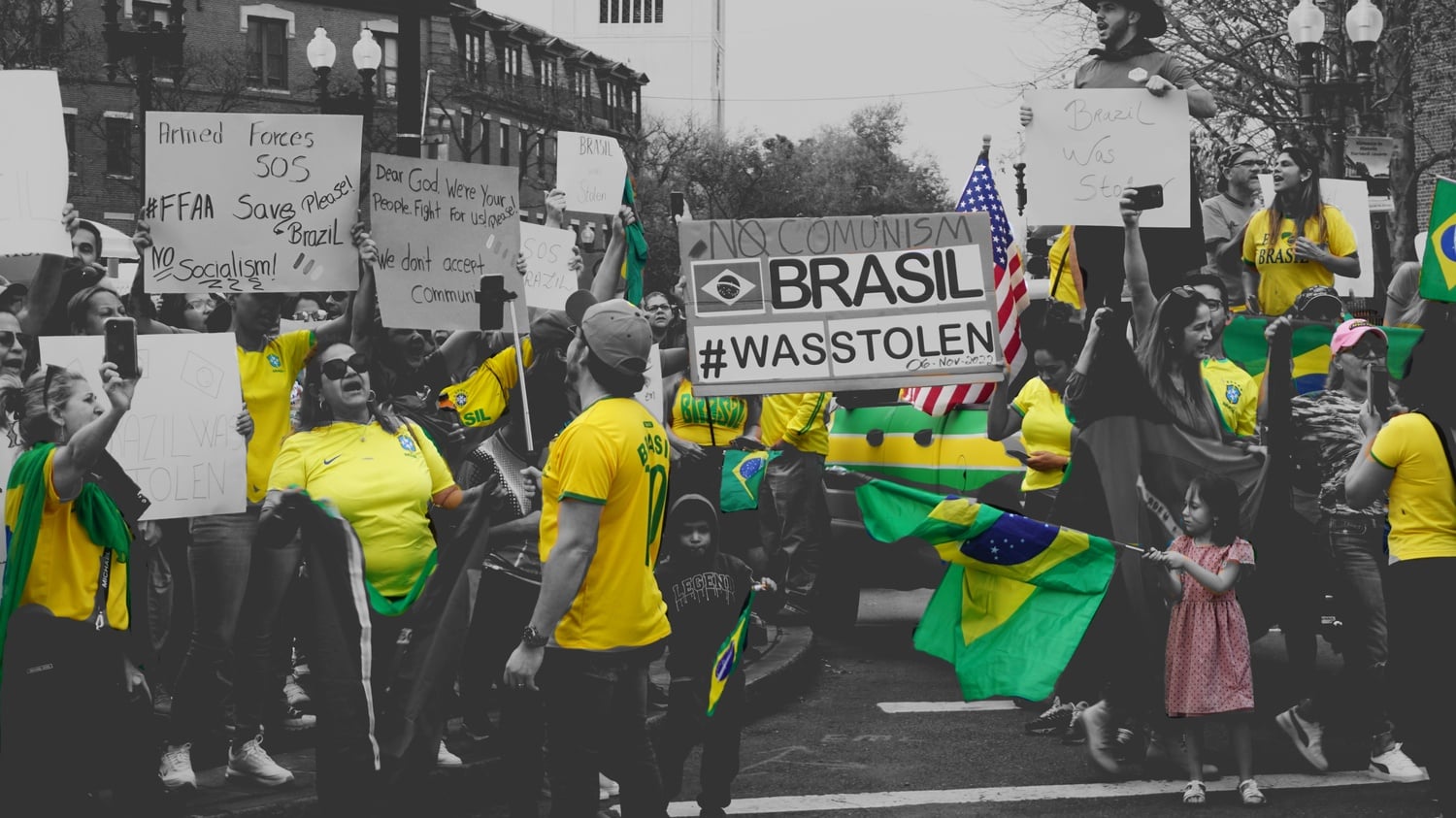
hose who went to the polls in Massachusetts for Brazil’s 2022 presidential election will remember a sea of voters in yellow soccer jerseys. Over the past decade, the jerseys have become a political symbol in Brazil, worn to signal support for Jair Bolsonaro, the far-right president who was then running for reelection.
Those driving past the polling places would have also noticed political paraphernalia on cars: a collection of bumper stickers in support of Bolsonaro. He smiled from countless tailgates, set against the green and yellow of the Brazilian flag.
Still, some voters showed up in red, signaling their support for Luiz Inácio Lula da Silva of the center-left Workers’ Party. Lula had served two consecutive terms as president, from 2003 to 2010, and he would emerge victorious again in 2022.
Four years later, on Oct. 4, thousands of Brazilians living in New England will help decide the fate of their homeland in what many are calling a rematch between Lula and Bolsonaro — only this time, it’s Bolsonaro’s son on the ballot. Though the election is taking place more than 4,000 miles away, in many ways it is a local one.
Across Massachusetts, New Hampshire, Vermont, and Maine, 68,000 people have registered to vote — nearly double the 37,159 who registered in the same region in 2022. They will cast their ballots at the Salemwood School in Malden and Saint Tarcisius Parish in Framingham.
The election is haunted with questions the last one left unanswered.
Lula, the incumbent, is running against Flavio Bolsonaro, a far-right senator from the Liberal Party. Flavio took his father’s place on the party’s ticket because Jair Bolsonaro is barred from running.
Jair Bolsonaro is serving a sentence of 27 years and three months after Brazil’s Supreme Court convicted him of plotting a coup to stay in power after narrowly losing the 2022 election. Since March, he has been serving his sentence from the walls of his home — under house arrest — due to a medical condition.
Flavio has fashioned himself in his father’s image, inheriting his platform and pledging to vindicate his legacy.
These political events are not just being debated by Brazilians living in Brazil. More than 200,000 Brazilians live in the Greater Boston area, according to the Consulate General of Brazil in Boston, and Brazilians are the largest immigrant group in Massachusetts.
The election is “polarized, it’s high stakes, and it’s a total nail-biter,” says Steven R. Levitsky, a Harvard Government professor who has studied Brazil extensively and co-wrote the bestselling book “How Democracies Die.”
“Nobody knows who will win, and it’ll be a close election. It’s easier to claim fraud or to not accept the results of an election when it’s a very close race,” he adds.
Brazil’s polarized political climate has consumed the attention of the diaspora in Greater Boston. Most still have family in Brazil, some plan to return soon, and many say the election’s outcome will affect them directly even though they live abroad.
Gildo Martins de Souza, who moved from Brazil to the Greater Boston area 20 years ago, is voting because he believes his family’s future is on the line. He has sons living in the U.S. and many of his family members still live in Brazil. “I have to vote for the next generation, the one of my sons,” he says.
Voting ‘Right’
While voters in Brazil are closely divided, Brazilians in the U.S. lean heavily to the right. In each of the last three presidential runoffs, they favored the right-wing candidate by wide margins.
In the Boston area, the right-learning candidate won 75.8 percent of the runoff vote in 2022, 86.6 percent in 2018, and 81.5 percent in 2024, according to Brazil’s Supreme Electoral Court.
Maxine L. Margolis, a professor emerita of anthropology at the University of Florida, says the voting patterns of Brazilians in the U.S.are significant because they learn further right than Brazilians living elsewhere abroad.
She attributes the trend to social mobility and a pride in self-made identity. “Some of these people come from working class backgrounds in Brazil, and yet manage to rise in the U.S., which again is more likely to make them conservative than Lulistas,” Margolis says. Since some members of the population have come to run their own small businesses — such as house-cleaning businesses — many celebrate meritocracy as they have ‘made it.’
In her view, this ethic is very compatible with elements of both Trumpism and Bolsonarismo.
Oliver Stuenkle, a nonresident fellow at the Kennedy School and a senior fellow at the Carnegie Endowment for International Peace, says Bolsonaro’s platform has much in common with President Donald Trump’s. Those similarities, including a shared anti-establishment, populist rhetoric, have led some Brazilian Americans to align themselves with Trump as well.
Brazilians who voted for Bolsonaro “probably supported Trump” in the 2024 U.S. election, even though many could not vote in it, Stuenkle says. In his view, that has created tension within the community, as undocumented Brazilians have been detained and deported by the U.S. Immigration and Customs Enforcement under Trump.
In response to a request for comment, an ICE spokesperson wrote that agents exercise “‘reasonable suspicion’ to investigate immigration status and probable cause to make arrests consistent with the Fourth Amendment to the U.S. Constitution.”
Taylor Boas, a professor of political science and Latin American studies at Boston University, offers another hypothesis. Because many Brazilian American families have lived in the U.S for decades, “policies that are or are not enacted in Brazil have less bearing on the community here than they do for Brazilians back home,” he says.
Stuenkel agrees. Brazilians who live in the U.S., he says, are “less attuned” to public policy debates over education, health, minimum wage, and public security in Brazil. Instead, he says, they become “more attuned to broader but also vague issues like culture wars, for example.”
Instead of focusing on specific party platforms, the diaspora tends to vote on values, according to Boas.
He sees church and the networks created around it as key spaces that shape those values. In many cases, he says, pastors are not telling people how to vote or explicitly discussing the election. Instead, the influence is more subtle.
“Churches form a really important community: a faith community, a social community, a community of social and economic support for migrants, and that as they participate in that community, that they develop shared understandings of what are the sort of acceptable political opinions and actions to take within that community,” he says.
Luicimara Rodrigues, who moved to Allston-Brighton 23 years ago and is now an organizer at the Brazilian Women’s Group, sees this dynamic especially in more recent waves of immigration from Brazil.
“This immigrant group that identifies with Bolsonaro and Trump has always existed, but it used to be a smaller group of Evangelical Protestants,” she says. Now, it characterises the majority of the Brazilian diaspora living in the region.
Just as Protestantism has grown in predominantly Catholic Brazil since the late 20th century, immigration to the U.S. over the past 15 years has been dominated by Protestants, many from rural towns.
As these immigrants arrive in the U.S., their political culture travels with them.
In Brazil’s interior, political affiliations and party ties are often mediated through community networks, and people stay informed about politics through local WhatsApp groups, Facebook, and their families.
These networks reinforce strong political loyalties, alongside what Rodrigues describes as the “buying of votes,” in which goods and services are exchanged for political support — part of a practice political scientists call clientalism.
“The politics of their town are fraudulent. They would die and kill for a political party,” Rodrigues says.
Boas says the centrality of these networks — through family and religious spaces — helps draw the community toward right-wing populism. He frames it as part of a global trend, in which both evangelicals and migrants are now supporting right-wing populists.
Voters are also expressing a strong anti-incumbent sentiment.
Levitsky says anti-incumbent sentiment has been decisive in elections across the world. “Across democracies, incumbents are losing across the board,” he says.
Lula may fall victim to it. “The same anti-incumbent attitude or sentiment that hurt Biden and Harris in 2024, the same anti-incumbent sentiment that hurt Bolsonaro in the last election, is going to work against Lula,” Levitsky adds.
That sentiment has helped reshape Latin America. The dominance of center-left and leftist governments across the region beginning in the early 2000s — known as the Pink Tide — have been replaced in recent years by conservative and far-right alternatives.
Alice Diniz, a Ph.D. student in History, looks to Brazil’s election in Brazil to make sense of that shift. “Brazil as this big country in South America will be an answer for this context that we have right now with right governments and the president of these Latin American countries,” she says.
Souza is part of that anti-incumbent current. He says that Brazil needs new leadership after three Lula administrations. “A change in leadership would serve us well. If they aren’t doing good things, the next change will be good,” he says.
U.S.-Brazil Relations
Still, opinions among Brazilians in Massachusetts vary.
Lafaiete Brito, director of the Worcester Brazilian Association, president of the Brazilian American Massachusetts Alliance, and pastor at the Carisma Comunidade Church, says his community includes people across the political spectrum.“I have friends who are leftists, others are right-wing, others are centrists.”
For some Lula supporters, U.S.-Brazil relations are shaping their votes.
Over the last decade, Trump and the Bolsonaro family have grown close.
As Jair Bolsonaro faced trial, Trump leapt to his defense. “Brazil is doing a terrible thing on their treatment of former President Jair Bolsonaro,” he wrote in a Truth Social post in July 2025.
“This is nothing more, or less, than an attack on a Political Opponent — Something I know much about! It happened to me,” Trump continued. Many believe Bolsonaro’s 2022 coup to be an imitation of the storming of the Capitol on January 6, 2021.
Many have compared the Jan. 8, 2023 riot in Brasilia, when Bolsonaro supporters stormed government buildings, to the Jan. 6, 2021 attack on the U.S. Capitol. But Bolsonaro’s coup plot was also shaped by Brazil’s long history of military intervention in politics, most recently a two-decade long military dictatorship that began in 1964.
Trump has used the power of his office on Bolsonaro’s behalf. In 2025, his administration imposed 50 percent tariffs on many Brazilian goods, with Trump calling Bolsonaro’s prosecution a “witch hunt,” and sanctioned the Supreme Court justice overseeing the case. In July, it imposed 25 percent tariffs following a trade investigation.
Trump hosted Flavio Bolsonaro at the White House in May. In July, Brazil denied visas to two senior U.S. State Department officials the administration planned to send to scrutinize Brazil’s electoral system ahead of the vote.
Heloisa M. Galvão, president of the Brazilian Women’s Group located in Brighton, plans to vote because she sees Brazil’s sovereignty on the line. She has lived in the area since immigrating to the U.S. in 1988.
“When we had dictatorships in Brazil, we never saw such a level of lack of sovereignty for Brazilian democracy,” she says.
“If Bolsonaro gets to power again,” she adds, “I’m afraid Brazil is going to become a colony of the United States.”
Brito, who did not say whom he plans to vote for, sees sovereignty as a key issue, too. “Brazil, in my opinion, is a sovereign country. Our country is a sovereign one, which has the right to make its own choices, to self-determination,” he says.
Stuenkle is skeptical that U.S.-Brazil relations will change much regardless of who wins.
“If Lula gets re-elected, you will have perhaps a slight improvement, but continuous tension and the discussions about tariffs, all that,” he says. “If Flavio wins, I think on some symbolic issues you will have greater alignment, but I think less than many people expect because ideology in the end isn’t as crucial as economics.”
Brazilians in the U.S. are uniquely affected by another part of the relationship: deportations.
“If Bolsonaro were president now, with Trump doing these crazy deportations, Brazilians would be suffering much more. That’s because Trump would be scattering Brazilians all over the world, just like he’s doing now, because he’s sending Brazilians to Africa,” Rodrigues says. “But Brazil is fighting to repatriate them back to Brazil. Lula built a lot of assistance for the deportees, if it weren’t for him, the deportees would arrive in Brazil with nothing.”
Rodrigues also faults Brazilians who have supported Trump.
“I do not understand how a Brazilian person that crossed the Mexico border can be pro-Trump and pro-Bolsonaro,” she says.
When members of this group come to the Brazilian Women’s Group, Rodrigues says she still works with them because it is “part of my job to help these kinds of people.” To avoid conflict, she steers clear of politics. When they bring up the subject, she stays quiet.
“I do not talk about politics, I am only discussing politics with you,” she says.
Some Brazilians approached at markets, bakeries, and shops in Somerville declined to be interviewed for the same reason.
‘Shut Up and Put Our Head Down’
“In Massachusetts, the Brazilian community has been more exposed because of its size, and from the stories that sort of circulate among Brazilians living in the U.S., Massachusetts has come up frequently because Brazilians — compared to other diasporas in Massachusetts — are quite large. Whereas, in Miami, ICE raids did occasionally pick up a Brazilian, but it was other countries that were more exposed,” Stuenkle says.
In response to a request for comment, a spokesperson for ICE said that skin color, race, and ethnicity are not motivators in ICE arrests.“Allegations that DHS law enforcement engages in ‘racial profiling’ are disgusting, reckless, and categorically FALSE,” the spokesperson wrote. “What makes someone a target for immigration enforcement is if they are illegally in the U.S.”
As stories circulate detailing the conditions of detainment and deportation and as community members disappear, anxiety has further spread within the community.
Galvão recalls panicked community members arriving at her center after learning about others’ traumatic experiences with ICE.
“People are scared to death of being caught by immigration, even if they have some process for adjustment of status going on. They are very scared because they hear these stories,” she says.
Because her center focuses on women, Galvão sees how this climate affects them directly. “They do believe that the government is going to take their children.”
Awareness of ICE proximity has even crept into how Brazilians talk to one another. “There’s this joke going around when somebody doesn’t respond to your WhatsApp messages,” Stuenkel says. “Your first thought is ‘maybe he’s detained.’”
Some community members are so frightened of an ICE encounter that they have decided to leave preemptively.
“They don’t want to leave, but the fear is greater than their desire to stay,” Galvão says.
Some are choosing to self-deport through CBP House, a U.S. Customs and Border Protection app that offers participants a $3,000 stipend.
It’s a “terrible app,” Rodrigues says. “I don’t even like to say its name.”
A spokesperson for ICE wrote that they urge “all illegal aliens to take control of their departure” through the app. “We encourage every person here illegally to take advantage of this offer and reserve the chance to come back to the U.S. the right legal way to live the American dream. If not, you will be arrested and deported without a chance to return,” the spokesperson wrote.
Fear of ICE is also discouraging some from voting. “A lot of people are afraid to go out to vote because of ICE,” Galvão says. She explains, however, that she has not seen any evidence that ICE has historically made an appearance at these polls.
“In accordance with an agreement between Brazil and the United States, the polls are Brazilian territory, so ICE cannot go there,” Rodrigues says, who is also volunteering at the polls on election day. She hopes ICE will not arrive.
Through the Brazilian Women’s Group, Galvão and Rodrigues are trying to reassure community members y and encourage them to vote.
“I would tell people, go and vote. Don’t be afraid. We cannot let fear dominate us, or silence us, or make us still, freeze us. We cannot live under fear. That is what the government wants,” Galvão says. “They want us to shut up and put our head down.”
Asked if ICE has affected his plans, Souza says he will still vote. “We must be careful, but we must have faith as well,” he says.
With their minds split between their political reality in Massachusetts and the future of Brazil’s presidency — and whether they arrive at the polls in yellow for Bolsonaro or red for Lula — voters say the election seems to carry a dual weight for all.
“This year’s elections in Brazil will completely decide Brazil and the lives of those of us living abroad,” Rodrigues says.
—Associate Magazine EditorVictoria D. Rengel can be reached at [email protected]. Follow her on X @VictoriaRengel_.