




Somebody Else's Revolution
There’s an all-you-can-eat meat restaurant called Carnivore on a moored boat down the Nile from downtown Cairo. It’s one of those places you treat yourself to, because it’s expensive even by Western standards and because there is only so much meat you can eat in a month. I was in the city for two, writing for a local English-language newspaper.
I was eating dinner there at the end of June with my friend Pierre, a filmmaker, when his mother called. She lived in the area. They’re back in Tahrir, she told him.
What she meant was, at least partially, be careful. Protests had generally been peaceful since the regime fell nearly five months before, but everyone knew that when it got late—at midnight, they said—the police came out. By that time, the women and children had left, the foreign media was less likely to be around, and darkness provided easy cover for the sort of thing no police force wants caught on tape.
But she also meant, partially, this is something you don’t want to miss. This was something different. The protests were real again. She knows that Pierre carries a camera around with him for a reason.
Pierre’s parents are both Egyptian, but he grew up in Canada and the States. He went to film school in Colorado, and he was there, glued to al-Jazeera’s live online video stream, when Egyptians first flooded the streets in January. When classes ended in the spring, he moved in with his mom in Cairo to make a documentary on post-Revolution Egypt.
I made him wait for dessert to come—he blew me out of the water in our eating contest, having thirds of the ostrich meat, and I planned to make a comeback with the vanilla ice cream—but we were only halfway through when we changed our minds. We dropped our spoons and headed out.
The cabbie said he’d heard that the Interior Ministry—about four blocks from Tahrir—was on fire. If that were true, this was serious, this was something major: the Interior Ministry was a symbol of the old regime’s tyranny. Its security forces had shot at protesters, live bullets. The institution survived the Revolution, but then so did its repressive reputation.
He dropped us off at the end of the bridge, a short walk from Tahrir Square. He wouldn’t go any closer, but he was polite about it.
When we arrived in the Square on the other side of the Nile, the canisters of tear gas were falling sporadically.
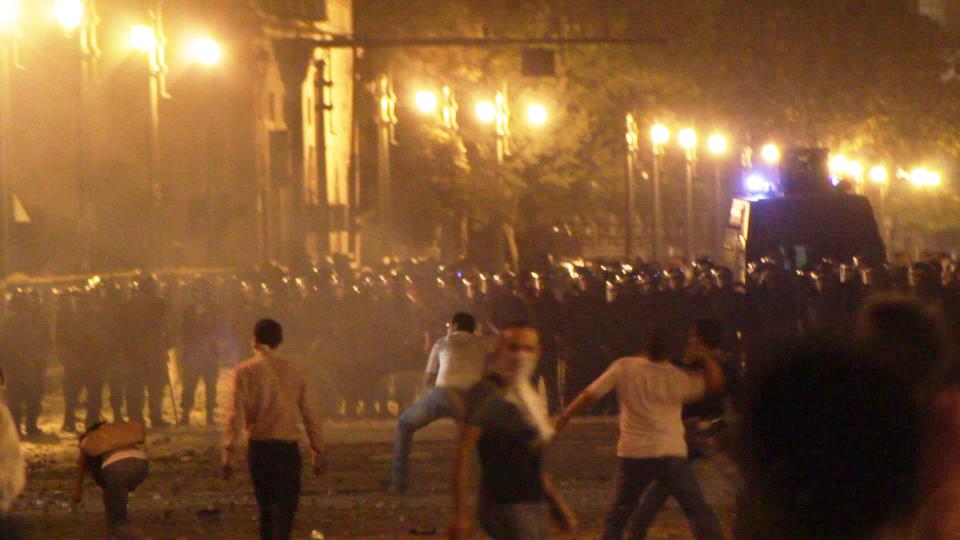
It wasn’t the ocean of people like in the pictures. We walked straight up to the center, a grassy circle surrounded by normally-traffic-plagued boulevards. There were other people watching with us, advancing and retreating according to how much gas was up ahead. In front—the front being the corner of the square where the police had chosen to take their stand—hundreds of young men stared down their opposites in anti-riot gear at the end of the street that enters Tahrir Square. The Interior Ministry was well behind them. We found out later that it hadn’t been aflame.
First you would hear a horn from the police side. It seemed to be a warning. It was hard to tell in the back of the crowd. Then they launched the canister. It flew up in the air, crackling like New Year’s wands, and on the ground everyone waited, all eyes looking up. When you had an idea where it would land, you ran the opposite way—the opposite of baseball, fielding something that wasn’t there. We fled the poison gas.
Pierre struggled to focus the camera—a tripod was out of the question—as I yelled at him to run some way or another. He stumbled over a curb evading a canister that I’d seen too late to warn him, with the camera in one hand, catching himself. I laughed because it was funny. It was funny that we were here right then. We were wandering in somebody else’s Revolution.
There was one section of the Square that didn’t fall directly in the path of the police launchers. We found some relief there. Pierre lifted his camera towards the launchers. I took a break from scouting duties. I started to look horizontally. That’s when I saw Mahmoud walking by.
I’d met him at an American journalist’s house party. It was a party where we all wore galabeyas, traditional Egyptian clothing. It was a joke. Mahmoud is the type of person whom you wouldn’t catch wearing such long pantless clothing in the street. In Tahrir Square, he was calmly making his way over to the police blockade in a large group that was flowing back and forth with the intensity of the teargas shots, a school of fish swimming into the current.
Seeing Pierre and me, Mahmoud stepped out of his informal formation to greet us. He asked if everything was ok.
“I have to go,” he said apologetically. Lifting the end of his scarf to his mouth, squinting behind his thick glasses, he turned into the crowd. Most of the young people were wearing jeans, like Mahmoud, but there were some galabeyas too. I watched Mahmoud jog away, and then lost him as he blended into the mass of people and smoke and shouting, rejoining his generation.
When I wrote to my parents of the experience in the Square, my father said it reminded him of his days protesting the Vietnam War. He said to be careful, because at least back then, except at Kent State, he was reasonably sure they wouldn’t shoot live ammo, but in Egypt you never knew.
He’d told me about his trips to Washington with college buddies, but I never really imagined him facing down the National Guard on the National Mall. That was at Kent State, or Columbia, or at an SDS rally.
But my father was a freshman on May 8, 1970, when 4 million students the country over walked out on classes. Here at Harvard, 35,000 people rallied at Soldier’s Field. It was the only nationwide strike in U.S. history, and my father was a part of it.
I can imagine his protest days in D.C. It was an eight hour trip to the Capitol. There were four of them in a car, and they all took turns driving. One of them was a conservative, and my father and the others spent the whole ride arguing with him. When they got to Washington, three of them went one way, and one went another. My father and his friends marched to the White House front gate where, in line with thousands of others, they stepped forward, one by one, and called out the name of an American killed in Vietnam.
I’m sure he felt that same pull that drew Mahmoud into the thick of things, a feeling that was similar to but not exactly the same as standing there watching the gas canisters fall.
Egypt is a country of 81 million people, of which 29 percent are between the ages of 15 and 29. In the United States, that figure is 21 percent. Since 1952 Egypt has been ruled by an authoritarian figure, and for the past 30 years by Hosni Mubarak, an air force officer who became President when Anwar Sadat was assassinated. Then, on January 25, which is National Police Day in Egypt, several activist groups hoped to draw a crowd to protest the brutality of the Interior Ministry police force. The Tunisian president had fled earlier that month under the pressure of popular protests, and while these protesters were less ambitious, they were riding a wave of popular sentiment.
That day, January 25, 2011, tens of thousands of people heeded the call to protest, storming the streets. What had been a minor event became something much larger. And the crowds hardly left—on Friday, after the Noon Prayer, the numbers skyrocketed. Hundreds of thousands flooded the streets that day, labeled the “Day of Anger,” with incidents of violence erupting across the country.
It took 18 difficult days—days of families barricading their doors and vigilante police forces securing neighborhoods—to push President Mubarak out.
After that, the military took over, as an interim government. The Supreme Council of Armed Forces assumed power. It was during that time that the signs went up across the city, ones that said things like “Egypt first, Egypt forever,” and “God will protect Egypt.” They were still up when I arrived in June, at the airport, passing through immigration, one with a quote from President Obama with which I was unfamiliar: “We should raise our children to be like Egyptian youth.” Even in America’s most jingoistic moments I wasn’t used to seeing that kind of nationalism. It wasn’t until later that I realized that many of the signs covered posters of Mubarak.
Mahmoud wasn’t really an activist. He was going into his third year at Ain Shams University in Cairo, and not thrilled to be studying commerce. He had written a play with his sister about a young woman who suffers through cancer. He dreaded the mandatory stint in the military that was still two years away.
The real activists—the ones the newspapers love talking about—were coordinating protests on Twitter and Facebook. They were calling for doctors in the Square. They were holding press conferences and writing slogans. They were getting on the loudspeaker at the mosque beside Tahrir and barking orders.
They were big names like Khaled Said, 28, whose death at the hands of overzealous police in June of 2010 was a major catalyst for the January protests. There was Wael Ghonim, 31, the Google executive whose Facebook site, “We are all Khaled Said,” drew more than 100,000 followers. And there were people like Mohamed Adel, the 23 year-old spokesperson for the April 6th Youth Movement, a precursor to the January protests and now a part of the post-Revolutionary discourse.
But Mahmoud, no less a patriot, represented a different sort of youth activist. He believed in the ideals of the revolution and knew that his presence at demonstrations meant something. He wasn’t behind the bullhorn, but he showed up. He was part of a generation of some 20 million young Egyptian men and women grabbing the reins. Some days, for the more volatile protests, he needed his parent’s permission to come downtown.
Tahrir Square had been quiet for a month. But that changed earlier in the afternoon when families of the hundreds of men and women who had lost their lives during the protests—the Martyrs of the Revolution—enacted their usual call for recompense elsewhere in the city. This time, it devolved into confrontation with the police. Arrests were made, activists remobilized, and Tahrir Square was once again center stage, filling with crowds and strangely quiet due to the absence of cars, that knew to avoid the area.
Sometimes you don’t see it coming. Pierre the journalist leaves the safe space and you follow suit. You aren’t looking. Or the police inconsiderately aimed horizontally and you don’t have time to see it. You find yourself in a gas cloud, running into the wind, whose direction you’ve determined long minutes ago. Holding your breath, breathing through your mouth when you must, your eyes tear up, your face burns. You can’t see so you just keep running.
They say Pepsi reduces the burning sensation—no one quite knew why, a Google search, the soda’s acidity counteracting the basic chemicals in the gas—and someone was always around to offer a splash.
They toss rocks and chant lines dating back from January. Then the teargas would come. The canister in the sky, the din of protests becoming shouts of warnings. When it hit the ground, spontaneous volunteers of all ages running to the canister and dousing it in water, covering it under a box, or picking it up, running it to the police line, throwing it back. You can’t tell what the police do when the gas comes back at them. Their helmets and shields are no defense, and they are as cramped up against the divide as the protesters, across from them, on top of them, us.
At some point, the police began to retreat. They shot off a final round of tear gas canisters and then they took a few steps back. The two police vehicles at the front rang their sirens and the whole line moved backwards.
Pierre and I followed along and watched as the whole process repeated itself. The protesters throw rocks, the police fire gas—I later heard accounts of bird shot and rubber bullets but saw none—the people run, the people return, the police retreat.
Soon we found ourselves a block behind the protesters. Motorcycles were carrying the injured—overexposure to the gas, hit by a rock or canister—back up the street, where several ambulances were stationed.
Glass broke at the KFC—colloquially known as “Kentucky”—midway down the block, and a semicircle immediately formed around the store. Possible looters were dissuaded.
“They must not have heard, Kentucky made its last call hours ago,” joked a young man next to us, fumes of smoke and teargas enveloping the area where the police had stood less than an hour earlier.
Two weeks from now, a “Million Man March” will take place, with all the momentum of the summer up till then. Nearly one hundred thousand people—families, women, children, university students, older men in galabeyas, journalists, activists, food vendors—will gather in the Square.
Loudspeakers will blast. Stages will be set up. Each faction of the protesters will be represented.
Leaders will hoist an enormous white tent over much of the Square’s green, providing shelter from the desert sun. Some will literally pitch their own tents, sleep in the open there.
Some things will happen. Some things will change, as a result. They will reshuffle the cabinet, they will speed some trials up, not everyone’s. But come August first, the first day of Ramadan, the army will kick everyone out of the Square. And they will go, quietly, without protest.
The part that I never asked my father about his Vietnam War demonstrations is the ride back. He put it all behind him and went back to school. But he had been there. More than that, he had been part of it. It was something that didn’t wear off no matter how long the drive. When I lost sight of Mahmoud in the crowd, in Egypt, that June, he was surrounded by young men with their fists in the air, chanting. I don’t think he had his hand in the air. He didn’t seem the type, not yet anyway. I couldn’t bring myself to have my hand in the air either. I too believed in democracy, justice, freedom, but right now I was only watching.
Pierre and I turned back. It took us three minutes to make it to where we started, which had already developed into something of a carnival. Where tear gas had been fuming at the center of the square, a crowd of couples and curious observers mixed with the protesters still on location, the ones already setting up the stages. A couple kids were having a snowball fight of sorts with the stones still on the ground, the ones that had been chipped off the sidewalk earlier in the evening, for ammunition.
“So this is how you take a street,” Pierre said then.