

News
Pro-Palestine Encampment Represents First Major Test for Harvard President Alan Garber

News
Israeli PM Benjamin Netanyahu Condemns Antisemitism at U.S. Colleges Amid Encampment at Harvard

News
‘A Joke’: Nikole Hannah-Jones Says Harvard Should Spend More on Legacy of Slavery Initiative

News
Massachusetts ACLU Demands Harvard Reinstate PSC in Letter

News
LIVE UPDATES: Pro-Palestine Protesters Begin Encampment in Harvard Yard
Beautiful ‘Señora’ Reaches the Clouds
The Crimson Arts Board.
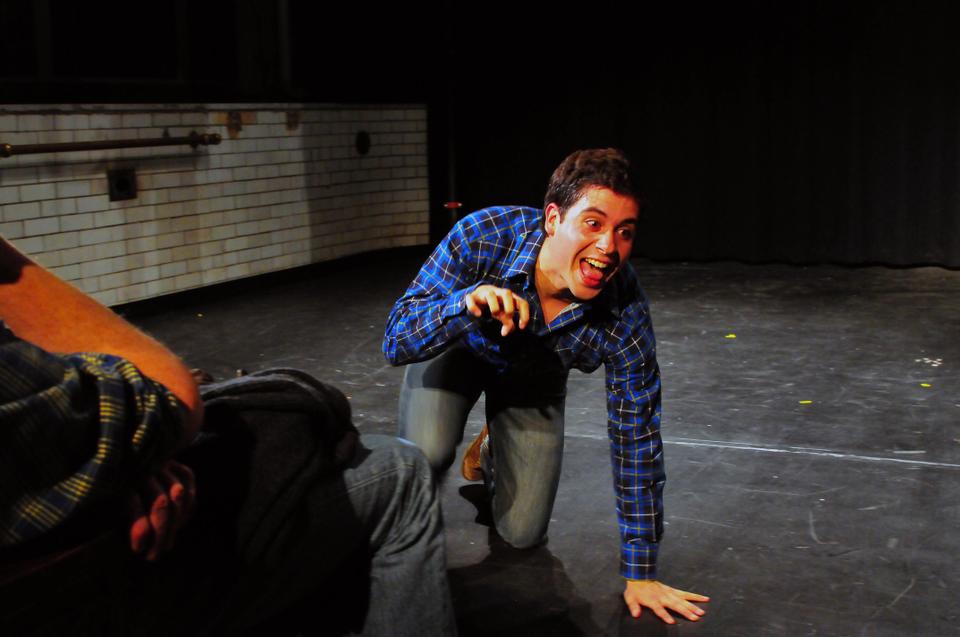
Sometimes an unusual shows requires a unusual review. Last week, TEATRO!—an oncampus theater company that specializes in Spanish language and Spanish-influenced drama—put on “Nuestra Señora de las Nubes,” a play by the Argentine playwright Aristides Vargas. This production was entirely in Spanish, but the cast and crew advertised “Nuestra Señora” as a show that was relatable for people who don’t speak the language. This fact presented us with a conundrum: should we tailor our review for a Spanish-speaking audience, or should we try to see how accessible the show is to viewers who can’t understand the dialogue?
We decided to do both. We sent two reviewers to “Nustra Señora:” Charlotte M. Kreger, who is fluent in Spanish, and Noah S. Guiney, who can’t speak the language to save his life. We hope that both of these reviews, when taken together, provided a balanced view that gives TEATRO!’s production the respect it deserves while still providing an insightful critique of how well the cast communicated to audience members who didn’t speak Spanish.
Charlotte M. Kreger
Sometimes memories are all you have left of your home. TEATRO!’s production of Aristides Vargas’ play “Nuestra Señora de las Nubes”—which ran from April 5 to April 7—uses recollections about the past as a thread that connects the show’s disparate scenes. Not only did it broach over-arching social problems such as repressive governments, but it also dealt with more personal issues such as mental illness and exile. Through impressive acting that explored all sections of society, Director Enzo E. Vasquez Toral ’14’s production of “Nuestra Señora de las Nubes” intertwined light-hearted comedy and serious examination of social problems. It provided a series of vignettes that, when taken as a whole, formed a heartrending representation of both the beauty and the horrible injustice that make up life in Latin America.
The play follows the characters Bruna (Vanessa D. L. C. Martinez ’15) and Oscar (Adrian Arteaga ’14), who both hail from Nuestra Señora de las Nubes—an imaginary region that represents Latin American countries more generally. After meeting each other unexpectedly in a new home, they reminisce, and these musings frame the rest of the play. Oscar and Bruna’s relationship to each other threaded the different scenes together, and therefore it was important that they maintained an emotional connection to the audience, as well as with each other. Their quick banter offered a constant manifestation of their characters’ deep friendship. For example, at the end of the play Oscar and Bruna ask for shelter from the residents of an English-speaking community. Although his character did not know English—Oscar only speaks Spanish—Arteaga’s body language conveyed a sense of deep emotional support to Bruna as she broke into an impassioned, English-language plea for dignity. Despite Oscar’s status as an exile, he held himself with pride and self-worth in a way that provided a visual manifestation of Bruna’s appeal to the humanity of her hosts.
Not all of the play is serious. Scenes of two brothers catcalling women in the audience and the relationship between a pompous governor and his ditsy wife provided welcome relief from the sometimes heavy nature of the play. Also, most of these characters were played by members of the opposite sex, and this heightened the farcical nature of these scenes.
However, sometimes these comic interludes hampered the show’s political message. Abuela (Arleen B. Aguasvivas ’15) would have been more believable if she weren’t so comically portrayed. Her voice and demeanor were cartoonish, and the artificiality of the performance made it difficult to empathize with her.
However, Aguasvivas’s portrayal of the conductor’s needy, air-headed wife was spot-on. She barged in on her husband’s orchestra rehearsal and with her aggressive sexuality managed to both horribly embarrass her significant other and steal the show.
“Nuestra Señora de las Nubes” provided a unique opportunity for both Spanish and English speakers. Through a balance of lightness and sincerity, it explores the pain of exile and the displacement it brings.
Noah S.Guiney
In 1888, the world changed: a French-born inventor by the name of Louis Le Prince shot what is commonly considered to be the first film in history. Known as “Roundhay Garden Scene,” it was a little more than two seconds long and was filmed in a place called Roundhay, a suburb of the Leeds, England. He would have made a fortune on his invention—the Single-Lens Reciever—had he not mysteriously disappeared two years later on a train to Paris.
Le Prince’s early video camera heralded the age of silent film, which, at least for about 30 years or so, showed audiences the crucial importance of non-verbal communication. While body language is always valuable, modern viewers very rarely have to rely exclusively on what they see to understand the story. However, last Thursday I had the opportunity, if only because of my embarrassingly poor Spanish, to do just that.
“Nuestra Señora de las Nubes” provided me with 72 wonderful minutes of blissful, mild confusion. Apart from what I could gather from the acting, I had to rely only on what I could recall from seventh-grade Spanish, as well as geeky realizations I made about the language’s similarities to English (“Soy el Gobernador” means “I am the Governor!”). Although I was only able to figure out the plot after reading the playbill, I was pleasantly surprised at how much of the characterization I could understand just by watching the action on stage.
The two leads, Oscar (Adrian Arteaga ’14) and Bruna (Vanessa D. L. C. Martinez ’15) provided some of the best onstage chemistry in the show. During their scenes together Martinez would interject very subtle bodily movements into the dialogue. She would tilt her head slightly and smile at Arteaga, and she would shrug her shoulders as she listened to what he said, hinting at the possibility of romantic interest between the two. I couldn’t understand what they were saying, but I got the emotional arc of their relationship as I watched their body language.
In another scene, the Governor (Lizette B. Suxo) of the region was talking to his wife (David L. Orama ’12). Suxo’s portrayal of the pompous official included some truly impressive eyebrow acting. They were always in motion, darting from furrowed in dignified concern to raised in surprise. These brow poses displayed a sense of mock stateliness that perfectly fit her character. Orama complemented this performance by playing up the role of the ditsy trophy wife. He was constantly curling the hair of his huge blonde wig and his over-the-top eye rolls seemed to come direct from “The Real Housewives of Atlanta.”
One of the things that makes theater such a moving medium is that what is left unsaid in the script can be articulated through the body language of the actors. “Nuestra Señora de las Nubes” provided a refresher course in just what can be expressed to an audience who can’t understand what you are saying.
—Staff writer Charlotte M. Kreger can be reached at charlottekreger@college.harvard.edu.
—Staff writer Noah S. Guiney can be reached at nguiney@college.harvard.edu.
Want to keep up with breaking news? Subscribe to our email newsletter.