




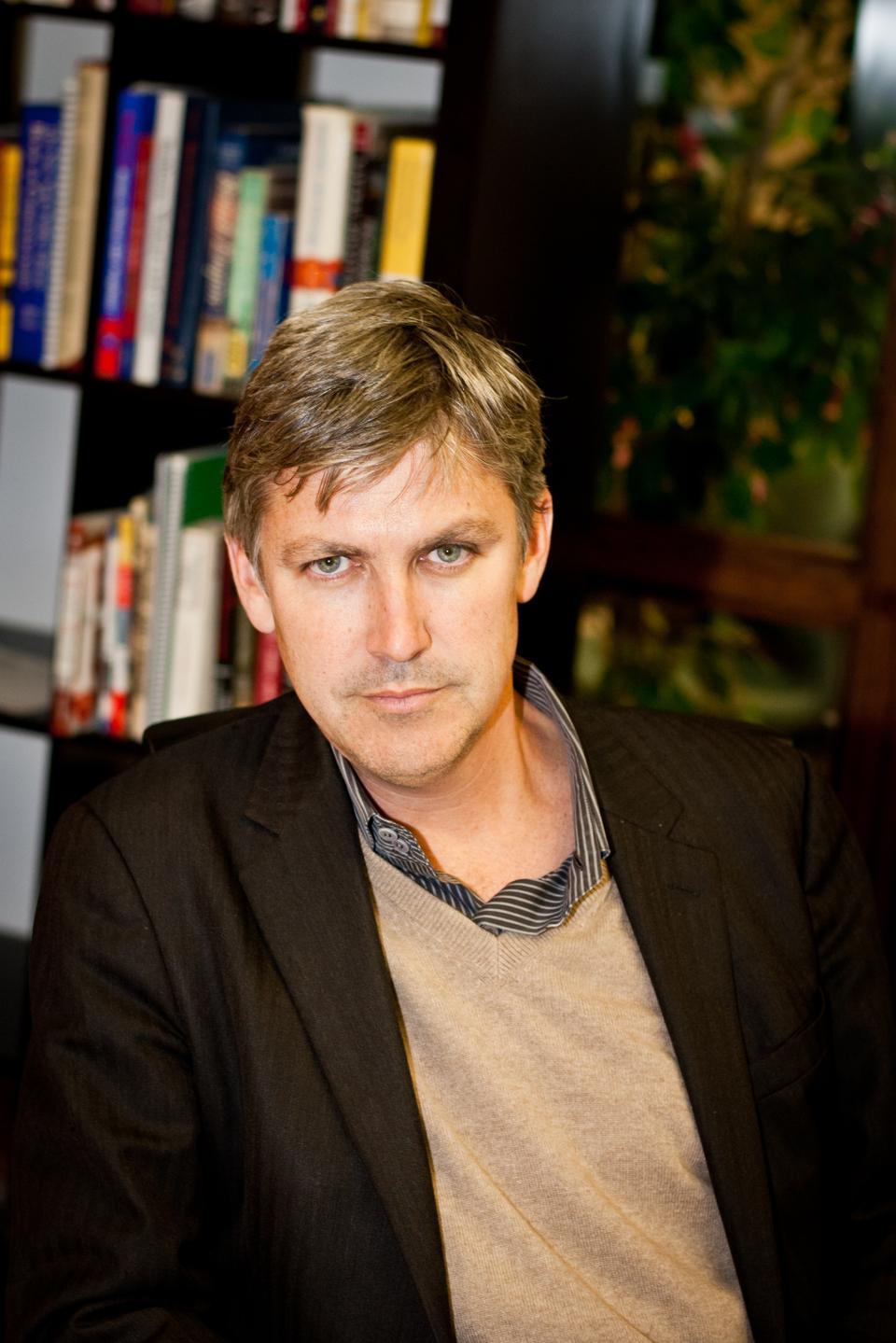
10 Questions With Steven Johnson
Steven Johnson is one of the most influential popular science thinkers of our time. The author of eight books, including “Everything Bad is Good for You: How Today’s Popular Culture is Actually Making Us Smarter” and “Where Good Ideas Come From,” and co-founder of three websites, Johnson talked to FM about hunches, heroes, and the human experience in an urbanizing world.
1. You majored in semiotics at Brown. What does that mean?
Semiotics was effectively a media studies major with a heavy dose of French twentieth century philosophy. You were interpreting the world of media and the world of advertising, and it was as if there was a secret code that you could use to make sense of them, a hidden meaning in all these popular forms. But it set me up very nicely for when the web first really blossomed in the mid-ninties. I had spent all of this time studying media and thinking about hypertextuality in traditional books, and suddenly there was this hyptertext medium that actually was real hypertext.
2. At this point you’ve written eight books, spanning in subject matter from a cholera outbreak in 19th century London to why videogames are engaging. How do you decide what to write?
In my last book I talk about the slow hunch. You have these ideas where you start thinking about them a little bit in the back of your mind, or somebody says something to you that plants one seed, then two years later somebody else plants another seed, and if you keep those hunches alive eventually they hit a critical mass. They eventually get to this point where they start gathering up and they’re like this swarm that you can’t ignore anymore.
3. What underlying themes unite your books?
I used to think of my books as being very different. But when I was writing “Where Good Ideas Come From,” I consciously thought of that book as a trilogy with “Ghost Map” and “Invention of Air,” both of which were books of world-changing ideas and the environments that made them possible. Those were case studies in innovators of the past, and “Good Ideas” was the theory. But then I finished and realized that all of my books had been about innovation in some way or another. They were about new ideas that were coming into being and new scientific developments, new forms of entertainment or media.
4. Where do you see your work fitting into the current intellectual landscape?
I used to think of myself as a public intellectual in the sense that I was trying to write for both a popular audience and an academic audience. Like in “Everything Bad is Good for You,” I was trying to write a book that would be interesting to people who were teaching media theory classes and also interesting to 15 year olds who wanted to convince their parents that video games weren’t rotting their brains. It’s hard to write on those levels. What changed and surprised me was that I ended up having this other side of my career of building things, of doing these web companies and web products or tools over the years.
5. And how did you become involved in those initiatives?
I’d always been really interested in computers, and this is one of those things where generationally it’s really funny to think back, but when I was in college, computers were not cool at all. I was really into my Mac—I was into all of that page layout stuff—but my friends were all art kids so they would come by and I’d be like, “You’ve gotta see this new program!” And they were like, “Steven, don’t show that to people. That’s really not cool.”
6. You’re a science and technology writer with almost 1.5 million followers on Twitter, which is pretty incredible. How do you attract and retain so many followers?
So when Twitter first came along—this is one of my weird little early adopter things—I kind of bet on Twitter. I was like, “I can’t be on Facebook and on Twitter,” so I’m going to go with Twitter. Twitter had this problem where if you signed up and you weren’t following anybody it was useless, so they had to create an on-ramp to teach users how to use the service from day one. They created this thing called the “Suggested User List,” and initially it was a list of 40 people to follow. And because of some combination of I was using it as an author, and frankly they knew me a little bit, they put me on this list. As Twitter’s growth exploded, so did my follower count. I get new followers all the time, but now every time I tweet something I lose 30 followers. So it’s a little bit depressing and it’s also a little bit of stage fright: You’re like, “Oh my God no more drunk tweeting.”
7. Who do you follow? Who are your intellectual heroes?
One of them is E.O. Wilson with his book “Consilience.” Consilience is Wilson’s argument that we need interpretive systems that are kind of stacked on each other. So in the sciences, the physicists can talk about how atoms are built, then the molecular biologists can talk about how those atoms form molecules, then the cell biologists can talk about the cellular system, and then the organ level biologists can talk, and then you can talk to ecosystem scientists and each system can exist independently but they kind of talk up and down to each other. And that process of layering knowledge is what he calls consilient thinking. That’s something I’ve tried to do very consciously since I read that book many many years ago in the writing I do.
8. Your newest book, “Future Perfect”, claims that peer networks, like big governments and big markets, are effective systems for catalyzing social progress. What can college students do to maximize their peer networks?
We have this assumption in our society that innovation just comes from people being competitive and having proprietary stakes in things and ownership. That is true in some places, but it is also true that you can get comparable levels of innovation and creativity by not restricting the ideas and by not claiming ownership of them because other people are free to improve on them. A big theme behind that is diversity as an engine of innovation. That’s the thing I think about in terms of being a student, and particularly being a student in a place like Harvard. The rest of your life the world is going to try and specialize you. They’re going to try to make you focus on one thing, one silo, one department and become an expert at it. And there’s a role for that, but there are a lot of problems that we have that we can’t solve within the vantage point of a single discipline. And when you’re in college you have this opportunity to build interpretive bridges between disciplines. You can’t tell the whole story of what happened or how the world works without making those connections.
9. A lot of your writing advocates for the city as a hub of human development and innovation. How will the increasingly urbanized human experience affect us?
There was a period of time when we saw the favelas and shanty-towns and everything and we would think, “Oh my god, that’s terrible.” But what we’ve started to realize now is that even as these conditions persist they’re turning out to be very progressive forces. And what happens when people move from the country to the city is that you see this immediate drop in fertility rates, people have far fewer kids. That’s partially because they don’t have enough room, partially because they have access to birth control, and also that the economic incentives to have more kids change from when you’re living a rural life. You see a tremendous improvement in the female entry into the workforce. So the urbanization of the planet may be the single thing that ultimately saves us from runaway population growth.
10. How should we be preparing to thrive in this newly urbanized world?
If you and I had been having this conversation in 1995, a lot of people at the time were saying, the internet is going to come along and transform society and nobody’s going to want to live in cities anymore because they can just telecommute. The internet’s going to be the death of distance. And that ended up being completely wrong-headed because the internet gets more and more useful the bigger your city. The internet is not just about connecting people who are far away from each other, but about actually exploring the space you live in. And when people were thinking about the internet they were thinking, “Oh, you’ll be able to order on Amazon or telecommute to their office,” but they didn’t ever think about Foursquare, they didn’t ever think, “there’s going to be this thing showing what’s going on around me on my phone using GPS.” It’s not just that it’s an exciting time to live in a city, but that we have all these tools now which will help us actually make these cities more engaged, creative, and responsive places.