

News
Cambridge Developer Sues City Over Inclusionary Zoning Policy
News
Immigration Authorities Arrest HLS Visiting Professor After October Shooting Incident

News
The ‘Eyes and Ears’ Behind Harvard’s State Lobbying

News
Humanities Departments Are in Trouble, but ‘Applied Humanities’ Are in Demand, Harvard Panelists Say

News
Harvard Endowment Appoints 3 New Directors, Including JPMorgan Exec Who Managed Epstein’s Bank Accounts
Colleges Have Struggled To Curb Grade Inflation. Can Harvard Beat the Odds?
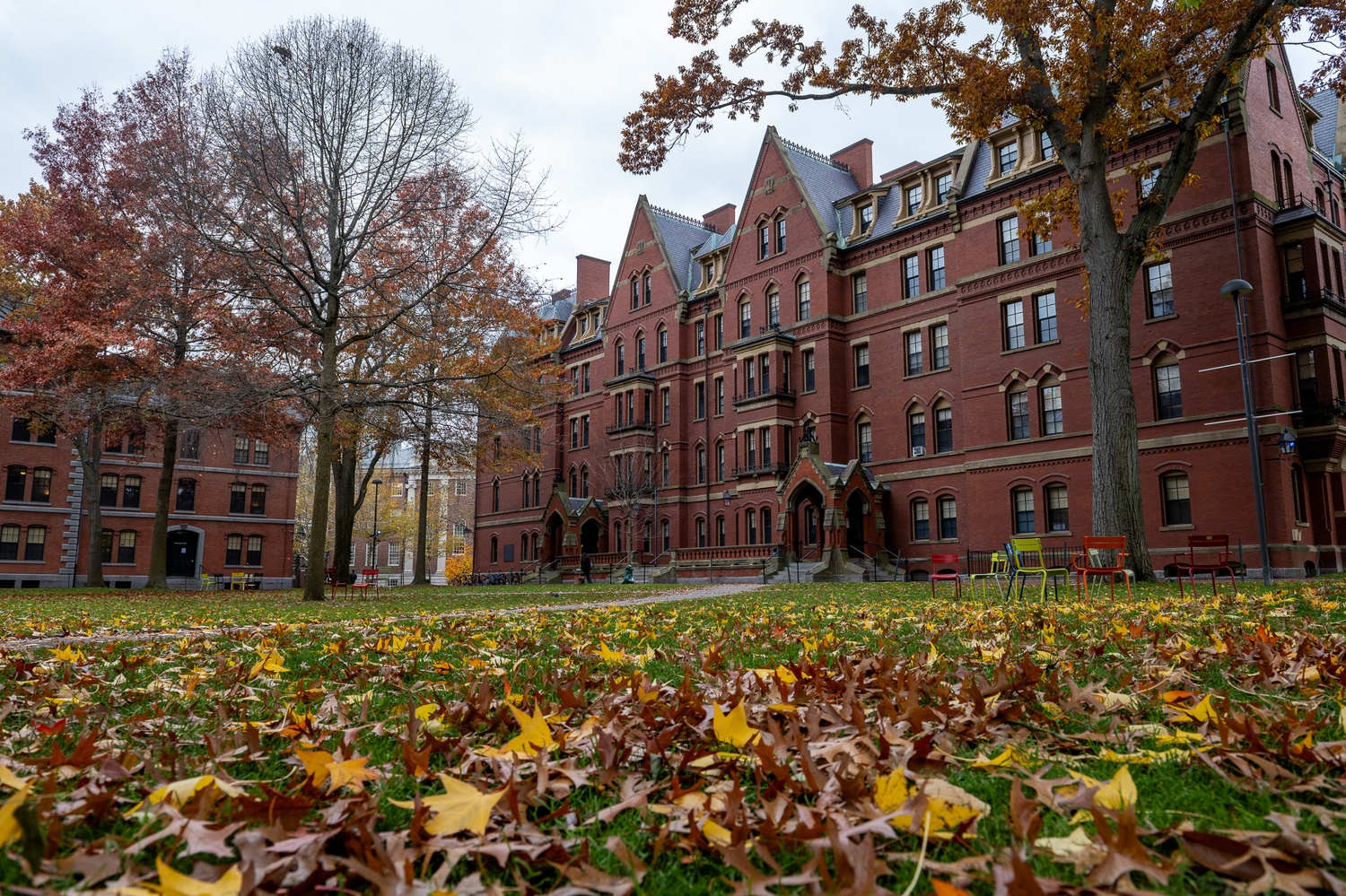
When the Office of Undergraduate Education released a report in October suggesting that Harvard College overhaul its “failing” evaluation system to curb grade inflation, it acknowledged that other elite universities had launched similar efforts — only to see them fail.
But Dean of Undergraduate Education Amanda Claybaugh, the author of the report, wrote that Harvard should still forge ahead, introducing multiple measures at once to reduce grade inflation across the board.
“Grading is a problem too complex to admit a single solution,” Claybaugh wrote. “Our approach bears that in mind. We are trying awareness raising, information sharing, and capping A+s all at the same time, and we are doing more than that as well.”
No major university has attempted the kind of sweeping, multi-policy strategy that Claybaugh has proposed for Harvard. But faculty at peer universities said the anti-grade inflation policies faced fierce resistance from their student bodies — and even produced unintended consequences, like widening racial gaps in grades.
Gennady Samorodnitsky, a professor of engineering at Cornell University, said addressing grade inflation is “very difficult” for just one university to address on its own.
“The problem is not just that of Cornell or Harvard or whatever. The problem, to a large extent, is that of the society,” Samorodnitsky said.
Reforms and Reversals
In the October report, Claybaugh named several Ivy League institutions and other elite universities whose anti-grade inflation programs had fallen short. Among them was Cornell, which began posting the median grades for courses on its registrar’s website in 1998 and on students’ transcripts in 2008.
Claybaugh’s report said that adding median grades to student transcripts is among the reforms that a faculty committee at Harvard is considering. But Cornell’s experience may be more of a cautionary tale than a blueprint.
At the time they were introduced, the university said the policies were intended to encourage students to take more difficult courses, according to Cole Gilbert, a professor of entomology at Cornell.
But Cornell was ultimately forced to walk back the measures amid backlash from students, who said the practice put them at a disadvantage in the labor market. In 2011, the university announced it would no longer post median grades online, and in 2023, its faculty senate voted to stop placing them on transcripts.
Gilbert said university administrators initially thought students would select into courses with lower grade medians to showcase their academic “excellence.” But he said that the notion was not “reasonable logic, given the way many students are.”
“Some are very tightly prescribed from a closed list what they have to take, regardless of the median grade, and other students are looking to maximize their GPA. They’re not necessarily going to take a course that has a lower median grade,” Gilbert said.
Policies intended to curb grade inflation at other universities have faced similar headwinds from students concerned about how lower marks would impact their job searches. But other institutions have also found that these policies can have limited effects on grade inflation — or even lead to unintended consequences for grading distributions at the universities.
At Princeton University and Wellesley University, administrators tried to put limits on the number of high grades received by students. Wellesley specifically introduced a policy in 2004 that limited the mean grades in 100- and 200-level courses in some departments with historically high grades to a B+.
But in a study published in 2014, Wellesley economists reported that the policy had come with unexpected downsides: expanding racial gaps in grades and reducing student enrollment in departments affected by the cap.
In the ensuing years, faculty also began doling out A’s again and surpassing the grade caps set by the administration without facing any penalties, according to Wellesley Economics professor Akila Weerapana, a co-author on the study. When his colleagues realized they could freely resume more lenient grading, Weerapana said, grades across the university began to rise.
“The policy had been losing its teeth long before it officially went away,” Weerapana said.
By 2019, with flagging support for the grade caps, Wellesley opted to axe the policy.
In her report, Claybaugh recommended introducing a limited number of A+ grades — a distinction not currently offered on Harvard transcripts — to help distinguish the best students. But she did not suggest any quotas for existing grades.
Institutional Inertia
Some universities have found it hard to make reforms to evaluation systems stick. But others have struggled to introduce policies in the first place — even when administrators announce their intent to rein in grade inflation.
In 2013, the then-Yale College Dean Mary Miller commissioned a committee to evaluate the university’s grading system. The group delivered several recommendations in April 2013 and February 2014, but Yale left implementation up to the discretion of instructors. Shelly Kagan, a Philosophy professor at Yale, said departments changed little about their grading practices after the report’s publication.
“Every department probably did it in a kind of half-hearted way,” Kagan said. “Certainly there has been no follow up within my department.”
At Dartmouth, a committee recommended several strategies in 2015 for curbing grade inflation, including through the coordination of grading standards across departments and instructors. But Dartmouth biology professor Mark A. McPeek, who chaired the committee, said that few if any concrete changes recommended by the report were actually implemented by his university.
“We turned in our recommendations to the administration, and then that was the end of it,” McPeek said. “I don’t know what the reasoning was about — why they didn’t take any of our recommendations.”
At Harvard, concerns over grade inflation have also rarely manifested in policy change. And the October report has already seen blowback from students, who took to the campus social media platform Sidechat and the pages of The Crimson to criticize the prospect of grade deflation.
But with the report, Claybaugh and the College are indicating that they are committed to addressing grade inflation head on — even if it leaves undergraduates frustrated in the short-term.
“This history might seem to suggest that grading is an insoluble problem,” Claybaugh wrote in the report. But, she added, “by reducing the pressures on grading, by altering the incentives, and by deciding to act collectively to solve the collective action problem, we can restore our grading to what it was before the dramatic changes of recent years.”
—Staff writer Anna Shao can be reached at anna.shao@thecrimson.com.
—Staff writer Andrew Park can be reached at andrew.park@thecrimson.com. Follow him on X @AndrewParkNews.
Want to keep up with breaking news? Subscribe to our email newsletter.