
A Taste of HUDS
“I grew up on a farm; my father was a farmer. I could walk out into the field and pick peas and eat them off the vine.” Crista Martin, director of communications for Harvard University Dining Services, sits on a swivel office chair surrounded by piles of papers.
“I grew up on a farm; my father was a farmer. I could walk out into the field and pick peas and eat them off the vine.” Crista Martin, director of communications for Harvard University Dining Services, sits on a swivel office chair surrounded by piles of papers.
Jiggling her rainbow-socked, clog-clad foot, she continues, “That is my very unique entry-point perspective on food. My mother was a great cook, my sister is a chef—all these things play a role in how I approach food. Every individual has a different approach to food.”
Martin’s office is situated in the basement of the HUDS Human Resources building, across from Pinocchio’s Pizzeria on Winthrop Street. From there, she handles all incoming complaints, requests, and compliments from the nearly 6,600 undergraduate students that HUDS serves on a daily basis.
On any given day, she receives 25 online comments pertaining to HUDS, along with feedback from texts, Facebook, Twitter, and handwritten forms.
Listed last year as the 12th best college dining service in a nationwide ranking by The Daily Meal, HUDS operates 13 dining halls every day during the academic year. According to its website, HUDS serves 25,000 meals a day and five million annually, spending nearly $55 million on its food service.
“There have been different sorts of models, but since the House system was initiated in the early 1900s, this has been it,” Martin says of the current HUDS approach. Having evolved in the University’s 377-year history, HUDS now links houses with food education efforts, and sustainability initiatives.
Dining at Harvard, however, is about much more than its administrative infrastructure. Adams House chef Edward B. Childs affirms, “Our aim is to make it more student-friendly, ‘cause we feel that we work for our customers, which is the students and the University. We don’t necessarily work for management, because management has gone and come.”
THE PERFECT RECIPE
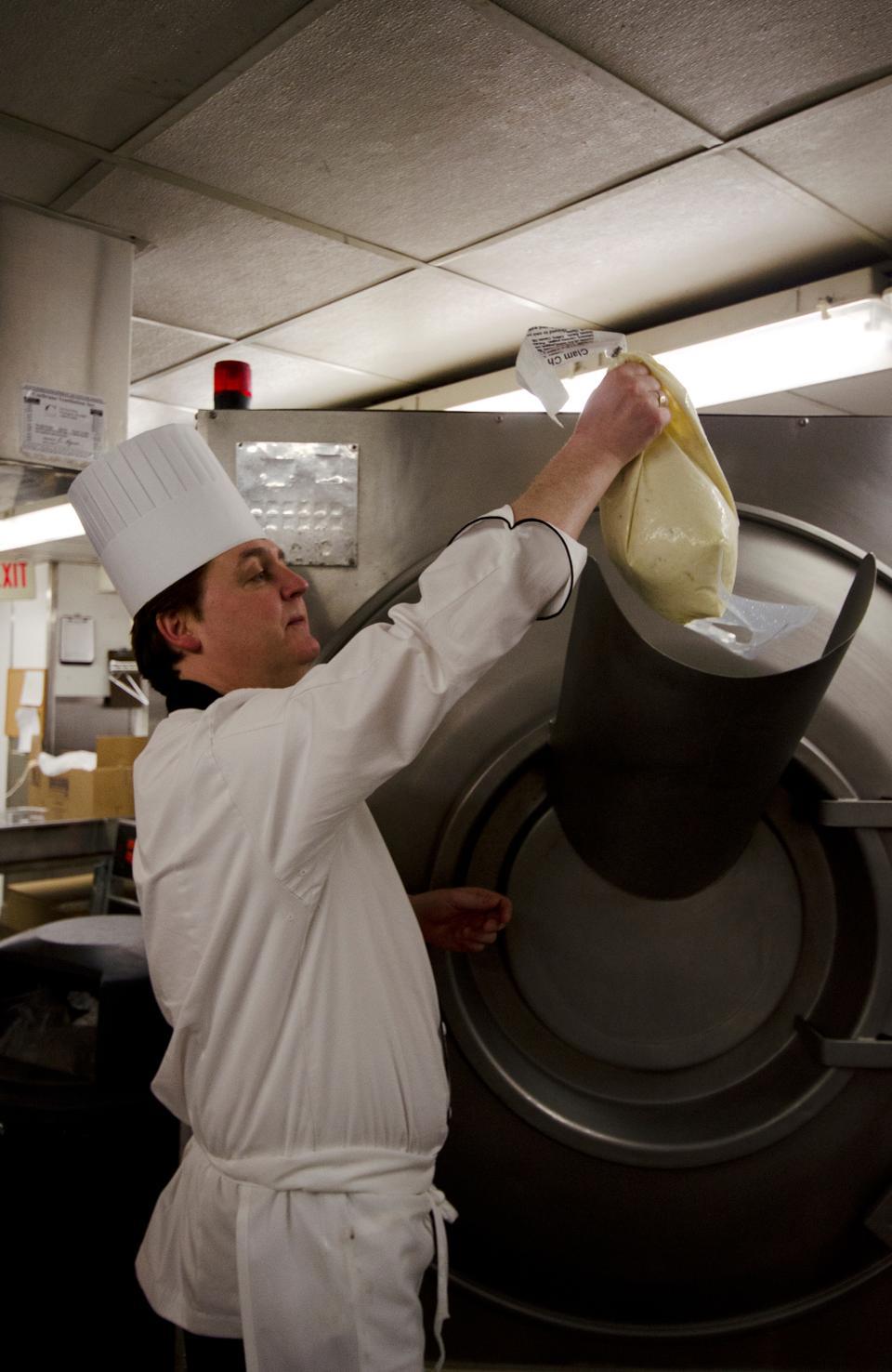
Nestled under 80 JFK St. lies the Culinary Support Group, a bustling central kitchen where HUDS assembles ingredients and ships them off to be served in individual Houses. A network of underground tunnels running from Kirkland to Leverett Houses makes up the Culinary Support Group, where Chef Martin T. Breslin, Chief of Culinary Operations for HUDS, prepares the undergraduate menu.
The Culinary Support Group follows the same procedures one would see in a typical kitchen. Feeding almost 7,000 undergraduates, however, requires a considerably larger amount of manpower and production capabilities. “In an average year, we’re talking about 36,000 gallons of soup in this room, so what we do is, we’ll make the soups today, deliver it to the Houses tomorrow, and serve it in the Houses the following day,” Breslin says.
Before favorites like tomato basil ravioli soup can be served, the Culinary Support Group must prepare it in stages to complete the “cook-chill” process. In one room, chefs slice and dice fresh vegetables, herbs, and spices, to flavor soups and sauces. These are then placed in sizable white vats that are transported and emptied into industrial-sized kettles in another room. These kettles, which have the capacity to store 150 gallons of liquid, are equipped with an agitator that stirs ingredients just as one would stir a normal pot of soup.
Portions of soups and sauces are later distributed in plastic bags that are sent to a tumble chiller, which cools them down to one degree above freezing temperature. A refrigerator that could encompass half of Lamont Café stores all of these bags right until they need to be shipped off to feed hordes of hungry college students.
“Something that should be done in a larger kitchen is what we do here, and it makes for a better product—a consistent product—and we can work with our purchasing department and procure as much local as we can, depending on the season,” Breslin adds in his Irish brogue.
Further along the tunnels, plastic hoses slithering down from Kirkland dhall suck up soda syrup from an organized pile of boxes. Meanwhile, workers rush into Eliot’s underground pantry, next to where trays and plates are sent to a dishwashing station via a conveyor belt known as the “dish super highway,” according to Martin. The tunnels have grown over the years as the University expanded and acquired new buildings.
“We’ve begged, borrowed, and stolen space over the years,” says Martin. “We had to live within the existing footprint of these historic buildings, but meet sort of current demands for how food needs to be made. We take whatever space we can get. Every kitchen is a little bit different.”
FOOD FIGHTS
Despite adaptations and renovations to its internal structure, HUDS has been met with criticism, most commonly in the form of student grumblings. Though multiple students declined to comment, their dissatisfaction with HUDS food can be heard between mouthfuls of Red Spice Chicken and the clinking of cutlery.
One of the most frequent complaints about HUDS revolves around the lack of hot breakfast in upperclassman dining halls. In the midst of the 2008 economic crisis, Harvard’s endowment decreased significantly. Since HUDS’s undergraduate meal plan is covered by room and board costs, not the endowment, some budget cuts were in order.
“The endowment helps to offset the cost of your academic experience,” Martin articulates. “In order to try and keep the overall cost of the university level, they had to decrease funding in other places. One of those was dining. Breakfast was the least attended meal and was the opportunity for the least impact.”
Additionally, Harvard’s dining services differ from other universities in that every single undergraduate is on an unlimited meal plan. Restricting dining hall access by installing customized, and more costly, meal plans would limit many aspects of student life, says Martin. “It means that people can no longer come and go freely, some people will have access and some people won’t,” emphasizes Martin.
“Sitting at a table and mingling over food and dining, and equal access to all parts of your house are what drive dining.”
In the spirit of community dining, HUDS operates a 14th dining hall, Harvard Hillel, to serve the Jewish community by offering kosher food.
“HUDS is incredible in comparison to a lot of campuses who make students pay for kosher food,” says Sara Kantor ’14, former Harvard Hillel president and Crimson Arts editor. “The cafeteria is a very important part of Hillel, and provides a nice community outside Houses.”
However, the budget deficit has also affected Hillel’s accessibility. Last year, HUDS put dining restrictions at Hillel into effect, whereby only “members or invited guests of Harvard’s diverse Jewish community” were allowed to enter.
The resulting controversy incited waves of student indignation, culminating in the university’s decision to lift the ban within a week after imposing it. “We were definitely pretty outraged,” says Brett M. Biebelberg ’16, an Undergraduate Council representative. He stresses that students should acknowledge that “it was a decision that Hillel did not make” and that HUDS, which runs Hillel, has a limited budget.
“It’s unfortunate that a decision was made to attempt to restrict the students who should be able to eat there based on religion,” he says. “At the same time, it is important to note that the University recognized very quickly to maintain a community that was inclusive and not restrictive.”
Students also suspect that HUDS repurposes leftovers into future meals. Martin dismisses this claim as an “urban legend.”
“If they serve chicken parmesan at lunch, they might add it to dinner,” Martin reports. “They’re not going to replace it for something, but they might add it.” Unused dishes and food items are regularly donated to the Harvard Square Homeless Shelter or other food banks in Boston. There is no “creative use of leftovers,” says Martin.
According to Biebelberg, student objections tend to stay within the confines of undergraduate dining halls and are not relayed directly to HUDS.
“I think we often hear people complain about the food that is served, but it’s important to have some perspective on the issue,” he says. “Let’s not forget that this is a college dining service, not the White House catering service. Credit should be given where the credit is due.”
ADDING TO THE TRIMMINGS
Enterprising students have taken personal nutrition and food at Harvard into their own hands. Nina L. Hooper ’16 started her own company, Harvard Holistic, after her first trip back home this past January. Her mother, who is a nutritionist, and her sister, who hasn’t eaten sugar for two years, inspired Hooper to commit to healthy eating.
While looking at the HUDS menu to determine what options were available for her new nutrition plan, Hooper was not satisfied. “I realized how difficult it is to get by with any kind of dietary restrictions, although the dining hall provides quite a few vegetarian options.” Influenced by her mother’s recipes, Hooper now sells nutritional brownies made in her dorm’s kitchen.
Other initiatives, such as the Food Literacy Project, address students’ sense of curiosity surrounding food. Louisa C. Denison ’11, coordinator for the Food Literacy Project says that the project “was born out of Harvard Dining Service’s realization that students were increasingly interested in food, about where their food came from, but that they lacked critical information about it.”
Initiatives like the Food Literacy Project, managed by HUDS but led by students, emerged from this disconnect.
The Food Literacy Project’s mission is to engage debates and interest about food in the context of Harvard, its community, and beyond.“I see it as active education of students around food rather than reacting when students have questions. We do that too, but we want to actively promote engagement around food,” Denison says.
While HUDS has been lauded for sustainability initiatives like its cage-free eggs campaign, some have criticized its fish purchasing practices. The Sustainable Food Project, an entirely student-run organization, works with HUDS to make purchasing decisions that are environmentally friendly, sustainable, and good for both students and the community.
“Our main areas that we’re looking at is food that is environmentally friendly, local, humane to animals, and fair trade. We’re also looking at health to improve the quality, social, and environmental impact of the food overall,” says Sustainable Food Project member Max E. Zacher ’15.
“HUDS is willing to make a lot of decisions, they just need pressure and interest from students,” Sustainable Food Project member and Crimson Editorial editor Hannah M. Borowsky ’15 says. “I think that our job here is to go to school and HUDS’s job is to feed us. If we can align our academic interests with improving HUDS and improving Harvard’s food purchasing choices, then that can result in better food for us and also Harvard having a more positive impact on the food system as a whole.”
THE ESSENTIAL INGREDIENTS
Crucial to the core of HUDS are the dining hall staff members, who make a point to accommodate each student’s particular needs from the moment they swipe into each dining hall.
At times, that might include giving invaluable life advice. “One of the dhall workers had just come back from a wedding, and we talked about weddings for a while,” Katherine C. V. Damm ’13 remembers, “and he was just talking about how true love is the best thing ever.”
Michael L. Charles, who swipes Quincy House residents into their dining hall, describes his job as being HUDS’s “first line of defense, the meet-and-greet customer service.” He adds that one of the staff’s aims is to meet student requests as much as possible with culinary alternatives easily found in a House’s kitchen.
“It doesn’t solve the problem, but at least the thought of it even being out there and people even trying, I think that people take that in,” he says. Charles is currently a chief shop steward in Local 26, the union that represents more than 600 HUDS workers.
“The main goal is to meet customer service to our best capacity and serve the students as much and as professionally as we can. We’re all in agreement on that. The main goal is to make sure that the students are happy,” he says.
That goal is rooted in a long history of conscientiousness and care, one that HUDS staff has developed with students throughout the years.
Childs, another one of the union’s chief shop stewards, expresses that protecting this sense of community has been not only his, but also the staff’s first and foremost preoccupation.
Childs recounts how HUDS staff has gone above and beyond for students over his 38 years on the job. They have started campaigns that include initiatives like maintaining breakfast as a meal option, curtailing bullying, prohibiting the use of inflammatory language, promoting sustainability, and encouraging the presence of more safe spaces on campus.
“We feel that we are a community no matter who among us tries to divide us, so we’re the only ones that have to defend it,” Childs states. “We’re not going to let the university go backwards.”
When students were allowed to choose their house affiliation, Adams used to be known as popular among students who identified as gay or lesbian, Childs says. He recalls that BGLTQ students would face the threat of physical violence. “We nurtured them,” says Childs, his voice growing stronger.
Sitting on break in Winthrop dining hall, Childs points to the floor. “Football players from here and Eliot went over there and pissed into the dining halls through the windows. It was our workers that chased them away. We supported the students. They marched every day and sat in these dining halls.”At one point, dining hall workers wore shirts that read “We’re All Gay” in the front and “We’re Coming to Get You” in the back, he says.
Nearing 11:30 a.m., the lunch rush is almost upon Quincy House dining hall. Charles mindfully looks at his watch and notes, “We’re their home away from home. We communicate with them on a level where we’re their brothers; we’re their sisters; we’re their mothers. We can connect in that way as far as just getting them through the tough times. It’s not always about coming in, and getting food, and you go in and you sit down and eat it. It’s more about, ‘I’m going in, and I’m having conversations.’”
6,600 DIFFERENT PALATES
With so many components to orchestrate, imperfections are bound to pop up. Martin compares the process to having a piano tuned.
Over the course of a year, HUDS abides by a concept she dubs the “acceptability factor,” which elucidates how much people like a certain dish. “If people really didn’t like it, we pull it off the menu, put something else in its place,” Martin clarifies.
“So when you put something else in its place, you can’t always re-jigger its slot, so over the course of the year, the piano gets a little untuned.”
“It’s tough because you’ve got 6,600 different palates, and you can’t make everybody happy every day,” she says. “But hopefully you make most people happy most of the time. And if they’re not happy and they can tell us why, we’re always glad to hear it.”
See more on: Scrutiny, On Campus, College Administration, Food and Drink, Adams, HUDS, Labor, LGBTQ, Gender and Sexuality, Freshmen, Love, Food Literacy Project, Environment, Sex, Sustainability