Why Act When You Can Task Force Instead?
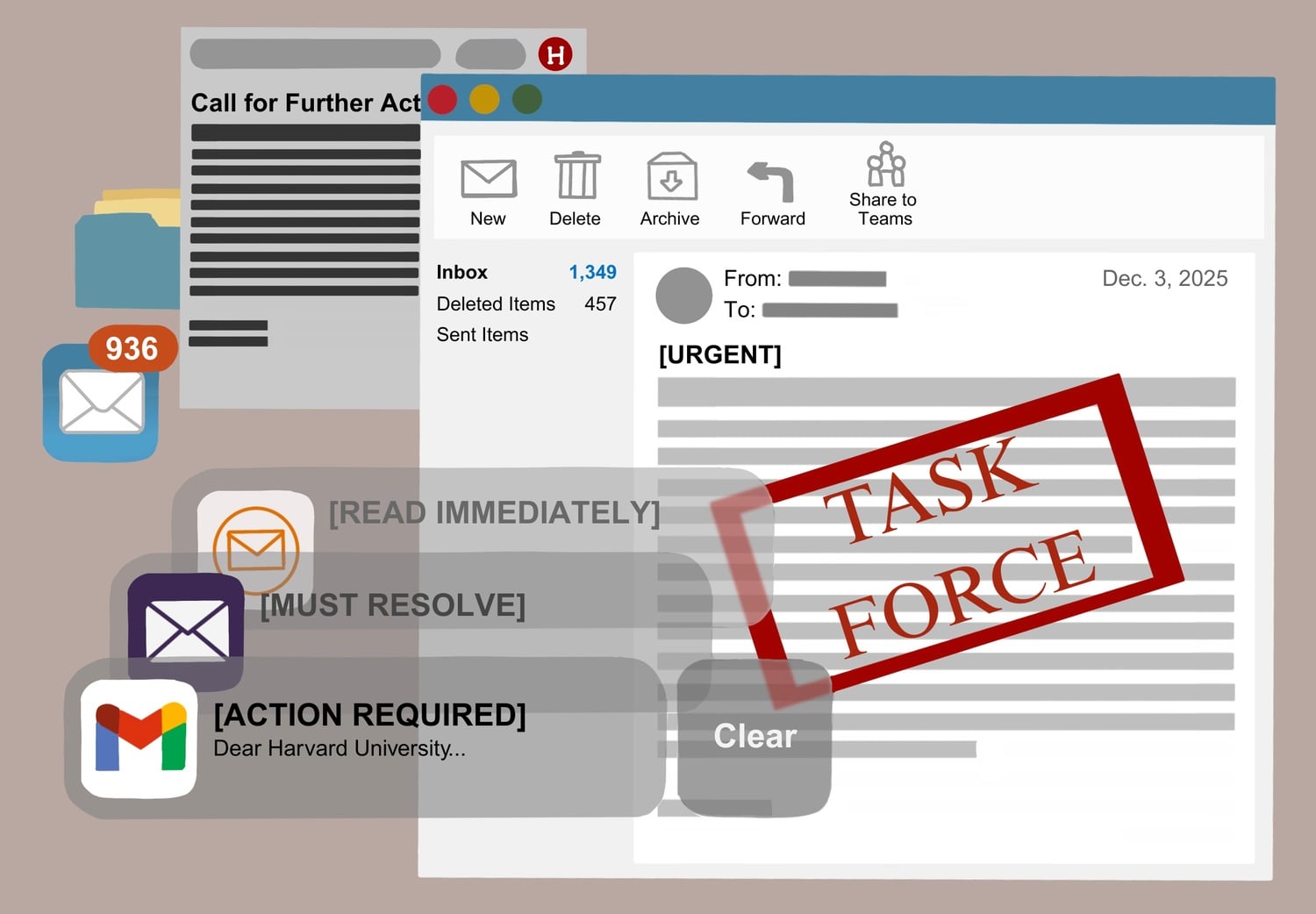
Like its students, the Harvard administration appears to have mastered the skillful art of procrastination.
When a crisis erupts, the University’s instinct is to delegate and delay. From Covid-era teaching, to campus bias, to workforce planning, Harvard’s infatuation with task forces raises a fundamental question: are they designed to solve problems, or merely to postpone them?
In January 2024, Harvard announced twin task forces investigating bias towards Jewish, Israeli, Muslim, Arab, and Palestinian affiliates due to intensifying concerns over discrimination on campus. Yet, while those final reports have been published and some of their recommendations adopted, many of their more significant suggestions, like a proposed pluralism center, remain largely unimplemented.
Task forces are inherently designed to study issues and provide advisory recommendations, but they offer another convenient benefit — namely, the deferral of formal decision-making.
Reports, while lengthy and thorough, stop short of enforcing action. This gives the administration plausible deniability: they appear to be addressing the University’s problems, but in practice, nothing changes.
In their current form, Harvard’s task forces cannot act. They can gather data, interview stakeholders, review history, and draft recommendations, sure, but their efforts only serve to delay action.
What results from this everpresent stream of task forces is bureaucratic inertia. Detailed reports are produced, but they are often published months or even years after being commissioned.
At Harvard, where decision-making is often routed through a complex bureaucracy of overlapping task forces, administrators, and committees, accountability becomes diffuse. As the number of stakeholders increases, responsibility spreads thin and decisions must satisfy more constituencies, making it easier to substitute prolonged processes for concrete action.
This phenomenon of inaction certainly isn’t unique to Harvard, or even to higher education. “Death by committee,” or the slow, painful demise of a project due to overbearing bureaucracies, is a common issue within large organizations or companies. Like other committees, task forces create a veneer of activity while allowing leadership to defer responsibility.
Take the Faculty of Arts and Sciences Task Force on Workforce Planning. This task force spent five months in its first diagnostic phase, identifying “complex and inefficient administrative systems” and interviewing over 100 groups and individuals. The task force only just entered its second phase this winter, in which they will actually design a new administrative model to better support the FAS community. Then the task force will review the administrative model — and make yet another set of recommendations. We’ll see how long it takes for that model to come to fruition.
None of this is to say task forces must be done away with entirely. As much as I oppose bureaucratic bloat, it’s obvious that a problem cannot be solved without at least some research to identify solutions. But decision paralysis has real stakes. Delaying action on antisemitism, Islamophobia, and other forms of campus or workplace bias undermines the University’s credibility. Worse, it impacts the daily lives of students and faculty.
Ultimately, Harvard’s overreliance on these archaic committees reflects a broader institutional preference for process over outcomes. Task forces have their uses, whether generating expertise or coming up with meaningful solutions. But in large institutions, these mechanisms can often become substitutes for action rather than pathways to it.
Harvard can continue to utilize task forces so long as they don’t become deferral mechanisms. The solution is straightforward: task forces must have some decision-making authority and publicly commit to implementing recommendations, accompanied by enforceable deadlines. Task forces should help implement solutions, not merely recommend them. Without such reforms, Harvard risks perpetuating a cycle of analysis without action — a cycle that undermines both campus morale and institutional integrity.
The University can convene experts and produce reports until the cows come home, but unless leadership commits to acting on those findings, its endless research will fail to address real issues.
Harvard has to choose: will it study its problems, or solve them?
Taylor P. Beljon-Regen ’29, a Crimson Editorial editor, lives in Thayer Hall.
Want to keep up with breaking news? Subscribe to our email newsletter
Have a tip for The Crimson? Share it confidentially