The Elephant in the Square
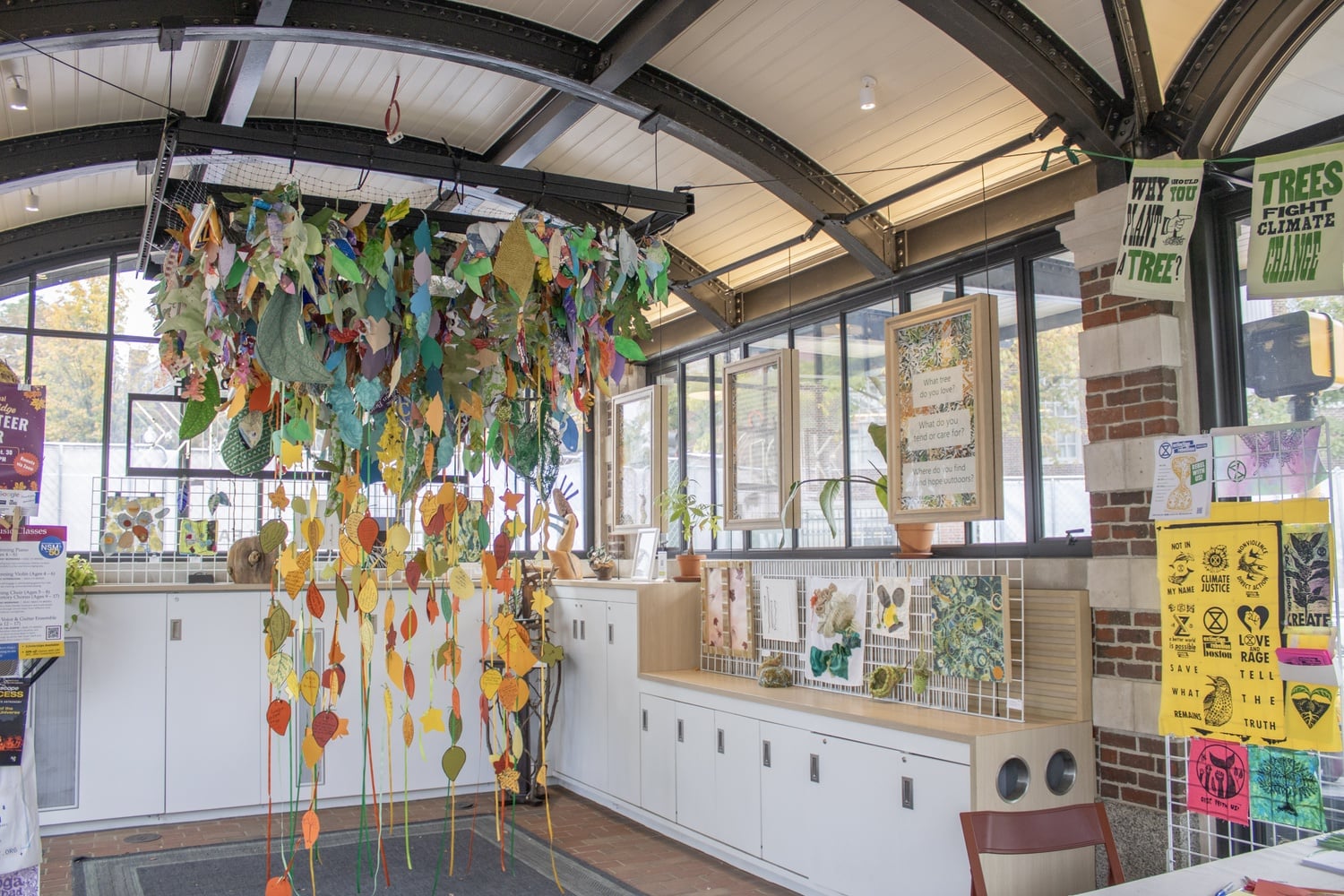
Standing in front of Joe’s Pizza and looking out into Harvard Square on a sunny Saturday morning, one will notice three things: the ever-busy Red Line station, a line slowly making its way out the door of Blank Street Coffee, and an empty-looking building with “Harvard Square” written in an arch shape on the panel.
This quaint, oftentimes desolate building in the nexus of the city is the Cambridge KiOSK. It has been bluntly nicknamed “a waste of space” because of its apparent vacancy. More recently, the KiOSK has again faced scrutiny — from students and Cambridge city councilors alike — about whether or not it is serving its purpose.
Indeed, the KiOSK suffers from not tailoring workshops to Harvard Square’s day-to-day rhythm, hosting activities that don’t have a clear connection to Cambridge culture, and a lack of interaction with community members. But despite these problems, the KiOSK is not a lost cause. A deliberate and intentional reangling of the space can turn the KiOSK into a beacon instead of a burden.
The Cambridge KiOSK opened in 2025 — after several years and $3.3 million — following the closure of Out of Town News in 2019. The project was envisioned as a revival of a vibrant community space in the heart of Harvard Square. During the KiOSK’s reopening, Cambridge City Manager Yi-An Huang termed the achievement “a milestone for our community.”
Now, the KiOSK has remained open but has hardly lived up to those hopes. Set the scene: you’re in the Square, probably heading towards class or your dorm. You can’t see what the KiOSK is hosting until you are directly in front of it. At that moment, you have to decide whether or not you want to take the time to step inside. Since you’re in a hurry, you keep on going about your day.
This scenario is not difficult to imagine. Harvard Square is bustling, and the KiOSK’s location adjacent to a T stop and a college campus filled with busy students means people passing by already have places to be and no time to spare. Beyond the mismatched pace, the vast majority of the Square’s visitors are not here to stay. With nearly 1.24 million visitors to Harvard Square in November 2025, the KiOSK’s passersby are just that: passing by.
Contrast this with the activities the KiOSK hosts, which often require a greater time commitment and fail to sufficiently engage with the community. Take for example the “craftivism” series or “snail mail station,” two workshops that have been hosted several times since the summer. Although the intention of snail mail — to stop for a moment and express handwritten gratitude — is endearing, there is no strong incentive for people to pause their day for these activities. There is a mismatch in the rhythm between the Square and its KiOSK.
It is important to note that the KiOSK has already made strides to increase community engagement. For example, in July, it partnered with Mooish Productions — a Boston based group — to host “KiOSK Comedy.” The show involved local performers and chaotic humor, intending to attract a wide audience. While events like these are a good start, the KiOSK needs more flagship events to ground itself in the community. For now, the KiOSK invites locals to reach out for programming ideas, and nearly half of the events hosted in 2026 so far have been crafts-related.
Although the KiOSK also solicits nonprofits and businesses to host events, in order to attract a wider audience, it should expand its workshop themes. Perhaps myth busting in Harvard Square, artifact night with nearby museums, story time with Cambridge’s urban legends from local historians, student a cappella performances, food tours, affinity nights during cultural holidays, or anything to engage more of the vivid community that already exists outside the glass walls.
By making each event more specific but hosting events catered to a wider range of interests, the KiOSK can generate higher turnout. Not being afraid to experiment with events geared towards a smaller portion of the diverse surrounding community would give those individuals more incentive to participate.
For such an important historical and cultural location, the Cambridge KiOSK must invest in more active ways to engage the community around it. The centerpiece of Harvard Square shouldn’t feel like it’s from out of town.
Emily X. Yu ’29, a Crimson Editorial editor, lives in Currier House.
Want to keep up with breaking news? Subscribe to our email newsletter
Have a tip for The Crimson? Share it confidentially