The Secondary Needs a Second Start
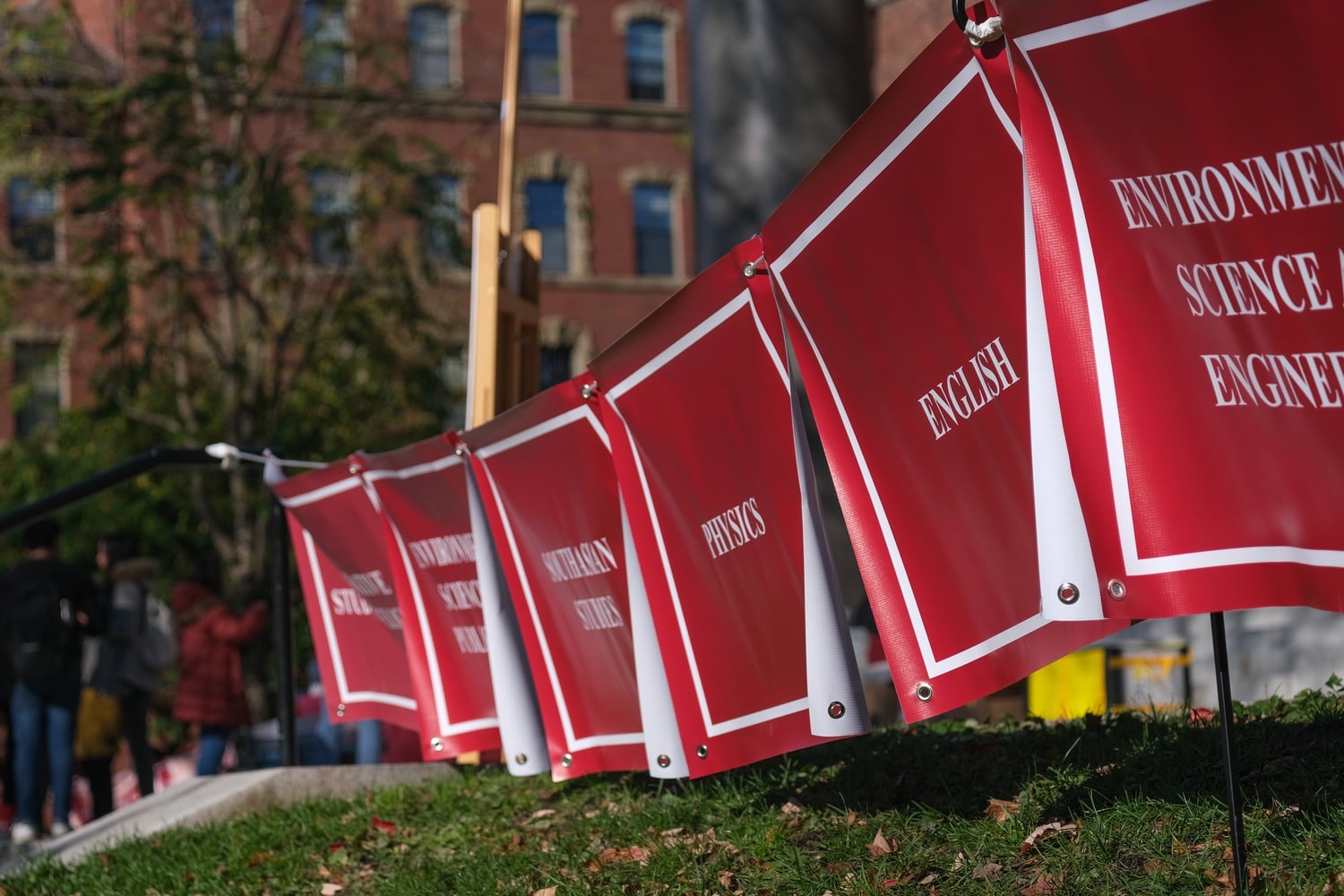
I didn’t declare my secondary field until the last second, midway through concentration declaration day on October 9. There was no invitation to a department-wide lunch, no welcome notification for a special mailing list. I simply received an email from [email protected] alerting me that my request was approved.
This was a rather stark contrast to my concentration declaration process, which required departmental approval and completion of a concentration-specific form in advance of submitting a petition. By the second half of the day, I was left thinking about how secondary concentrations fit into Harvard’s academic landscape.
Secondary fields are an important part of Harvard’s academic structure; they serve to recognize the work students do outside of their primary concentration and to communicate these additional academic pursuits to potential employers and graduate schools. In light of this crucial exploratory role, Harvard must revamp secondaries by creating more uniform advising requirements, ensuring that the secondary field is a legitimate academic program as opposed to a list of classes to take.
Typically, students must take between four and six courses within a department or related department to earn a secondary. By completing that coursework, a student demonstrates interest and competence in a subject other than her primary concentration. More than a credential, it is an academic shorthand understood across the University.
However, in order for secondaries to truly serve this purpose, these fields must be improved upon. Most pressingly, advising structures need to become more uniform and rigorous. Scrolling through the Fields of Concentration handbook, I quickly saw major differences in how different departments treat their secondary concentrators.
Depending on a department’s size, and on whether or not it offers a primary concentration, undergraduates experience vastly different advising models for secondaries.
According to the “Advising Resources and Expectations” description for the Astrophysics secondary, students “enjoy many of the benefits afforded concentrators in Astrophysics: They choose a faculty advisor, are encouraged to participate in all departmental events and activities, and have access to several on-campus observatories.”
In the Economics secondary, meanwhile, students can meet with concentration advisors to discuss course selection during the same hours as full concentrators. For the Near Eastern Languages and Civilizations secondary, this same section contains only one sentence: “For more information, students should contact the Director of Undergraduate Studies.” They helpfully include the DUS’s contact information.
This disparity is different from the interdepartmental homogeneity afforded primary concentrators: All departments assign their concentrators a primary academic advisor following a student’s declaration in their third term. However, many secondary concentrators aren’t provided the resources — such as advising networks or priority enrollment in capped seminars — that are automatically granted to full concentrators in the same departments.
Of course, a student doesn’t need to declare a secondary to explore academic areas outside of her own concentration. In fact, Harvard’s graduation requirements force every student to have at least an introductory level of exposure to key academic field clusters. The many elective credits afforded to each student give everyone the ability to pursue academic interests in more depth.
However, the same could easily be said of a concentration: it doesn’t motivate students to take a class or hone their efforts into a more specialized field. It serves as a marker, indicating to others that a student has achieved a certain degree of mastery in a subject. A concentration isn’t simply a credential — it signals what a student spent the majority of their time on during their Harvard career.
After over 20 years of secondary fields, the time has come for Harvard to seriously evaluate this program and make it better serve the overall mission of a liberal arts college.
The secondary is a useful signifier that provides concrete recognition for students who spend enough time and effort exploring other academic fields to become moderately knowledgeable. But secondaries need a stronger advising structure to be more than a byline on a diploma.
Anna J. Guerrini ’29, a Crimson Editorial editor, is a Physics concentrator living in Pforzheimer House.
Want to keep up with breaking news? Subscribe to our email newsletter
Have a tip for The Crimson? Share it confidentially