London School of Economics Professor Says Democracy Should be Cultivated Like Agriculture in Mittal Institute Talk
Mukulika Banerjee, a professor of anthropology at the London School of Economics and Political Science, argued that it takes a consistent, active effort to effectively maintain democracy at a Wednesday talk.
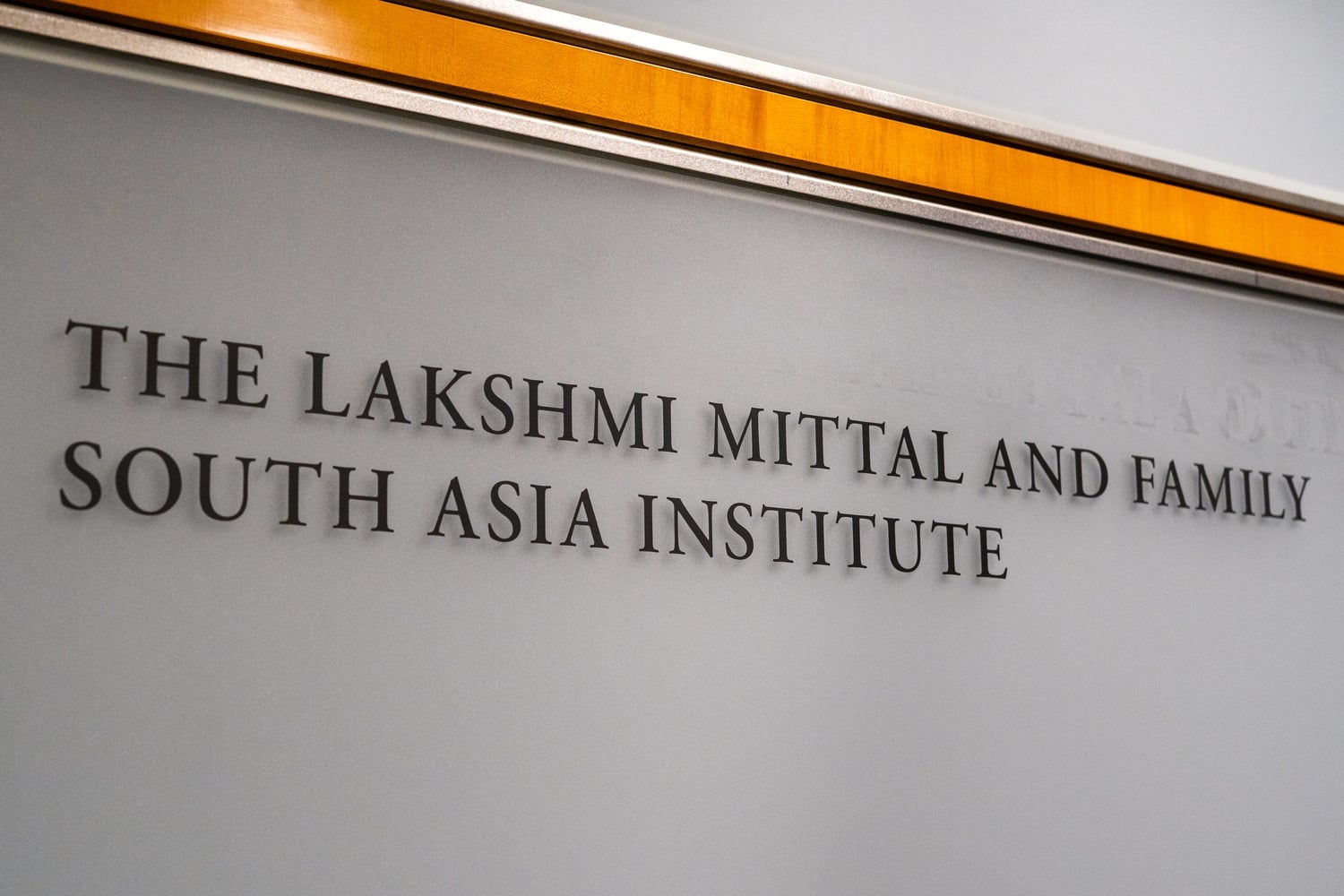
The event, titled “Why Democracy Needs Cultivation: Lessons from an Indian Village,” was hosted by the Lakshmi Mittal and Family South Asia Institute, and invited Banerjee to discuss the ways democracy is cultivated in everyday life — drawing from her 2021 book on politics in Indian villages.
The book, “Cultivating Democracy: Politics and Citizenship in Agrarian India,” catalogs more than two decades of ethnographic research that Banerjee conducted in villages in West Bengal, where voter turnout exceeded 66 percent.
Banerjee said she was most interested in studying “people who are socially disadvantaged and keen about voting” in local elections and exploring how facets of village life and farming can provide insights into democracy.
Throughout the Wednesday talk, Banerjee frequently drew parallels between the effort to preserve democracy and the agricultural work in the villages she researched. She took India’s land reforms – launched after the country gained independence to level an unequal agrarian system left by colonial rule — as an example.
Agricultural knowledge was rebalanced across castes, allowing for a collective investment and redistribution of labor that ran contrary to social hierarchies in other sectors of life.
“The woman who was tying paddy bundles together did just that for three weeks, that was her job,” Banerjee said. “She knew that it was a small task but a task without which you could not have had a harvest — someone had to tie those bundles.”
And Banerjee said these same principles carried over into voting.
“One vote is part of a collective, and if my vote is missing from that collective, I’m not part of that, right?” she said. “And this idea of individual effort contributing to a collective good is not just through elections; it happens to us.”
Get The Crimson in your inbox.
Ping-hsiu Alice Lin, an assistant professor of anthropology who moderated the talk, said that “it’s hard to think of a timelier moment than now for a talk on democracy in India” — pointing to ongoing protests and allegations of corruption in Indian elections.
She discussed the Cockroach Janta Party, a political group founded in May that has launched widescale protests over allegations of election fraud and government corruption. The group has called into question the removal of more than 130 million names from voter lists in India and questioned the impartiality of the Election Commission. The Indian government has since cracked down on protests, escalating police force and restricting transit and internet access near protests.
“What is happening on the streets of India today — in an assault on India’s democracy that has been taking place — there’s a protest, there’s a fight back, there’s a reclamation,” Banerjee said.
“It’s a moment of tremendous strain, but also a tremendous celebration of democratic spirit and democratic politics in the way that you see a flowering of democratic sentiment,” she added.
Outside of the current political unrest, Banerjee also explained her decision to focus on “elections and the inter-electoral temporality,” noting that she was interested in the way that interpersonal relationships affect voter turnout in rural villages.
“Political subjectivity is shaped as much by their religious beliefs, by their economic activity, by what kind of friendships they have, what kind of marriages they conduct, etc.,” Banerjee said.
She noticed that women would save their ‘best’ saris for the polling booth, just as they did for festivals, weddings, and Eid — evidence that elections were valuable in these communities. Banerjee’s team of 12 researchers who conducted field work on elections in other local Indian communities found a similar sentiment to be true.
In “a deeply socially segregated, hierarchical, caste-ridden, gender violence-ridden country like India,” Banerjee said, “the polling booth is literally the only place and the only moment in Indian public life where there is no hierarchy.”
The act of voting thus becomes a moment for citizens to “experience what the Constitution tells us,” Banerjee said, citing active citizenship between elections as crucial in keeping democracy alive.
She argued that pursuing accountability for the government, even in the absence of an upcoming election, is what enables a flourishing democracy.
“The opposite of cultivation is really complacency,” Banerjee said.
Want to keep up with breaking news? Subscribe to our email newsletter
Have a tip for The Crimson? Share it confidentially