‘How Can I Be Helpful?’: Father of Entrepreneurship, Howard Stevenson, Dies at 85
Howard H. Stevenson, who taught more than 15,000 students during four decades at Harvard Business School and helped define entrepreneurship as a field of study, died at 85.
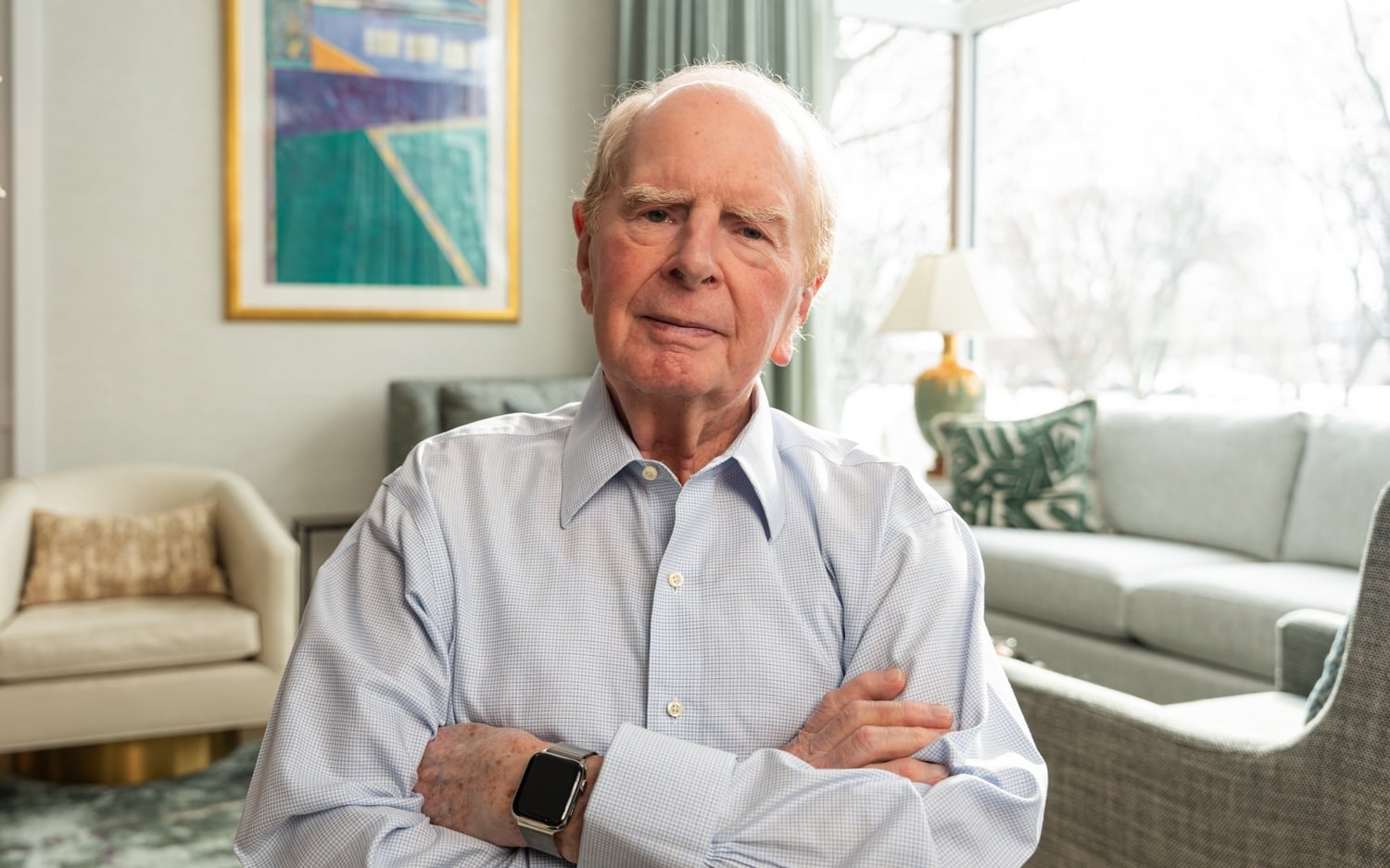
When Howard H. Stevenson launched an elective course at Harvard Business School to teach entrepreneurial management in 1983, the course caught the attention of nearly three quarters of the student body.
The elective course laid the foundation for what would become the Entrepreneurial Management Unit of HBS, now a department with nearly 50 members that first-year MBA students are required to take a course in.
“There was no field before him. He created the academic field, or is largely credited with creating the academic field of entrepreneurship,” said Eric C. Sinoway, an entrepreneur who wrote two books on Stevenson’s life. Stevenson authored the foreword to Sinoway’s second book.
Stevenson, a professor emeritus at Harvard Business School since his retirement in 2011, died on Sep. 27 at the age of 85 after a long illness. He is survived by his wife, three sons, four stepdaughters, 14 grandchildren, three great grandchildren, and his sister.
Stevenson spent more than 40 years teaching at HBS, first joining the faculty in 1967. He became the first HBS faculty to hold an endowed professorship dedicated to the field of entrepreneurship. In his time at the Business School, he also held two separate terms as Senior Associate Dean and spent two years as the University’s Vice Provost of University Resources and Planning.
Stevenson left Harvard twice — first to serve as the vice president of investment banking firm Simmons Associations for a year before returning to the faculty in 1971, and again in 1978 to serve as vice president of finance and administration for Preco Corporation.
He returned to HBS in 1981 at the request of then-Dean John McArthur, who asked him to lead the school’s emerging studies of entrepreneurship.
Before Stevenson’s work in the field, an entrepreneur was defined as someone who started a business. But to him, entrepreneurship was something that could be learned and applied to any lifeway or practice.
“Howard was the first person who said, entrepreneurship is an outlook, a way of thinking, and a certain set of beliefs and behaviors, and because of that, it could be observed, taught, and replicated,” Sinoway said.
Entrepreneurship as a ‘Team Sport’
Get The Crimson in your inbox.
Stevenson is credited with coining the modern definition of entrepreneurship, describing it as “the pursuit of opportunity beyond the resources currently controlled.”
Entrepreneurs had been widely regarded as risk takers prior to Stevenson’s academic contributions to the field, according to William A. Sahlman, an HBS professor of business administration who also studied under Stevenson. But Sahlman said much of his work treated entrepreneurs as risk seekers — “someone who focused on opportunity and managed the relationship between risk and reward.”
“He discovered that entrepreneurship is something that can occur at any point in anyone’s life,” Sahlman said. “It’s also not an individual sport; it’s a team sport ultimately, and it evolves over time. If you don’t move from a founder or group of founders to a set of people able to identify and exploit an opportunity, then it’s not very interesting.”
Sinoway said Stevenson was also known to advocate for the real-world application of business knowledge — aiming to bridge the gap between the academic theory and practice of entrepreneurship.
Former students said that, with Stevenson’s framing, entrepreneurship was no longer confined to business.
“It helps you to realize no matter what field you go into, and this could be even personal or professional, is that you can bring that entrepreneurial lens to what you’re doing,” said Angela Q. Crispi, a former student of Stevenson’s who now teaches at HBS.
Crispi said that there are “countless people who will look and say that he spurred them to go down lanes they would have never imagined.”
Mentoring from Kitchen Table to Classroom
Sinoway said Stevenson had a unique “ability to inject humor into almost anything or any situation.” He used well-trodden quips — dubbed “Howardisms” by his family, students, and colleagues — to distill complex concepts into workable knowledge.
“Often people, including me, would walk away from Howardisms, as they were widely known, and reflect upon it for a considerable period of time, and eventually come upon a deeper meaning — even if it was done in jest — that fully enabled you to fully understand what it is that he was trying to convey,” he said.
In the classroom, Crispi said Stevenson was often able to use these quips to make information easier for his students to understand.
“He could work through those complicated ideas and almost find a quote, a simple phrase, a funny turn of words that actually would end up being almost the epiphany of the idea that then you knew how to act on,” she said.
Stevenson was praised for teaching more than 15,000 students in his tenure at HBS, remaining a close mentor for many.
Shirley Spence, a longtime co-author and friend of Stevenson’s, said that “the sheer number of people that he’s touched, not totally separate from the intellectual contribution, is mind numbing.”
His son, Andrew L. Stevenson, said he was “very much a person who just tried to assess where you are, and help you figure out the best path forward for you.”
And much of Stevenson’s mentorship style carried through his home life, Andrew Stevenson said. He described his father as “parenting by the case method” — encouraging his children to analyze both sides of a problem and talk through it.
But his father’s pragmatic advice later spurred his own interest in business, Andrew Stevenson said. He followed in his father’s footsteps in business, and the two later co-owned an investment management and advisory firm.
“Even from a young age, we spoke about credit card companies,” he said. “We talked about business at the kitchen table, which is why I did end up working with him, part time or full time, for the extent of my entire career,” he said.
“And I would say it was never really a lecture – it was always an engagement,” Stevenson said.
A ‘Lifelong Learner’
Andrew Stevenson described his father as a “lifelong learner to the ultimate degree,” pointing t0 one of his father’s frequent quips: “I want to wear out, not rust out.”
Beyond his academic work, Stevenson became a prolific philanthropist later in his life and continued to research new topics just because he found them interesting.
“He dove in on his problems, and he loved helping people figure out what was going on, and how to address the issues they had in front of them, whether it be a local nonprofit, a personal issue, or something larger,” Stevenson said.
While a faculty member, Stevenson also chaired the board of National Public Radio, and served as a trustee of Mount Auburn Hospital, the Nature Conservancy, the Boston Ballet. Sahlman said that Stevenson often applied his view of entrepreneurship to philanthropy “to make that as impactful as it should be.”
Stevenson had taken an interest in artificial intelligence shortly before his death, often sitting near a “pile of books on AI,” Spence said in an interview alongside Andrew Stevenson.
“He knew he was not going to be solving long term problems for generational questions around AI,” Andrew Stevenson said, adding that his father still “wanted to learn about it.”
But Sinoway said that Stevenson’s philanthropic contributions extended far beyond their monetary value.
“Howard donated to humanity,” Sinoway said.
“Most people donate to an organization. He donated to the world, and it was his time, treasure, and talent, all of which were extraordinary, and without regard to recognition,” he added.
When asked what made his father happiest in recent years, Andrew Stevenson gave a simple answer: “people.”
“Even in his last week, we had people that were important to him coming over and talking to him,” he said. “He loved talking to people, hearing what’s going on, hearing what’s current in their life, hearing the challenges they face, and talking about them.”
Sinoway also pointed to Stevenson’s unflagging desire to help others. When asked what question he would pose to Stevenson if he could speak to him again, he quoted the question Stevenson most often asked those around him: “‘How can I be helpful?’”
“If you asked anyone who knew him well, that was probably the most common thing he said,” Sinoway stated. “And so think about who he is, what he’s accomplished, the impact he’s had, and he almost always would say to someone, ‘How can I be helpful?’”
—Staff writer Siena G. Devine Guzmán can be reached at [email protected]. Follow her on X @sienadevinee.
Want to keep up with breaking news? Subscribe to our email newsletter
Have a tip for The Crimson? Share it confidentially