Caroline Kennedy Returns to the IOP for 60th Anniversary, Six Years After Leaving Advisory Committee
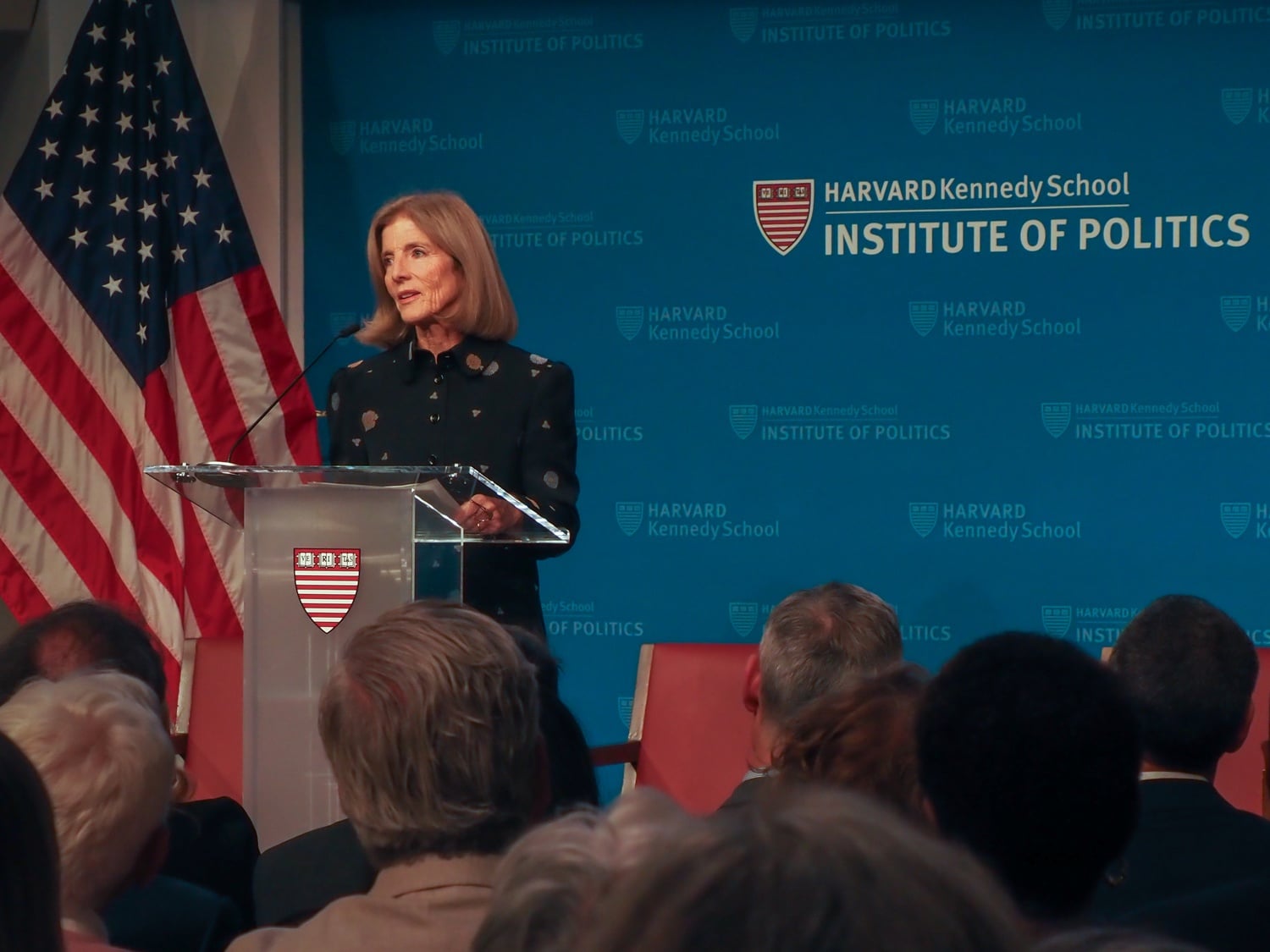
Caroline B. Kennedy ’80 introduced the Institute of Politics’ 60th anniversary forum Thursday, marking her first known public appearance at the Institute since she resigned from its Senior Advisory Committee more than six years ago.
Kennedy — the daughter of President John F. Kennedy ’40, to whom the IOP is dedicated – stepped down as the committee’s honorary chair in 2020 amid concerns over the IOP’s diminished independence, declining programming, and tensions with Harvard Kennedy School leadership.
Speaking at the John F. Kennedy Jr. Forum before an audience that included more than 70 former IOP fellows, Kennedy opened by thanking the Institute’s new leadership.
“Thank you, Jeremy Weinstein, for your leadership and your appreciation for what the Kennedy School means — not just to Harvard, but to students around the world,” Kennedy said, referring to HKS Dean Jeremy M. Weinstein.
Turning to new IOP Director Betsy Fischer Martin, Kennedy said she was excited to have Fischer Martin at the helm of the Institute.
“We are thrilled that you are bringing your lifetime of political, academic, and journalistic experience to this community,” she said.
Kennedy went on to speak about the Institute’s history and what it means to her family.
“To give you some idea of what the IOP means to our family, my uncle Teddy, who was not even the chair, did not miss one meeting in 47 years, and he took attendance of the rest of us,” Kennedy said. “He didn’t do it because he wanted control. He did it because he cared.”
Kennedy also praised her brother, John F. Kennedy Jr., who she said “was ahead of his time in recognizing that politics, popular culture, and energy were converging.” She noted that the IOP was “the first of its kind” and has inspired more than 50 similar institutes in the U.S. and abroad.
“Today, this is still a living memorial for President Kennedy, the one he probably would have most enjoyed,” she said.
Get The Crimson in your inbox.
Other members of the Kennedy family in attendance included former Representative Joseph P. Kennedy III, who sits on the Senior Advisory Committee, and Victoria A. Reggie Kennedy, a former ambassador to Austria and the widow of Senator Edward M. Kennedy ’54.
The relationship between the Kennedy family and the IOP has ebbed and flowed over the Institute’s 60-year history. Tensions peaked in 2020, when then-HKS Dean Douglas W. Elmendorf presented Kennedy with a revised governance structure that would have reduced the committee’s authority.
In a letter to then-Harvard President Lawrence S. Bacow, Kennedy described Elemendorf’s proposal as an “ultimatum” that “did not reflect the mission or history of the IOP.” The committee has grown increasingly marginal since, with its membership shrinking from 14 to nine in the past three years.
In an interview with The Crimson last month, Fischer Martin said she reached out to Kennedy shortly after taking over in August and that the two are “very aligned on the mission of what the IOP stands for.”
Fischer Martin, a former executive producer of NBC’s “Meet the Press”, described warm interactions with Kennedy from her time at the show but sidestepped whether she would expand the committee or ask Kennedy to rejoin it.
“I have enormous respect for Ambassador Kennedy. She has such a deep history with the IOP and its mission, and our students have so much to learn from her experience and her own public service,” Fischer Martin said. “I’ve been very glad to be in conversation with her about the IOP and I’m grateful that those conversations are continuing.”
Introducing Kennedy on Thursday, Fischer Martin said Kennedy “has played such an important role in the life of the IOP over many years.”
“It is especially meaningful to have you here as we mark this milestone,” Fischer Martin said.
Following Kennedy’s remarks, a panel of Republican strategist Betsy Ankney, pollster John Anzalone, Democratic strategist James Carville, Cook Political Report founder Charlie E. Cook, and Washington Examiner chief political correspondent Byron York discussed the country’s political climate. Political senior columnist Jonathan Martin moderated.
Ankey, Anzalone, Cook, York, and Martin have served as resident fellows in the IOP’s Fellows and Study Groups program, which connects undergraduates with leaders in politics and civic engagement every semester.
The discussion centered on the 2026 midterm elections, now about a month away. Panelists pointed to the Trump administration’s high disapproval ratings and poor economic conditions as pressures on Republican candidates, and also discussed late swings in races, fundraising, voter outreach, and the 2028 presidential elections.
Panelists singled out two Senate races to watch in the coming weeks: Maine, where Republican incumbent Susan M. Collins (R-Maine) is seeking reelection and Michigan, where Abdul El-Sayed is the Democratic nominee.
Ankey said Republicans face a “tough environment” heading into the midterms, and stressed the importance of reaching across the aisle and bringing funding back to the states, pointing to Collins as an example.
“In the spirit of the IOP, it’s kind of maybe a segue into your broader conversation, we need more people like Susan Collins in the Senate,” Ankey said. “She is the last Republican representing a blue state. Last cycle, there were no more Democrats representing red states. She reaches across the aisle all the time. She is constantly working to get things done.”
Cook, who predicted Democratic gains in the midterms, warned that wins by more progressive candidates could send the wrong signal to the party.
“If Abdul El-Sayed wins, that is going to be a green light for the aggressively progressive wing of the Democratic Party to start running candidates,” Cook said. “Not just in Cambridge, Ann Arbor, and Berkeley, but in purple key states and districts around the country – and that might not end well.”
Before opening the floor to audience questions, Martin said voters’ frustration with the state of the country could reshape American politics for decades.
“People are much more open, in both parties, to much more extreme measures to reduce inequality and address these failed institutions,” Martin said. “We talk about Trump a lot for obvious reasons, but the big story of the next couple of decades is the willingness of politicians to listen to the voters and really take some more drastic steps to intervene in the economy.”
—Staff writer Jen L. Phan can be reached at [email protected] and Signal at jenphan.74. Follow her on X at @jenllphan.
—Staff writer Mirei S. Saneyoshi can be reached at [email protected] and Signal at mireisaneyoshi.09. Follow her on X at @mireisaneyoshi.
Want to keep up with breaking news? Subscribe to our email newsletter
Have a tip for The Crimson? Share it confidentially