An Emergency Is Not the Time for Ambiguity
Harvard’s emergency alerts have a clarity problem.
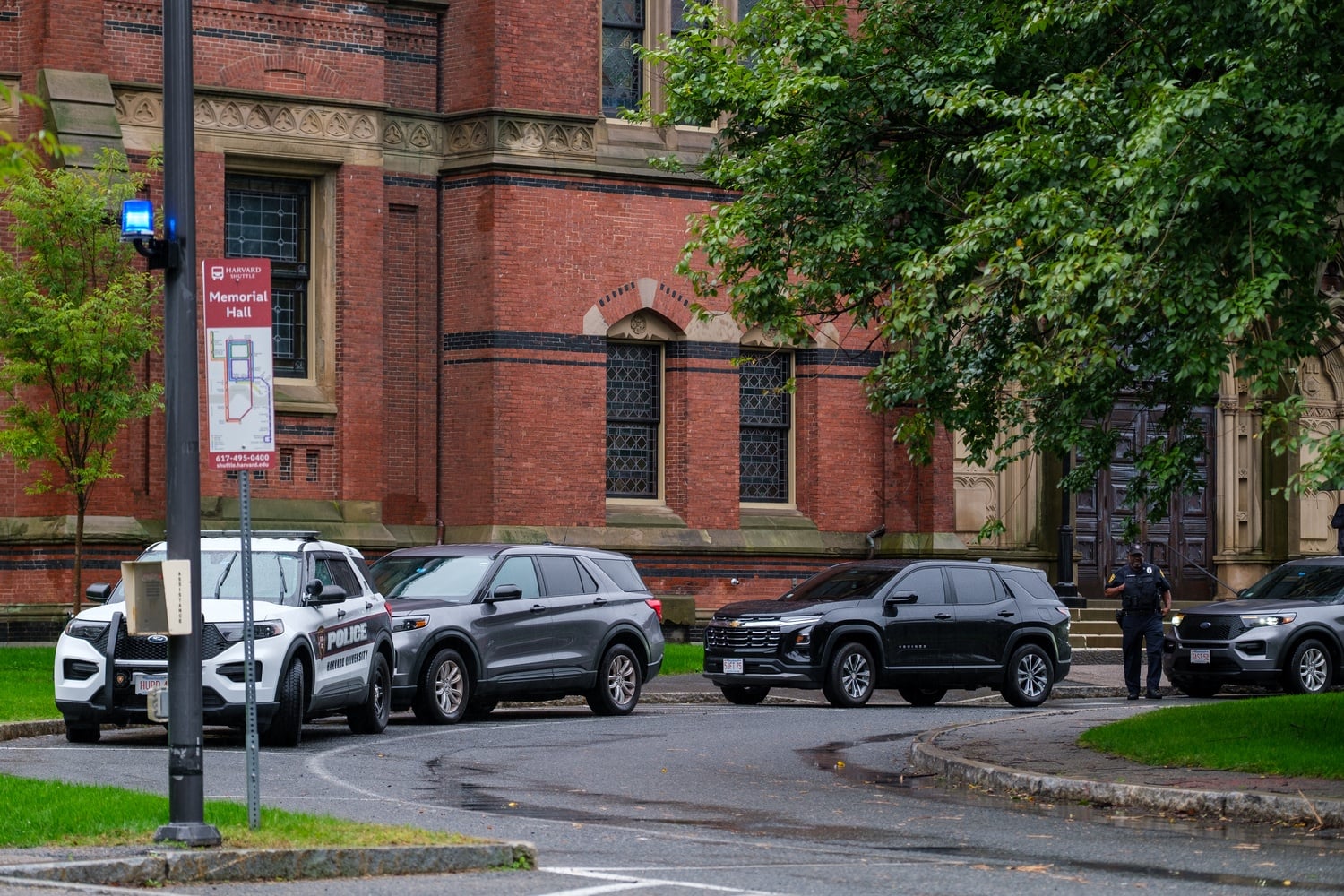
Last week, the Harvard University Police Department prompted students to shelter in place after a person brandished a knife near JFK Street. Three weeks ago, another series of emergency alerts urged students to avoid the area and shelter in place after a reported bomb threat at Memorial Hall.
But despite the security mandates, confusion over the reach and impact of the threats led to inconsistent decisions over whether courses in affected areas should continue as regularly scheduled. Emergency alerts need not be so nebulous — Harvard must implement a more coherent communications policy to ensure future safety.
On the morning of the bomb threat, University notices warned affiliates to avoid the area around Memorial Hall, Zimmer Hall plaza, and Memorial Church. Yet, I felt a sense of confusion pervade campus. It seemed largely unclear where it was safe for classes to run, and which specific buildings were impacted by the threat.
Some courses heeded the emergency warnings. LPS A: “Foundational Chemistry and Biology,” normally held at 9 a.m. in Zimmer Hall, was cancelled at 9:24 a.m. But others, like ECON 1010A: “Intermediate Microeconomics,” outright ignored ongoing risks. Students in the course were informed only ten minutes before class that despite HUPD’s instructions to avoid Zimmer Hall plaza, the lecture would continue as scheduled because Zimmer Hall itself was not closed.
This lack of clarity led to widespread student uncertainty. Some wondered whether to attend specific classes or which buildings to avoid. Other students, left without answers, felt forced to decide between risking their safety and their attendance grade. Such a choice should never be necessary.
To make matters worse, this confusion was far from an isolated incident. Across this semester, we’ve experienced a pattern of ambiguous emergency communications. During last week’s incident, Harvard directed affiliates near Brattle Street to shelter in place and others to avoid the area as authorities searched for the suspect. But what, precisely, constitutes near? Without clear boundaries, students are forced to extract implied meanings.
A similar chain of events occurred on September 1, the eve of the first day of classes: After an aggravated assault and battery, HUPD conducted an extended search for an individual armed with a machete. The alerts included the location of the search and a general directive to shelter in place, but failed to specify the geographic scope of that directive.
Harvard’s communication throughout these crises was at best mildly confusing, and at worst deeply dangerous. Thankfully, nobody was harmed in either incident — but should a future risk arise, the consequences of unclear instructions could have been far more serious. Student safety is dependent on clear and timely communications. While the University is excelling at prompt responses, the ambiguity of its directions leaves much to be desired.
The University must establish clearer protocols before communication failures put students in the face of avoidable harm.
Whether to hold class in light of a potential threat is a judgment call that should fall on safety officials and administrators, not teaching staff with incomplete information. A University-wide emergency necessitates a University-wide response; Harvard should never force individual instructors to make these incredibly difficult decisions. The College should also codify that when alerts instruct students to avoid certain areas, they must not be penalized academically for prioritizing their safety.
Granted, campus emergencies often vary in impact and scope. They rarely affect every building equally, rendering a blanket policy impractical. New protocols should focus on providing clearer communication, not establishing minute rules for every hypothetical.
One simple way to clarify procedures could be adopting a zoning system that divides Harvard’s vast campus into easily identifiable regions. The Quad and the Yard, for instance, could each constitute their own zones, while other areas might require more specific boundaries. Emergency alerts could then quickly identify impacted zones, allowing students and staff to easily understand whether their classroom falls within a region of concern.
Of course, HUPD should continue disseminating emergency alerts as quickly as possible without delaying to address academic logistics. Instead, Harvard should already have preset procedures for faculty whenever an alert identifies an affected zone.
Internal guidance for professors could detail specific protocols, such as when to relocate, transition to Zoom, or cancel classes altogether, depending on the nature and gravity of potential incidents. This quick fix would spare faculty the guesswork.
Last year, the Editorial Board critiqued Harvard’s safety preparedness after unclear emergency alerts. Clearly, our existing systems have long been lacking. It’s unfortunate that the University has consistently failed to meet the mark — but a few simple changes could go a long way.
Jacob R. Wolmetz ’30, a Crimson Editorial comper, lives in Wigglesworth Hall.
Want to keep up with breaking news? Subscribe to our email newsletter
Have a tip for The Crimson? Share it confidentially