Harvard Should Adopt the Chicago Principles
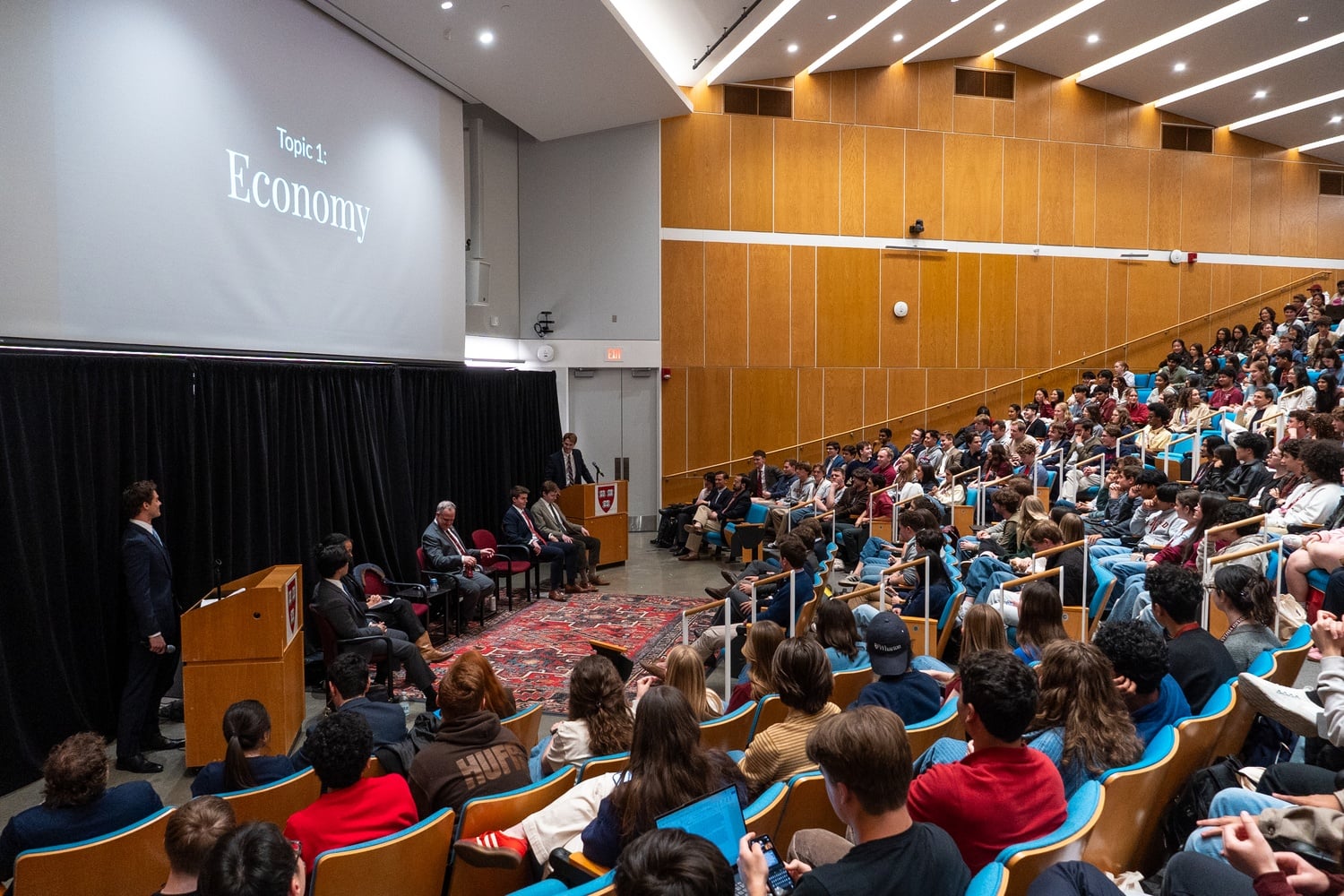
Harvard’s made a lot of progress on free speech — but there’s still a ways to go.
Last month, the Foundation for Individual Rights and Expression released its annual college free speech rankings, and for once, Harvard had some good news. The University ranked dead last in 2023 and 2024 before climbing just a handful of spots last year. But this year, Harvard jumped to 71st out of 261. FIRE in part credits Harvard’s defense of the free expression of its students despite demands from Washington and notes that students feel more comfortable expressing controversial views than in previous years.
FIRE’s rankings aren’t gospel, but they suggest that Harvard is moving in the right direction. To make that progress durable, the University must adapt its written policy on speech.
Harvard’s existing policies do affirm the importance of free speech, but they leave its place among the University’s competing values unclear. By putting speech beneath a broad standard of civility, some of Harvard’s key policy documents leave students guessing when speech takes precedence. Adopting the Chicago Principles, in line with FIRE’s recommendations for Harvard, would replace that guesswork with a clear expectation of open debate.
Written by a University of Chicago committee in 2014, the Chicago Principles commit a university to the “broadest possible latitude” for debate. They hold that it is not the university’s role to shield anyone from ideas they find offensive, and that concerns about civility shouldn’t justify shutting down discussion.
According to FIRE, more than 120 schools have adopted this model policy, including Princeton University, Dartmouth College, Massachusetts Institute of Technology, Stanford University, and just this summer, the University of Southern California. The University of Chicago itself has consistently ranked among the nation’s best universities for free expression, placing first overall in FIRE’s latest rankings and first for students’ perceptions of administrative support for free speech.
As for Harvard, the Faculty of Arts and Sciences has its own free speech code, adopted 36 years ago — the Free Speech Guidelines. They say a lot of the right things, expressing that the FAS does “not permit censorship of noxious ideas.” And yet, the guidelines do not even apply to the classroom, where the “agenda of discourse” is left to the teacher. Beyond that, the guidelines spend most of their time detailing minute procedures for responding to event disruption, hence framing free speech largely in terms of when it may be restricted.
The Chicago Principles are clear that civility and mutual respect can never justify closing off speech. The FAS guidelines aren’t as protective of potentially offensive remarks: though they claim that free speech is “uniquely important,” they also invoke “obligations of civility and respect for others” that result in greater interpretive ambiguity.
The rest of the University relies on a document that also lacks a protection of offensive ideas. The University-wide Statement on Rights and Responsibilities, first adopted in 1970, protects the right to demonstrate and advocate, but focuses significantly on conduct that isn’t allowed — such as obstructing essential activities, harassment, property damage, and building occupation — at the expense of saying what is.
Beyond that, other schools write their own rules. For example, Harvard Law School and Harvard Kennedy School each have protest and dissent policies, and the Harvard Graduate School of Design has its own code of community values. The result is a patchwork that leaves room for straying from a commitment to free speech, depending where you are.
This heterogeneity leaves Harvard’s progress vulnerable. A single high-profile incident at the University can chill speech far beyond the people involved.
For example, recall how the former director of Human Rights Watch Kenneth Roth had his fellowship appointment vetoed by the then-dean of HKS in 2023. Even after the decision was reversed, it stoked a lasting sense that Harvard was closed to open discourse on controversial issues.
Moments like these demonstrate the limits of a patchwork of insufficient policies. Clearer, university-wide principles would give Harvard a baseline to rely on when free expression becomes especially controversial.
The Chicago Principles offer exactly that. First, the principles would extend free speech protections to the classroom, which the FAS guidelines, for example, explicitly exempt. The classroom is arguably where intellectual growth primarily occurs, so, an absence of an explicit promise for the classroom is a disservice to maximizing academic freedom.
An internal FAS survey found that over a third of graduating seniors in 2024 did not feel comfortable expressing controversial opinions in their courses, underscoring the need for more powerful speech protections that normalize a culture of open expression and dissent.
In doing so, the principles would protect free expression through a clear, narrow set of exceptions and apply that standard consistently across all of Harvard’s schools. A patchwork might be tolerable if Harvard’s continued progress was guaranteed. But, it isn’t.
None of these efforts would remove the limits Harvard already enforces against true threats, harassment, and obstructing others from speaking or hearing. But it would be clarifying its priorities, ending the guesswork, and making free speech the default.
The move would carry symbolic weight too. At a time when Washington or donors are pressuring universities over what happens on their campuses, a formal commitment would signal that Harvard protects open debate as a matter of principle.
For a university that already professes a commitment to the free exchange of ideas, adopting the Chicago Principles should be an easy choice.
Ava M. Ribaudo ’27, a Crimson Editorial editor, is a Government concentrator in Leverett House.
Want to keep up with breaking news? Subscribe to our email newsletter
Have a tip for The Crimson? Share it confidentially