Making Room for Dance
The idea of Dance in Public was intriguing enough, but actually dancing in public is another matter entirely.
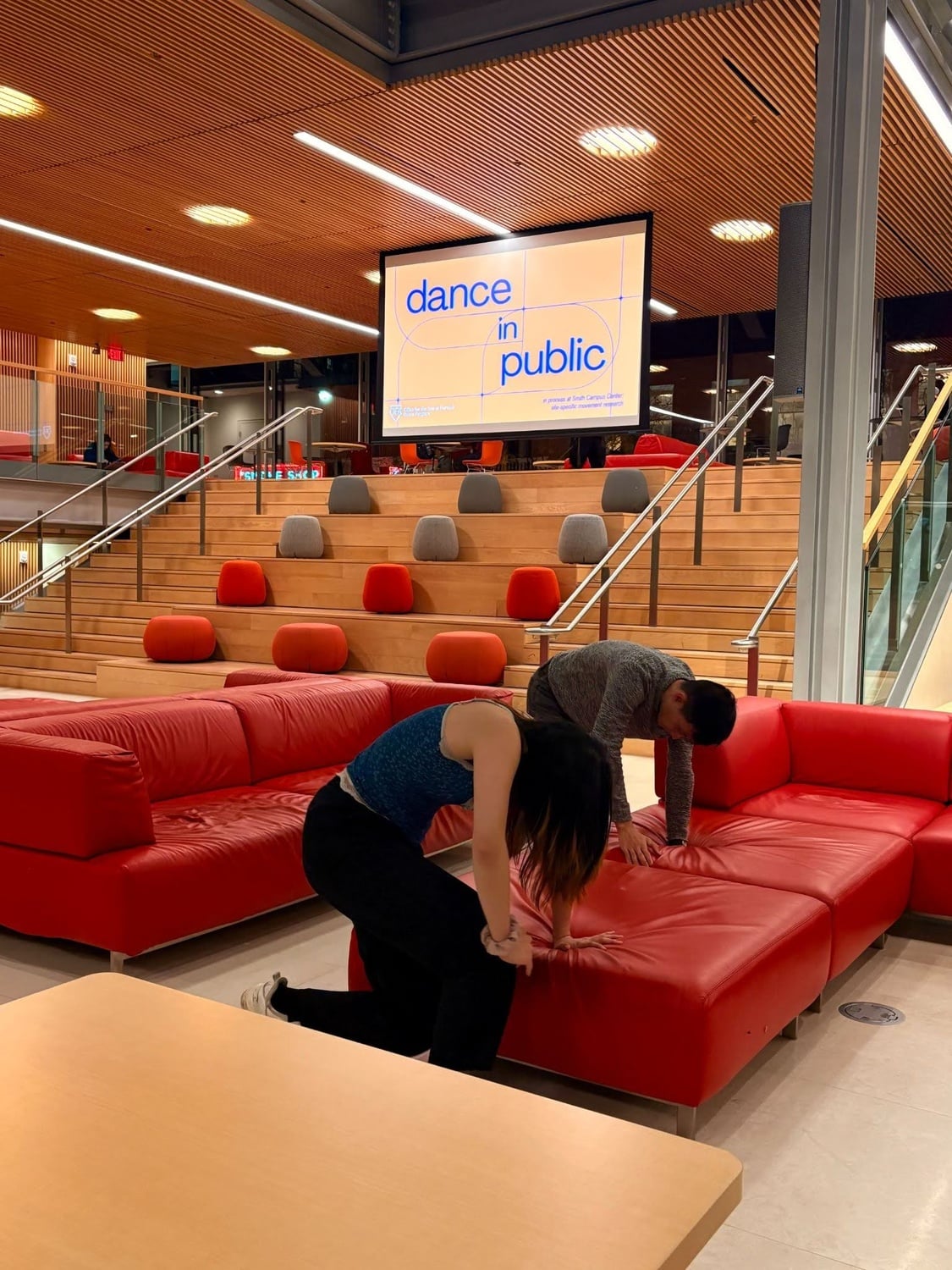
re you guys doing yoga or something?”
Three students have wandered over to our group at the pool table. I am crouching, stretching, and contorting myself around the table, trying to cover a billiard ball with my body. Whatever they expected to find in the Smith Campus Center tonight, I doubt it was this.
I am a little surprised to find myself here, too. First off, I am not a dancer in any way. I get self-conscious expressing myself too boldly in front of others. I come equipped with two left feet and the rhythm of a malfunctioning metronome. The idea of Dance in Public was intriguing enough, but actually dancing in public is another matter entirely.
Dance in Public is a year-long pilot initiative in which students conduct site-specific movement research in public spaces on and near campus, organized by the Office for the Arts at Harvard’s Dance Program. For this inaugural year, the initiative is being led by two artists: Kelvin Vu, a dancer and urban landscape architect, and Lonnie A.O.N. Stanton, a dancer who specializes in site-specific work. A core cohort of six undergraduate fellows commits to the full year, but others can register for individual labs.
So, on an October evening, I show up to find out what dancing in public actually looks like.
The lab begins on the 10th floor of the Smith Campus Center, with chill guitar music playing and a view of the night skyline. I arrive a bit before its 6:30 p.m. start to survey the environment. Standing there, seeing so many people around, I begin to second guess my participation.
The room, at least, is tranquil and positive, and so are we, its temporary intruders. We loosen our bodies by reaching up, waving our arms, reaching out, bending our knees, and wiggling our shoulders. I feel like limp spaghetti, an inflatable tube man waving in the wind. Vu’s instruction to melt our muscles and let our bones swim freely is more poetic than any of my comparisons. We bounce from the knees, then the hips, the ribs, the chest, the shoulders, and the head. When we reach toward the ground, I am amazed and a little horrified by my own inflexibility and creaking bones.
The theme of the night, we’re told, is blending in and standing out.
Our first task is to find three crevices to fit ourselves into and explore the ways we can occupy those spaces. I find an alcove and try contorting my body to fit.
Around me, other participants fold their bodies into narrow gaps, arch their backs, and stretch their limbs as they find possibilities everywhere from beneath the foosball table to the windowsill.
Enter the three students, attempting to play pool.
Their question of whether we are doing yoga briefly punctures the strange little world we have created. Outside our exercise, the Smith Center remains the Smith Center. People are still playing pool, studying, and moving through the building. The furniture and walls are familiar; what we are finding to do with them is less so.
Joy An ’27, an undergraduate fellow in Dance in Public and director of the Harvard-Radcliffe Modern Dance Company, later describes the question that drew them to the initiative: “How can we be in the Smith Center, which is the space that we’re all so familiar with, that we’ve studied in a million times, and turn it into something unexpected and new and fresh?”
Next, we move to the wall, where our task is to explore its surface by finding some way to traverse across it. There is no choreography to memorize, no sequence of steps to get right: we are instead supposed to find our own ways of moving across the space.
One fellow — in jeans, somehow — begins handstanding her way along the wall, eventually working her way into splits.
I am so focused on another dancer’s graceful movements that the background begins to fade away. For a moment, the wall stops being a wall and becomes a canvas for her body. So occupied with watching everyone’s creative interpretations, I end up way behind. Flashing from my awe-stricken state back to reality, I realize I am not built for this. My contribution to the exercise involves inching along the wall and attempting to look intentional about it. I make my way along the wall, concentrating on each movement, trying to paint the wall’s surface with my body. When I finally finish, the group claps, for which I am absurdly grateful.
Nobody has pointed out that my movements are incredibly stiff and unartistic. The exercise does not require me to be the best dancer in the room but rather to try something and see what happens. This is a relief, because one of the best dancers in the room — in the world, perhaps — is apparently capable of doing splits in denim.
Throughout the process, we catch a few giggles, but nobody seems afraid to embrace a little self-expression. (Well, except for me, when someone from my class walks by and stares.) In our bright outfits, we become part of the mural.
Stanton, who teaches contemporary dance and fundamentals of ballet at the Harvard Dance Center, says dancing in a public space asks performers to respond to their surroundings. A ballet-trained dancer might draw on familiar technique while navigating a chair, a wall, or an awkwardly positioned piece of furniture, allowing the environment to guide the movement rather than aiming to reproduce a particular line or pose.
Stanton explains that public dance also changes the relationship between the performers and their audience. “In a theater, we can create the lighting with a lighting designer. We can really say we want the spotlight on this dancer at this exact moment,” Stanton says. “And out here, it’s up to the sun or who has lights on or off in a space, right?”
On the 10th floor, there is no curtain to signal when the performance begins or ends. Stanton puts it more simply: “people can leave, people can film, people can read and then go back.”
The audience has a choice. So do I. I can spend the entire evening worrying about how ridiculous I look, or I can try to pay attention to what my body is doing. I am slowly learning that the second option is much more interesting.
Next we learn to frame — to watch and shape what someone else is doing. Vu explains why that is harder than it sounds. “For someone to be able to frame, which means observe and to react and make decisions and be aware of the space around,” he says, “it’s a lot to do at any one point for anybody.”
We carry the experiment to the Collaborative Commons, where a few students look up from their work as we arrive. This time, having exhausted my lifetime supply of coordination, I only observe. I watch the dancers as they incorporate the objects around them into their movements. One dancer heads for the hand sanitizer. The two dancers framing him follow his lead, incorporating the motion into their own movements. Soon, the three are taking turns getting sanitizer and twirling around. I had not anticipated the choreographic potential of hand hygiene.
Meanwhile, the rest of the room continues to operate as though it has not received the memo that we are conducting an artistic experiment.
When we speak afterwards, An says the experience has changed how they observe the places they enter. “When I walk into a room now, I’m a lot more aware of what people are doing, where people are, what the patterns of movement are,” An says.
Vu, inspired by his background in architecture and landscaping, approaches the project with a similar interest in how people occupy space. “It also just makes me think about how we make space, right? Like how we make space for certain bodies, for certain movements?” he asks.
It is a question that would have gone over my head until I spent an evening trying to fit myself into an alcove. A room might physically accommodate a body without making that body feel as though it belongs there. Certain activities seem natural in certain spaces, while others immediately attract attention. A student hunched over a laptop in the Commons does not attract much attention. A student waltzing across the floor does. Yet, neither is necessarily doing anything wrong.
For our final exercise, the dancers weave through a room still occupied with its evening routines. Students study and pack up; a vacuum cuts through the soft music. Some people glance over, while others lift their phones to film. Attention gathers around the dancers, then drifts back to the work at hand.
Stanton notices the filming too. She later tells me that this event was the first workshop she had noticed passersby filming. She says she has become increasingly interested in the sociology of public movement, including what happens when people watch and when they do not.
There is something appealing about the idea that a public space can accommodate a little disruption without requiring everyone in it to participate. The students in the Commons do not need to abandon their assignments for our exercise to matter. The pool players do not need to join us around the table. We can share the room without sharing the same activity.
By the end of the session, I am thinking less about whether I have managed to blend in or stand out and more about how those categories are created in the first place. Why does a person studying in the Commons seem ordinary while a person dancing there seems out of place? How much of that distinction comes from the space itself, and how much comes from what we expect people to do in it?
I still can’t dance, and I leave no more flexible than I was when I entered. But by the end of the night, I am considerably more aware of the space around me.
So, were we doing yoga? Not quite. But maybe that question was the point.
In a place where we expect movements to fit a familiar category, the dancers test what else the room can hold.
Want to keep up with breaking news? Subscribe to our email newsletter
Have a tip for The Crimson? Share it confidentially