Grading Is Dead, and AI Has Killed It
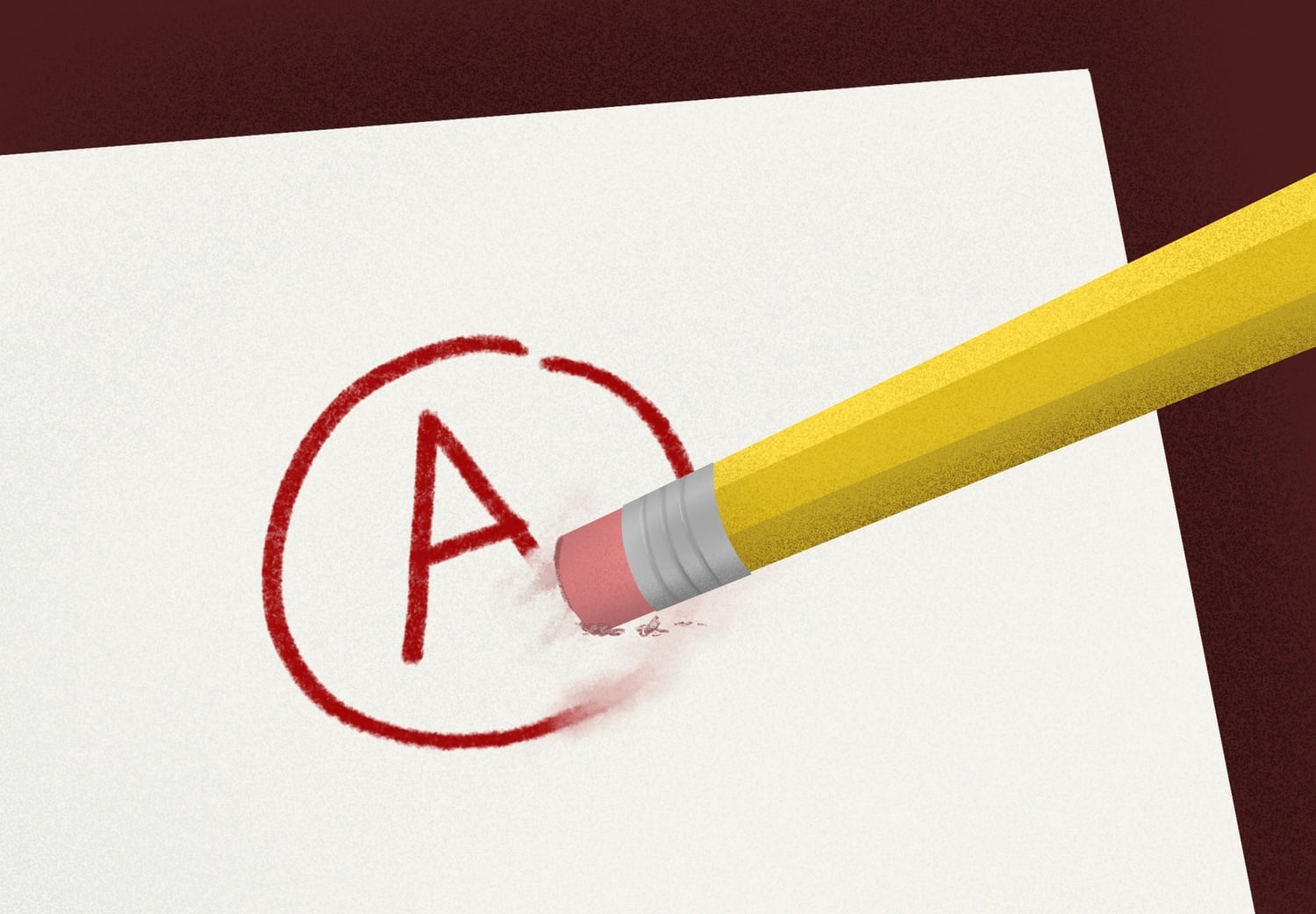
Artificial intelligence will soon deliver to grading its long-awaited coup de grâce — if it hasn’t already.
Much ink has been spilled in our pages over Harvard’s looming 20 percent cap on A grades. But few have recognized the key consequence of AI for grading: When A’s become a rare commodity and cheating is easier than ever, many will resort to “artificial” means of securing top grades.
What, then, is to be done? Open the floodgates. Lift restrictions on AI use in all classes. Then, radically reshape grading to assess most classes pass-fail.
Such drastic measures may seem excessive, but in reality, they are the logical consequence of two indisputable facts.
First: Never has it been easier to cheat. As Harvard College Dean David J. Deming has noted, it is now effectively impossible to tell if text has originated from a large language model. Can’t get ideas for a paper due at midnight? Your AI buddy starts whispering in your ear: “Prompt me. You know you want to.” Your teaching fellow will be none the wiser.
There are no good solutions to this AI menace. In-person exams and oral defenses have their place — but they aren’t practical for many courses. Take-home projects and essays are an irreplaceable way of honing and assessing the skills a liberal arts education is meant to cultivate. MIT’s recent report on AI and the future of education notes that such projects prove students’ capacity for “difficult, independent, and thought-intensive problem solving, not just acing exams on paper.” Unfortunately, these projects are exactly those most prone to AI contamination.
The second fact is that, for better or worse, people prioritize their primary goal. At Harvard, that’s rarely learning.
Indeed, Harvard students often prioritize careers over classes. When learning becomes merely a means to an end — the grade — any actual learning is incidental. The role of grade point averages in job recruiting and graduate school admissions deserves some blame for this problem — and is certainly beyond Harvard’s ability to fix.
Students are stuck between Scylla and Charybdis: Use AI or be left behind. This dilemma is made far more acute by the looming cap on A’s. Rather than reducing pressure on students to compete for A’s, a cap will exacerbate the problem. Under such circumstances, we can expect students to resort to using AI wherever they can.
The MIT report puts it well: “Students who are set on maximizing their GPA have a strong incentive to use whatever means they feel are most effective to achieve that goal. Rationing top grades would intensify the temptation to cut corners on actual learning by increasing reliance on AI.”
One popular suggestion is to simply ban AI. But it is impractical to insulate every assignment in every class from AI contamination. Paired with the impossibility of AI detection, this leaves us with no good options. But there is a least bad option: unrestricted AI use in all classes.
That is not to say that we should encourage AI as a substitute for learning. But it is naive to forbid it. One might argue AI use is antithetical to a liberal arts education. I don’t disagree. Worse, though, is a system that dangles a temptation in front of students, a system that punishes honesty and a sincere desire to learn.
How, then, can we assign grades? In many cases, we won’t!
Once we accept that allowing AI use is the only tenable future, grading as a concept becomes mostly useless. When students have the option to surrender their thinking wholesale yet maintain the illusion of having learned, assessment fails to be an assay of understanding, mastery, or any other target we might devise. For bedrock classes like Statistics 110: “Introduction to Probability” or Economics 10: “Principles of Economics” that can easily be graded solely on exams, letter grading still makes sense. But for everything else — from Irish folklore to string theory — it’s time to switch to pass-fail.
There are valid concerns that employers and graduate schools would be unable to judge who is competent without grades to reference. After all, studies show a positive correlation between GPAs and future success. That may have been true in the past. But in a world of limited A’s, an A signifies willingness to use AI rather than competency in most cases. Recommendation letters, demonstrated research, and technical interviews remain criteria to identify the most qualified candidates.
I am not pleased by these conclusions. But it is an inevitable consequence of the AI age that learning will suffer for those who take the easy way out, regardless of which policy we implement, so I cannot envision a better alternative.
And there is one silver lining. All of us, free from the constant need to keep pace with our peers, might instead see learning as a genuine exploration of our interests.
Evan B. Tsingos ’27, a Crimson Editorial editor, is a joint Physics and Mathematics concentrator in Adams House.
Want to keep up with breaking news? Subscribe to our email newsletter
Have a tip for The Crimson? Share it confidentially