From Speech to Debate
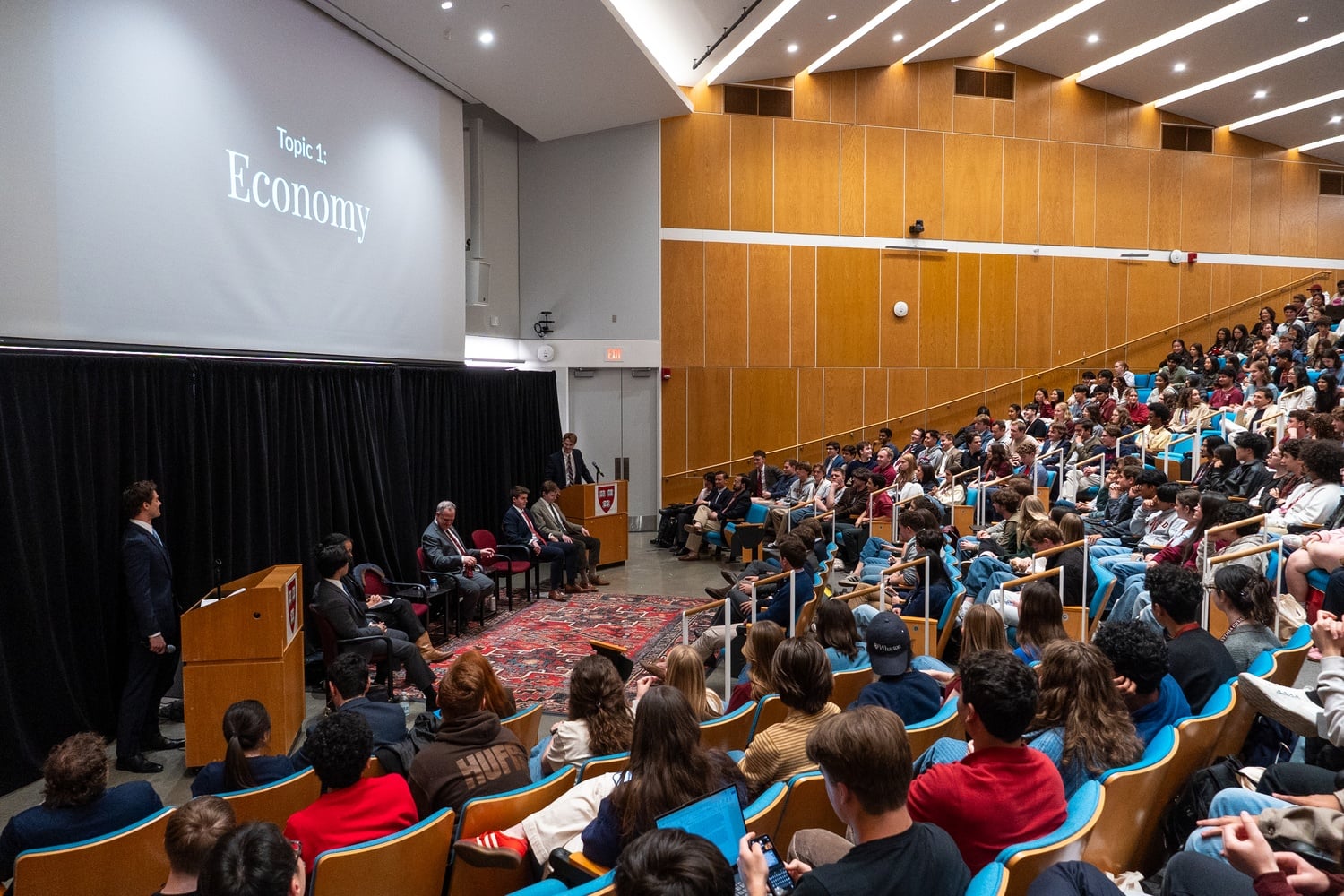
Last week, Steven Crowder debated Harvard Law School professor Randall L. Kennedy. The event drew attention for obvious reasons: Kennedy is one of Harvard’s most prominent scholars, while Crowder is one of the country’s most recognizable conservative commentators.
Amid longstanding concerns about a lack of ideological diversity and self-censorship when it comes to campus discourse, this debate was a step in the right direction for free speech. Regardless of one’s views on the issues, it deserves our praise, celebration, and most importantly, our emulation.
Last semester, I wrote that Harvard must create more opportunities for sustained public speech for students. I argued that the University should revive the tradition of oration because speaking publicly requires a unique set of skills distinct from writing, ones especially important in an age when artificial intelligence has diminished the value of polished prose.
But speech is only the beginning. It is no fix to a homogeneous culture of discourse. A speech can be delivered without ever encountering an opposing view, especially when it is given in front of an audience already inclined to agree.
Debate, however, demands more of us.
Crowder and Kennedy showed this to be true. Instead of writing essays, articles, or tweets articulating their beliefs, the format forced them to address each other and a live audience, listening, reacting, and clarifying live.
Speaking in front of someone who disagrees with you makes you immediately answerable to that person. Opponents force you to identify assumptions you didn’t know you were making, explain ambiguities in your language, and fortify your reasoning. Even details such as cadence, responsiveness, and presence subtly shift the meaning of your argument. They force you to distinguish the believable from the defendable.
A debate also helps participants and audience members alike refine what they actually believe. Reciting various arguments is no longer enough because you must uphold them in face of your opponent’s logic.
The famous bar scene in Good Will Hunting captures this distinction well. When Matt Damon’s Will Hunting intervenes in a confrontation, he tells the man trying to embarrass his friend that all he has done is “plagiarize” others’ ideas on American history and chastises him to develop thoughts of his own.
Putting this principle into practice requires us to distinguish two ideas. Debate is not endorsement. A professor can debate someone without endorsing the opponent’s worldview. And even when one does not endorse another’s view, what better venue than a debate? The forum gives an opportunity to challenge the idea one is concerned with.
It’s relatively easy to defend free speech in the abstract. It is harder to engage seriously with the views, rhetoric, or methods one dislikes. That is why Kennedy and Crowder both deserve credit for participating in this debate. They were willing to engage publicly with someone who commands a very different audience and operates in a very different media environment. They were willing to put their views in a setting where they could be questioned rather than simply presented. They demonstrated confidence that their ideas could withstand scrutiny and they were willing to subject them to it.
This is the kind of intellectual engagement that higher education should require.
Universities are uniquely equipped for productive disagreement. They bring together people with different backgrounds, disciplines, and convictions, then give them the time and resources to pursue difficult questions. The purpose of that environment is to prepare students to leave college more capable of articulating what they believe and engaging seriously with ideas that differ from their own.
Ideally, the Harvard education should contain a progression from speech to dialogue to debate. This turns students from passive consumers of arguments into practitioners of reason, ones capable of making claims, defending them, and responding to arguments that challenge them. Without debates, students are only partially prepared for that final step.
This is why the revival of oration is only half of the project. It ensures students can present and communicate their ideas, but a complete education demands more. Harvard must create more occasions where students and professors have to answer one another in person.
That requires exposure and practice. Offer more debates inside the classroom, like Michael J. Sandel’s Socratic method. Host more public conversations between professors with different perspectives. But remember that it matters that the interlocutors actually disagree — to accomplish this, we must embrace ideological diversity.
The Kennedy-Crowder debate offered a model of something Harvard should see more often: people with very different perspectives agreeing to make their case to their opponent and audience.
A university should not only teach students how to speak, but how to be answered.
Catherine E.F. Previn ’27, an Associate Editorial editor, is a Government concentrator in Lowell House. Harvard Law School professor Randall L. Kennedy is her thesis advisor.
Want to keep up with breaking news? Subscribe to our email newsletter
Have a tip for The Crimson? Share it confidentially