A Paid Strike Is Unserious
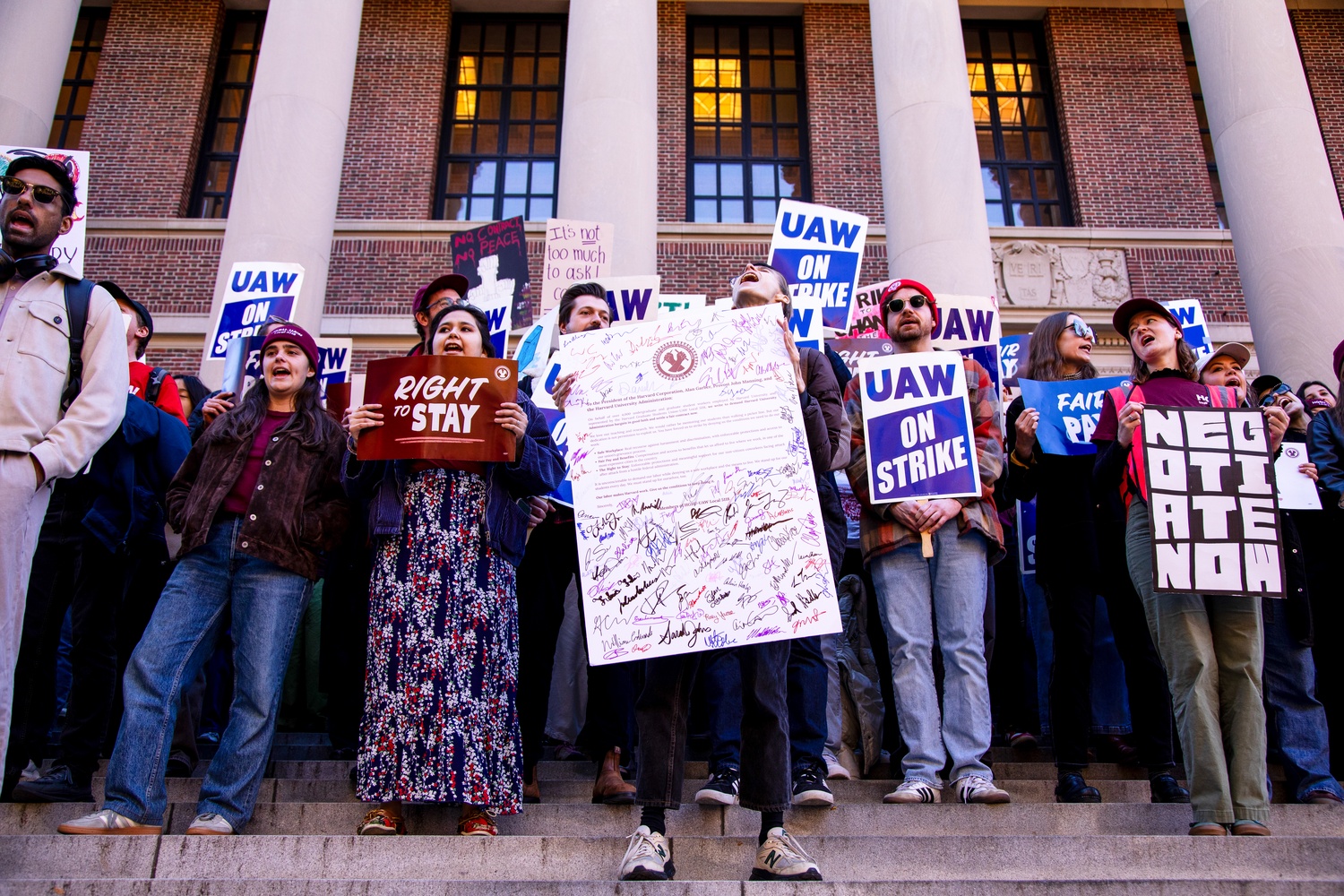
The Harvard Graduate Students Union-United Auto Workers has been on strike for two weeks. By definition, striking workers do not perform their normal duties as employees of the University. Yet bizarrely, the union seems bent on arguing that Harvard ought to continue paying them anyway.
In my four semesters as a teaching fellow, I have found the role to be a great privilege. I work closely with faculty members I like and respect, gain experience leading a classroom, and help shape students’ education. Since graduating from my master’s program last spring, I have been represented by Harvard Academic Workers-United Auto Workers rather than HGSU. As a result, I have until HAW’s deadline of November 10 to decide whether to join the strike. I have monitored the HGSU strike closely in making this decision.
What I have seen has led me to doubt the integrity of the strike entirely.
This semester, I will earn $13,150 to teach two sections of a General Education course. The University expects that I will spend 14 hours per week doing this work. That breaks down to roughly more than $60 per hour. This is not news; the pay rate for TFs is publicly available, and I have always been very satisfied with my compensation for this role.
A major consideration in deciding to strike is whether I am sufficiently committed to the principles of the strike to sacrifice my pay. I never entertained the thought that I could still be paid my usual salary while on strike; such an arrangement seemed to me incompatible with the standard purpose and function of a strike.
Thus I was alarmed to learn that some HGSU members are encouraging striking workers to not report hours not worked to the University — and to thereby continue collecting their pay. Picket lines and protest signs are powerful tools for espousing the principles of a strike, but what is their worth if striking workers are not also willingly demonstrating a tangible commitment to those espoused principles? Forfeiting pay is exactly what makes a strike a tactic of last resort, and a formidable one.
One day before the strike began, the University’s Office of Labor and Employee Relations emailed salaried student workers and informed them that those striking were required to report each day they did not work, and that doing so would entail not being paid for that time. HGSU leadership has informed striking workers that there is no legal obligation to comply with this University requirement, which they construe as a “disgraceful” way of weakening the strike.
Forfeiting pay is par for the course in any strike, and a reasonable consequence of a striking worker’s actions — a consequence workers ought to expect and prepare for when considering a strike. HGSU’s own website obfuscates this common practice of striking workers going unpaid, contending that the University is “not required to cut the pay” of striking workers but may do so “to intimidate or otherwise coerce a worker to continue working.” But how can it be that not paying a worker for work not performed is intimidating or coercive? It would be absurd to insist Harvard do otherwise.
Of course, some of the fault lies with Harvard for implementing a payroll procedure that puts the onus on striking workers to report that they are indeed on strike. Such a system rewards nonaction on the part of striking workers, who have committed to not responding to work-related emails or performing work-related tasks — which some may think includes said reporting.
Nevertheless, how can those on strike take themselves and their strike seriously while continuing to collect pay for work not performed? Such a stance threatens the perceived credibility of their actions. A reasonable observer might wonder if those on strike are sufficiently committed to their own stated cause.
While some strikers continue collecting their pay, the strike nevertheless demands considerable sacrifice on the part of faculty and undergraduates — sacrifices that they did not ask to make and do not stand to directly benefit from. Faculty must now scramble to rearrange course plans and assume greater teaching and grading responsibilities, and undergraduates must adjust to lost classroom time and learning experiences in a semester already rife with anxiety and uncertainty.
So I ask those HGSU members who continue to collect their usual pay: How can you ask faculty and undergraduates to stand in solidarity with you and make their own sacrifices when you are not making much of a sacrifice yourself?
C.J. Passarella ’23, a former Master of Theological Studies student at Harvard Divinity School, is a Teaching Fellow for General Education 1025: “Happiness.”
Want to keep up with breaking news? Subscribe to our email newsletter
Have a tip for The Crimson? Share it confidentially