You’re Hurting Your Own Cause
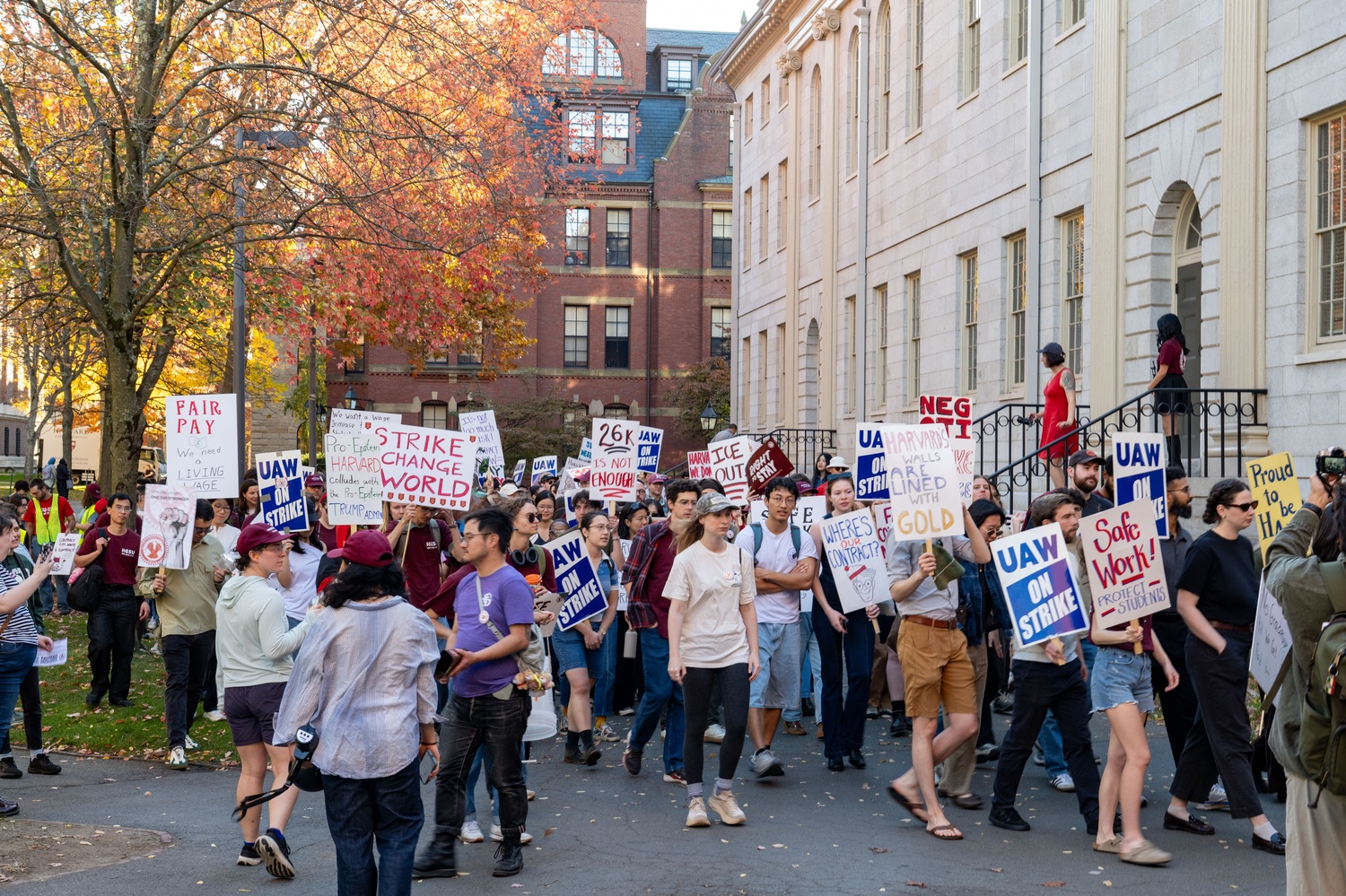
Let’s say you’re driving home and protesters in support of climate legislation shut down the street, extending your commute. It’s quite reasonable to feel frustrated, to even honk or curse. You might wonder why of all days, of all streets, the protesters had to choose this one. If you instead decide that their cause is now wrong, you’ve likely made that judgment on a faulty basis.
When evaluating a political demand, the relevant criteria are its merits and demerits. Why would your experience of inconvenience change your view on the proposal?
Yet if popular Sidechat posts are any evidence, countless students have made that leap.
After the graduate student union picketed a conversation between a famous cellist and comedian that took place in Sanders Theatre, one post read, “After ruining that wholesome event last night, I think it’s fair to say the grad students deserve to be paid less.” Another declared that “30k and a free Harvard degree is a privilege. Being obnoxious picketing tonight was a disaster for the union and made me lose any support I had for this strike.”
Simply put, personal inconvenience is given too much weight in our judgments of political causes and the tactics used to advance them.
A more defensible position could be that the protests’ “optics” are bad. Indeed, one Sidechat post insisted that the union was “losing an optics war.” It is true that it’s not worth needlessly alienating Harvard affiliates who might help by joining protests or signing petitions.
However, like any union, the primary leverage of the Harvard Graduate Student Union-United Auto Workers is that they can disrupt their employer’s normal functioning. Among the University’s functions is to educate undergraduates and host speakers.
That means that protestors’ disruptions can and will come at a cost to others. It’s easy to welcome a canceled section you didn’t want to attend in the first place — it’s much harder not to resent the cancellation of a celebrity speaker event. The mere fact that an action inconveniences undergraduates does not necessarily mean it is a mistake. Strikes are, in fact, supposed to be inconvenient.
If our support only extends to actions that leave us undisturbed, it’s worth asking how deep our support was to begin with.
Typically, criticism of tactics, encapsulated in the phrase “you’re hurting your own cause,” comes from people who are not organizers themselves. For these critics, the protest movement is often expected to do everything in its power not to alienate them, so that they feel as little personal cost supporting — if not ignoring — the movement as possible.
They might even expect rewards for their support. As one post with over a thousand upvotes reads, “Wait why doesn’t the union just add no grade cap to their demands? Boom instant support from all undergrads.”
There are, of course, legitimate reasons to criticize tactics or reconsider support for an organization. But not all of these claims are pointed criticisms of efficacy — which require more knowledge about why an action was taken than that which a typical audience possesses. For example, few undergraduates know the state of bargaining as well as union organizers do.
Assessing political action requires considering its purpose, the circumstances and alternatives available, its likely effects, and balancing risks with rewards. Students’ inconvenience is certainly a factor in the assessment, but it is rarely the sole determinant.
All that to say, the fickleness of student opinion speaks poorly of us.
During the 2024 Gaza Solidarity Encampment in Harvard Yard, we recall how the encampment seemed to enjoy widespread undergraduate approval. That was, until University President Alan M. Garber ’76 indicated it was possible that Commencement would not proceed as planned given the protests’ physical presence.
Though nothing had changed about the protesters’ actions, student opinion seemed to crater within a day, after a single email.
Yet, eleven days later, opinion about-faced again when 13 student protesters were prevented from graduating. In defiance, over a thousand graduates walked out of the ceremony.
Our political commitments may come into conflict with our other values, requiring us to adjudicate between them. An inconvenience may even reveal an unforeseen cost of supporting a cause. But it is callous to alter one’s values because of an inconvenience.
Indeed, our politics are easiest to maintain when they ask nothing of us. When we do little other than react to inconvenient circumstances, we do our beliefs — and ourselves — a disservice.
Zakiriya H. Gladney ’27, a Crimson Editorial Chair, is a Statistics and Social Studies concentrator in Dunster House. Andrew Q. Kang ’27, a Crimson Editorial editor, is a Statistics and Social Studies concentrator in Dunster House.
Want to keep up with breaking news? Subscribe to our email newsletter
Have a tip for The Crimson? Share it confidentially