Former DOJ Civil Rights Chief Says Division Exploring AI Use in University Admissions Reviews
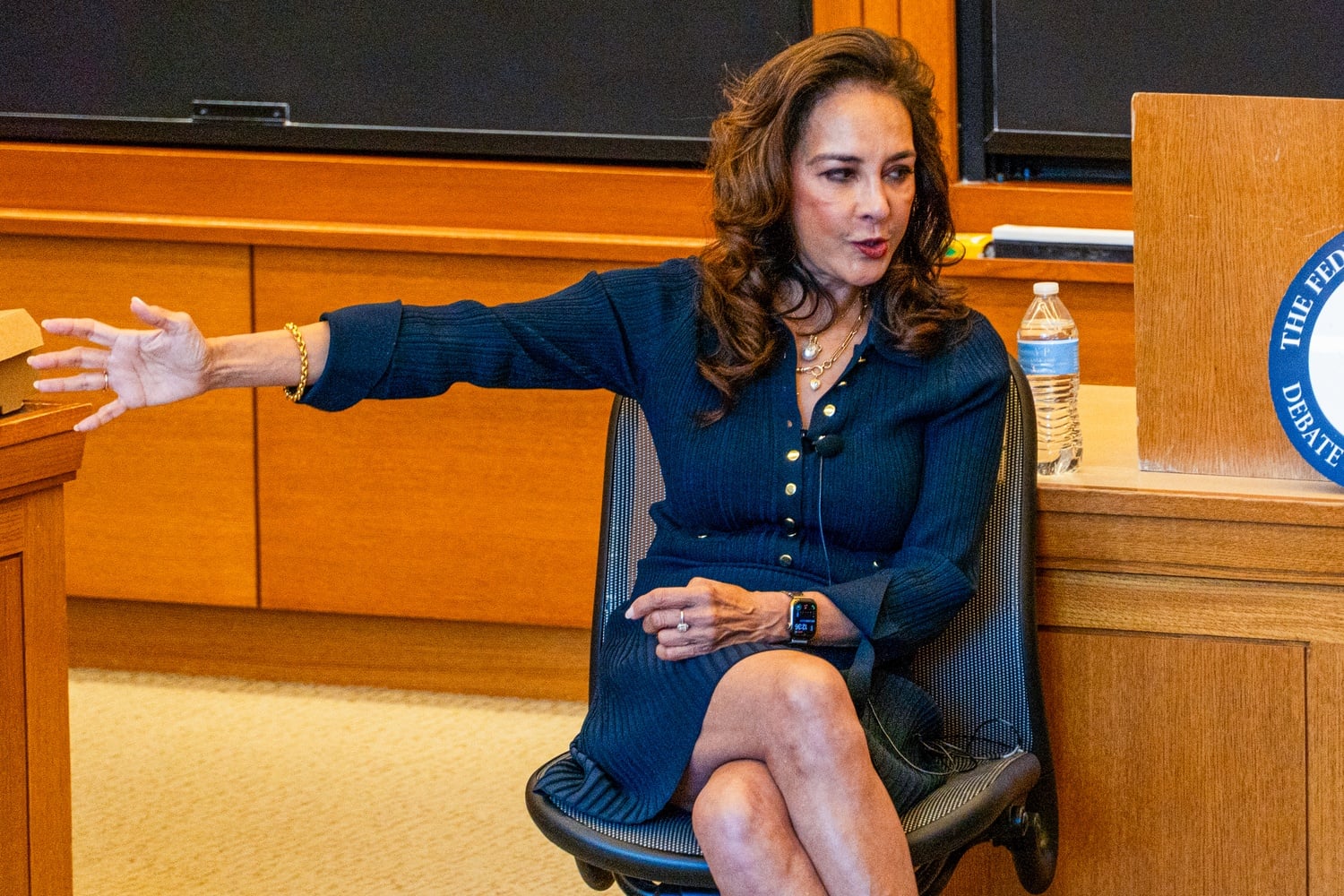
The Department of Justice is exploring the use of artificial intelligence to analyze admissions data as part of its investigations into alleged discrimination, former Civil Rights division head Harmeet K. Dhillon said Monday.
Dhillon said the division has traditionally relied on statisticians to analyze the data, but staff are now exploring the use of AI “within the bounds of government policy.” She did not specify what AI tools the department was considering or how they would be used.
“Every quarter data rolls in from dozens of universities now because I opened up over 100 investigations into American universities,” Dhillon said. “Many of them are cooperating with us, and one by one, they’re all cooperating with a couple of exceptions.”
The remarks came during a fireside chat with the Harvard Law School Federalist Society chapter, titled “Civil Rights and the Rule of Law: DEI, Free Speech, and the Trump Administration” — less than two weeks after Dhillon announced her resignation from the post following the midterm elections.
Dhillon told division staff that she planned to return to private practice and had informed President Donald Trump of her plans in early October. But CBS reported that Trump had expressed a desire to fire Dhillon, citing concerns that she hadn’t been forceful enough during an October interview with “60 Minutes.”
During her 19-month tenure, Dhillon was a central figure to the Trump administration’s investigations into universities over alleged violations of civil rights law, including race-conscious admissions and antisemitism on campuses.
“University leaders generally are cognizant that it’s a new world in Students for Fair Admissions, and they don’t want to lose federal funding, and so they’re hiring lawyers, they’re hiring consultants, they’re coming to us proactively,” Dhillon said.
Get The Crimson in your inbox.
“I’ve had many many university presidents come to my office to make their case. We take them at face value and say show your homework, and if you’re not discriminating anymore or you’re correcting, you won’t have a conflict,” she added.
Dhillon did not name specific institutions but warned that the “cooperative” settlements “could backslide easily if you had a different administration that decided to not enforce it.”
“But there is private enforcement,” Dhillon said. “Students for Fair Admissions was not brought by the United States government.”
Harvard has been among the targets of the administration’s investigations. The DOJ sued the University to obtain admissions records as part of a federal civil rights review, though a federal judge dismissed the lawsuit on Nov. 2, ruling that the government had failed to meet procedural requirements.
After a judge concluded the alleged incidents of antisemitism were “too isolated and episodic” to demonstrate federal civil rights law violations, the Justice Department appealed to the First Circuit in late August.
At the Law School, the DOJ opened an investigation into the Harvard Law Review — alongside the Department of Education and Health and Human Services — over allegations the journal discriminated against Black and Latino authors.
Dhillon also advised students to build a broad range of expertise, across legal industries, ideologies, and mentors.
“Being a civil rights lawyer means taking risks and always and only filing colorable lawsuits that advance reasonable extensions of the law, but being prepared to lose,” she said.
“I intend to keep practicing law for the rest of my career. I love being a lawyer. I love leading my law firm,” Dhillon added. “It’s a creative endeavor, and so I’m really excited about nonprofit work, public interest work, plaintiffs’ employment work, and other types of plaintiffs were, and then also speaking my mind about legal issues as well as political issues.”
—Staff writer Uy B. Pham can be reached at [email protected] or on Signal at ubp.88. Follow him on X @uybpham.
Want to keep up with breaking news? Subscribe to our email newsletter
Have a tip for The Crimson? Share it confidentially