At the Bargaining Table, Keep the Shop Open
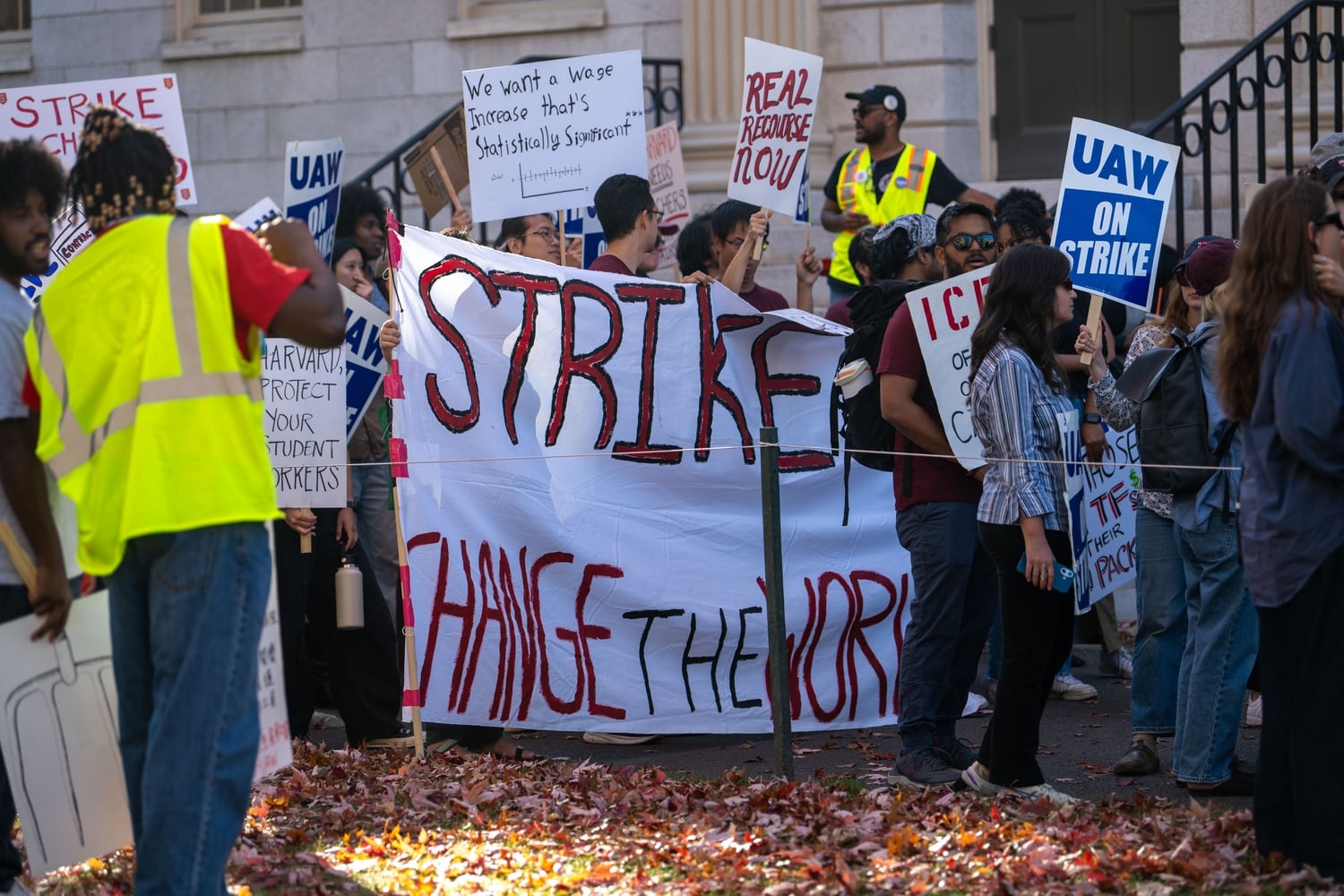
Three weeks ago, Harvard’s graduate student union walked off the job for the second time this year. They were later joined by Harvard Academic Workers-United Auto Workers, which subsequently ended its strike without a contract. In their negotiations with the University, HGSU and HAW ask that all members of their bargaining units be required to pay dues — whether or not they opt to join their union.
This so-called “agency shop” model would force thousands of scholars to bankroll organizations whose actions and politics they may disagree with. Harvard has refused to make such a change for years. As bargaining continues, this line in the sand should remain uncrossed.
Today, HGSU and HAW operate under an “open shop” model, whereby members of the bargaining units are not required to join their corresponding union or pay union dues. But by law, a union must represent every worker in its unit, member or not. As a result, employees who elect not to join still reap any rewards won at the bargaining table — from wage increases or benefits adjustments to workplace policy changes.
The unions argue that this is a free-rider problem. On the surface, this sounds like a reasonable argument for the agency shop model. But in practice, an agency shop would be a dangerous attack on scholars’ autonomy.
Federal labor law already recognizes that forcing workers to join a union goes too far. The 1947 Taft-Hartley Act banned the “closed shop,” under which employers agree to hire only union members. For a union, an agency shop is the next best thing: While non-union-members can still be hired, everyone has to pay into the union to keep their job.
But regardless of membership, payment of union dues — set at 1.44 percent of gross pay — inherently is support. Plenty of researchers, instructors, and graduate students do not agree with their union or its actions. Forcing them to financially back an organization that advocates for positions they do not believe in would contradict the values of an academic institution that prizes scholarly freedom. The Massachusetts Institute of Technology, whose graduate student union currently operates under the agency shop model, is trying to switch to an open shop for exactly this reason.
To make matters worse, HGSU is no stranger to controversial political statements. In 2023, the union endorsed the Boycott, Divestment, Sanctions movement against Israel. Dozens of members resigned in response — and they probably don’t want a cut of their pay going towards a union that doesn’t share their values. After endorsing divestment from Israel, HGSU should certainly understand workers’ desire not to financially support actions they oppose.
If an organization makes extreme statements so far outside its lane that it drives away committed members, perhaps it shouldn’t be demanding even broader, compulsory mass support. It would be completely unacceptable for Harvard to require graduate students and academic workers to financially back a union that has taken a side on one of our nation’s most divisive debates.
What’s more, in 2025 about 60 percent of union dues flowed directly to the national United Auto Workers — an organization that regularly endorses and supports political candidates. HGSU dues even directly contribute to the UAW Community Action Program, which supports progressive political causes. For all Harvard stands for, it would be completely absurd to force scholars to contribute to what is, in part, a political organization far outside our campus walls.
After all, given Harvard’s policy of institutional neutrality, we would be rightfully outraged if there were a push for graduate students and academic workers to be contractually bound to back a particular party or political action committee. Unfortunately, this case isn’t much different.
Unions are free to say what they like. On a campus that values free expression, that is how it ought to be. But the freedom to speak and protest has never included the right to make others pay for it.
On an agency shop, Harvard should hold the line.
Rohan Nambiar ’27, an Associate Editorial Editor, is a double concentrator in Mathematics and Economics in Leverett House.
Want to keep up with breaking news? Subscribe to our email newsletter
Have a tip for The Crimson? Share it confidentially