The Silent Debt of Being First-Gen
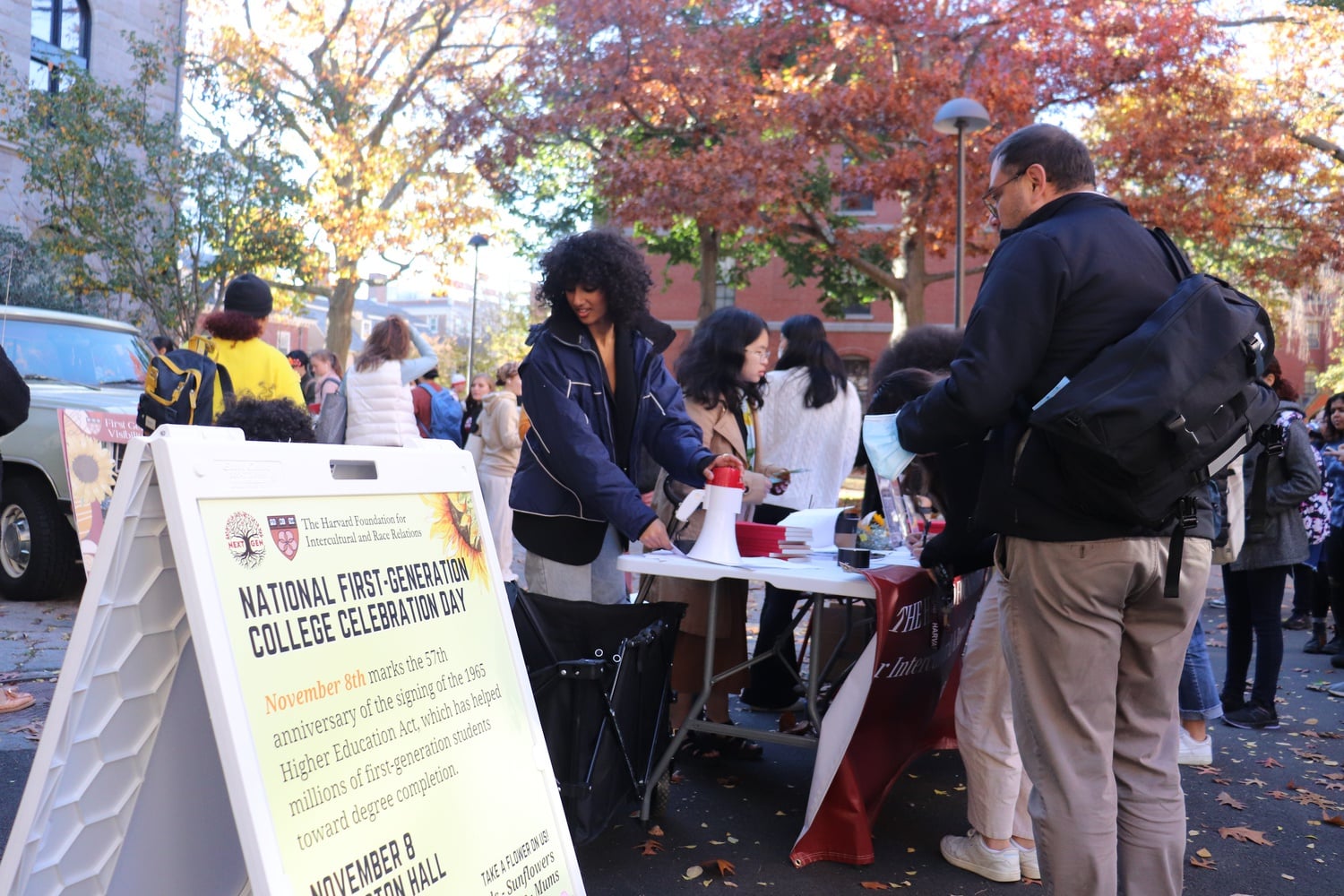
Back home, no one calls me FGLI, an acronym for first-generation low-income. At Harvard, the label earns me a week of celebration.
Last week was Harvard’s annual “FGLI Visibility Week,” when the College platforms first-generation students like myself, who are the first in our families to attend college — let alone Harvard.
Every visibility week, stories like mine do the quiet work of virtue signalling for Harvard. Each first-generation student who makes it here becomes proof that Harvard’s iron gates are open. The story of a student who is the first in her family to attend college fits neatly into a promotional email. Harvard ostensibly celebrates FGLI students, but its careerist culture pushes first-generation students away from where we come from and toward an elite definition of success.
Since I arrived at Harvard, finance and consulting emails have filled my inbox, promising the kind of prosperity and opportunity I am supposed to dream of achieving for myself, my family, and my community. I can take one of these jobs, since money seems like the most obvious way of repaying my debt to my community, but the life Harvard envisions for me does not resemble the life my parents built: modest and sufficient. I do not yet know how, or if, I can reconcile the two. But it seems that Harvard’s answer is clear.
I come from a small working-class city in northern New Jersey, 2.111 square miles to be exact. As far as I am aware, I am the first from my city to attend Harvard College. We are a city of immigrants, and I am the daughter of two Polish ones. Growing up, I never fathomed a world that looked anything other than my own. Then I got into Harvard.
The day I was accepted was the proudest I had seen my family. To them, attending an institution like Harvard meant that I now had the chance to finally reach the American Dream. That moment was also the first time I felt afraid of where it might take me. I worried Harvard would make me a stranger at home, belonging fully to neither world: not to the working-class community that raised me, and never at ease in the elite one I was entering.
For my parents, Harvard meant I could become someone they never got the chance to be: someone with a prestigious degree, a well-regarded career, and credibility within spaces they would never have access to.
What none of us said explicitly was that becoming that person would mean leaving part of them. It seemed that the more I bought into Harvard’s expectations — the courses, the internships, the networking events — the further I was from the place in which I was raised. Fundamentally, being at Harvard challenged the way I view myself in relation to the world.
This separation from home brought complicated feelings. For the feeling of being first, I turn to philosopher Friedrich Nietzsche — “schuld,” the German word for both debt and guilt.
A debt that cannot be repaid subsequently becomes guilt. Nietzsche noticed that the debt a community owes to those who sacrificed for it does not shrink as the community prospers — it grows. I recognize this arithmetic. Every achievement at Harvard is supposed to settle the account I keep with my parents and community. As my time in college increases so does my debt to them, and so does my guilt.
Parents who aspire for their children to rise beyond them are inherently asking for children who will become unlike them. Honoring that wish requires the child to stray from the world their parents built for them. The knowledge I took for granted — Polish, my childhood values, being content with simplicity — is real capital, but Harvard doesn’t seem to count it.
I have never felt so afraid of becoming unrecognizable to people back home. I have never been more aware of my working-class background than when I came to Harvard. I have never been more worried about forgetting a core part of who I am.
Supporting FGLI students cannot end with celebrating them. Visibility means being seen as first-generation. Being seen does not automatically mean being valued or understood.
Legitimize our knowledge of the communities we come from as real expertise. Do not assume we want to leave those places behind. Make careers and opportunities that lead home as visible and valid as the recruiting events that lead away.
Yet, recognition is not something the institution can bestow by fiat. It happens between equals; it is mutual, or it is nothing. Harvard cannot pay back what my family and community gave me. But it could stop implicitly treating where I come from as a deficit I must make up, and stop asking me to choose between the debt I owe my parents and the person the institution envisions me becoming.
For now, the version of me Harvard celebrates is an incomplete interpretation of my identity.
Victoria Konopka ’28, a Crimson Editorial editor, is a double concentrator in Social Studies and Economics in Eliot House.
Want to keep up with breaking news? Subscribe to our email newsletter
Have a tip for The Crimson? Share it confidentially