Harvard’s Fourth of July Came Four Months Late
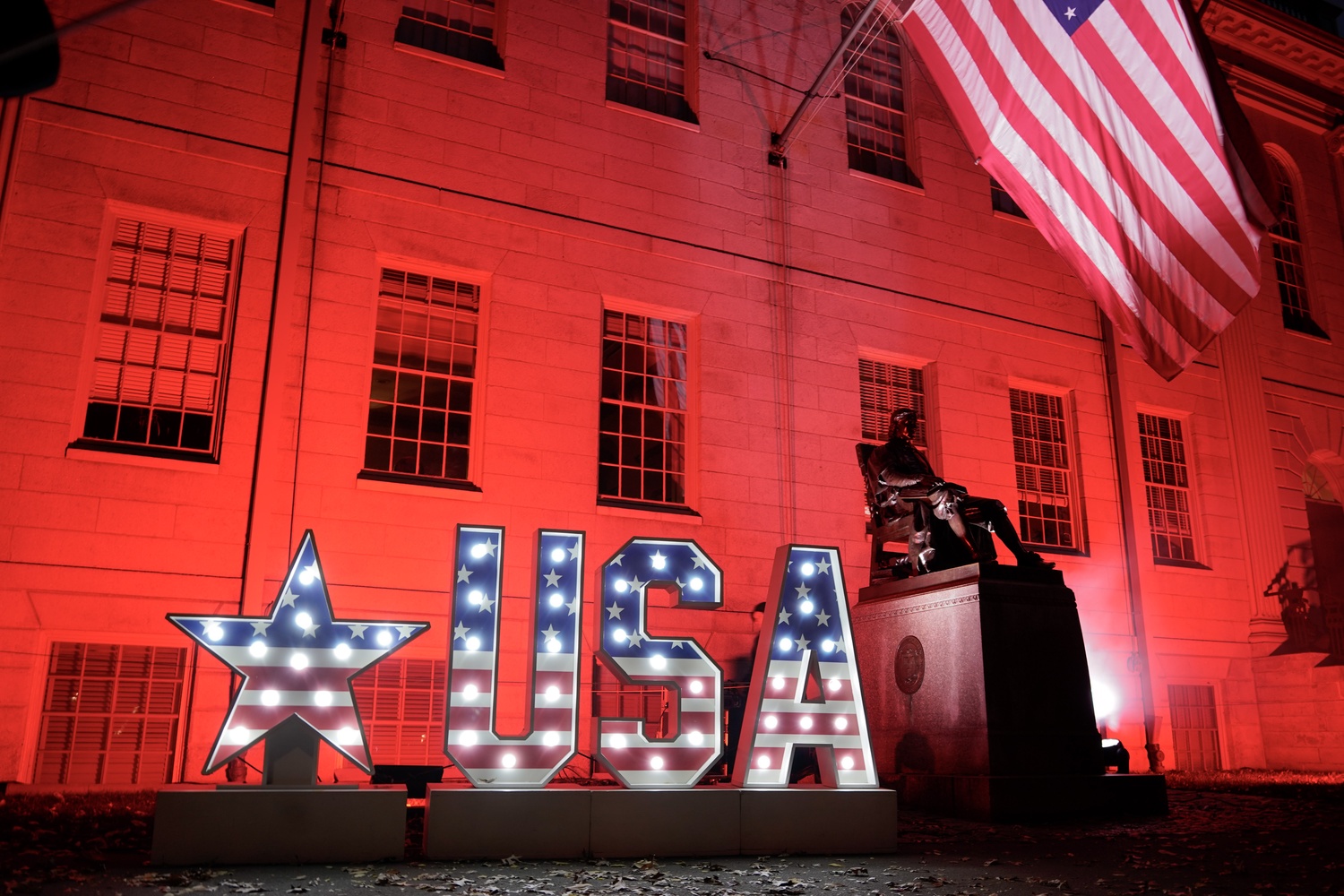
As a house-infused “Party in the U.S.A.” blared across the Yard, tens of freshmen gathered beside John Harvard to gaze at an underwhelming drone show. What I hoped was a satirical miniature train brought students around an enormous inflatable American flag as a laser light show lit up University Hall. Performers dressed in more red, white, and blue than Uncle Sam on stilts posed for pictures with bewildered students.
What, exactly, was all this hubbub for?
On October 30, Harvard College jointly celebrated America’s semiquincentennial and Harvard’s 390th. An email from College Dean David J. Deming introduced the event to students: “Please join us for a special evening of celebration, food, and entertainment on Friday, October 30, as we commemorate America’s 250th birthday.” Nowhere in the email did Deming explain why the College chose this seemingly arbitrary date for the celebration, which fell two days after the anniversary of Harvard’s founding. Even Deming seemed a bit confused by the event, adding Harvard’s 390th only as an afterthought to America’s anniversary.
Harvard believes it should generally minimize its endorsements of public matters beyond its core functions. Celebrating America’s founding four months after its anniversary fails to meet that standard.
The University formed its institutional voice policy to promote free expression on campus. In Harvard’s view, when the institution endorses a particular viewpoint, it chills discussion by creating an expectation that community members must agree. Harvard’s report on institutional voice found that when the University even just “appears” to choose a side, it “may make it more difficult for some members of the community to express their views when they differ from the university’s official position.”
Perhaps Harvard could justify celebrating the United States on the Fourth of July. After all, celebrating that day does not unduly preclude us from scrutinizing the country’s issues. The Fourth lets us appreciate America’s most romantic elements, such as its value of free speech or its diverse citizenry. The rest of the year, the institutional voice policy would suggest that celebrating the founding discourages Harvard affiliates from expressing dissenting views.
As such, a rah-rah party on America’s behalf is appropriate for the mid-summer. But in October, and especially on Harvard’s birthday, the event violates the spirit of institutional neutrality. As the working group puts it, the “university and its leaders should not, however, issue official statements about public matters that do not directly affect the university’s core function.”
Instead, Harvard could have done something far more appropriate to a university setting: host meaningful conversations on campus about how the institution relates to its home country.
To some extent, such conversations did happen on campus — the John F. Kennedy Jr. Forum hosted an event in October to mark the occasion and discuss the importance of a well-informed citizenry in a democracy; the Harvard in 1776 project has held events to discuss Harvard’s role in America’s founding.
The College-wide celebration should have followed this model, using the budget to facilitate dialogue among interesting high-profile speakers. Instead, I had to attend a kitschy commemoration of America — my entryway was closed for drone-show precautions, forcing me onto the Yard.
It’s fine for the College and its students to be patriotic — if anything, I hope Harvard’s students feel enough pride in their country to point it in the right direction. But a true patriot must love their country while reckoning with its shortcomings.
Worse still, Harvard’s event comes at a time when its relationship with both the American government and public has never been more precarious. Public trust in higher education has cratered over the last decade, and resulting attacks against universities have often placed Harvard front and center.
During the first two years of his second term, Trump led — and continues to promote — a crusade against elite American universities. As the poster child of higher education, Harvard faced the brunt of Trump’s attacks. The administration has not only cut $2.2 billion in funding from the University, but has also disqualified the school from future grants and frozen an extra $450 million.
Immediately after Trump instituted these cuts, he posted on Truth Social, claiming that Harvard “can no longer be considered even a decent place of learning.” Harvard consequently sued the federal government and won in September 2025, requiring the Trump administration to restore funding. And yet, Trump hasn’t given up: in early October, his administration demanded the First Circuit review its decision to curb its power.
How should we discuss our country under such combative circumstances? Certainly not by hosting a carnival. Harvard should have treated the occasion with more nuance, thoughtfulness, and discussion.
Instead, Harvard seemed to throw its very own “Great American State Fair,” a miniature imitation of Trump’s tacky attempt at a patriotic celebration of America’s 250th anniversary.
By the end of the night, the drones landed on the ground, and the American flag deflated, but our current climate was no better understood.
Shane A.S. Saber, a Crimson Editorial comper, lives in Canaday Hall.
Want to keep up with breaking news? Subscribe to our email newsletter
Have a tip for The Crimson? Share it confidentially