The Other Games
While everyone in New England knows that The Game refers to Harvard and Yale, many other parts of the United States have different associations with the phrase.
You just lost the game.
Believe it or not, “The Game” doesn’t just refer to the historic Ivy League football matchup between Harvard and Yale or the infamous Big Ten clash between Ohio State and Michigan.
“The Game” has meanings ranging from a movie to a psychological phenomenon in which thinking about “The Game” means you lose — hence why you all just lost — to three separate historic collegiate rivalries, and so much more.
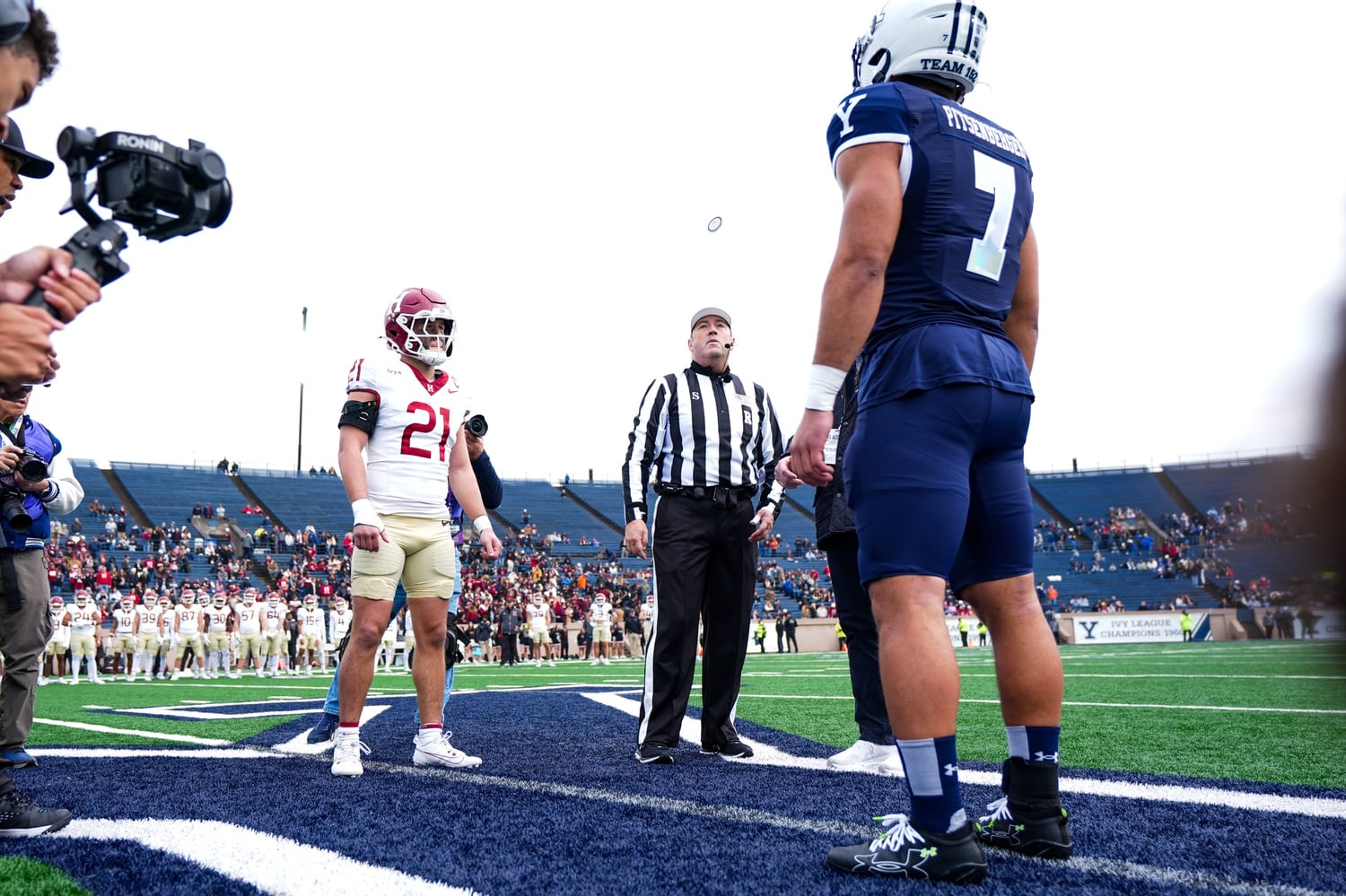
As you read up on all the coverage of Harvard football, fashionable athletes, and where the team eats, you’ll hopefully find yourself sufficiently prepared for the 142nd edition of the Harvard-Yale version of “The Game.”
Yet if you happen to search “The Game” on Google, to the shock of those in the Harvard bubble, several other instances of “The Game” make a claim to the historic moniker. Here are just a few of those other games.
The Oldest Small School Rivalry in the Southern United States
Hampden-Sydney College and Randolph-Macon College in Virginia have their own “The Game.” The rivalry dates to 1893, and the schools have now met 131 times.
The two schools, separated by just over a 90-minute drive, clashed on Nov. 14, when Hampden-Sydney defeated Randolph-Macon for the first time since 2013 by a score of 36-27. The Tigers’ victory secured them the Old Dominion Athletic Conference Championship and an automatic bid to the Division III playoffs.
In anticipation of hosting the duel, Hampden-Sydney’s athletic director Chad Eisele correctly predicted that “it’ll be crazy here, and for us, we’ll have anywhere from 12 to 20,000 people in a stadium that holds probably, seating-wise, 2,000.” The game’s official attendance was 10,277.
“The closest to a Division I game that I’ve ever been to,” Eisele said. “The tailgating, the atmosphere, the excitement, the packed crowds, it is really unique.”
“I just haven’t seen a lot of rivalries like this at this level,” he added.
Hampden-Sydney head coach Vince Luvara emphasized how, despite the excitement surrounding the game, the players still had to focus on preparing for the contest.
“It’s a big game. It means a lot to a lot of people,” Luvara said. “It means a lot to our alumni and our fan base, and while we try to keep it in perspective, it weighs the same as every other game. But there’s a lot more that comes with it, and it’s intense. The rivalry is intense.”
The stakes of the historic matchup extend beyond the scoreboard.
The winner also receives the “Game Ball Trophy,” which Randolph-Macon Director of Athletic Communications Zac Saylor described as “a gold game ball, and it’s basically made out of wood with panels around the side that have the score of every game since its inception in the 1800s.”
From tailgates Eisele compared to those at “Ole Miss,” to a stadium exceeding capacity by thousands of fans, the rivalry between Hampden-Sydney and Randolph-Macon nears Harvard-Yale in its history and regional importance.
Ohio State v. Michigan: The Toledo War Modernized
A mid-1830s border dispute known as the Toledo War marked the start of the rivalry between Ohio and Michigan. Though that conflict was largely bloodless, the strife found its focus again on the gridiron in 1897 and has since been full of blood, sweat, and tears, drawing millions of fans and entire states to a new kind of battle.
Perhaps the best-known version of “The Game” also has a connection to Cambridge: Harvard College Dean David J. Deming attended Ohio State, while Dunster House Faculty Dean Taeku Lee graduated from Michigan.
Lee surmised supporting a college football team most eloquently, saying, “For me, your college football team is kind of like your first and your last love.”
Deming broke state lines and agreed with his rival, emphasizing that “sports are an incredible opportunity for affiliation and a sense of community.”
“For me that was really my sense of affiliation while at Ohio State,” he added.
Both Deming and Lee acknowledged the century-plus of shared history between the schools, filled with traditions like Ohio State’s “Script Ohio” marching band routine and how Michigan students are lifted and carried throughout the stands in celebration.
Deming closed with a message of friendship that extends to Harvard-Yale as well.
“There’s a kind of special bond among people who are rivals. Like, yeah, I can say I hate the Michigan fans. Of course, I don’t really hate them. And actually, you can strike up a great conversation with somebody who attended your sports rival, and you can say things like, ‘Oh, I forgive you. We can still be friends.’ And everyone jokes around. It’s a way to meet people. It’s a conversation starter, and so I think that’s the thing that is very consistent across all of these things,” Deming said.
“The Game”: A Conversation with Jonathan C. Mostow ’83
Mostow, who concentrated in Visual and Environmental Studies and lived in Quincy House, went on to make a name for himself in Hollywood, directing notable films such as “U-571” and “Terminator 3: Rise of the Machines,” and most notably for this article, executive producing “The Game.”
Directed by David A.L. Fincher, “The Game” was chock-full of Harvardian influence, with Mostow joining his roommate Michael H. Ferris ’83 and Adams House resident John D. Brancato ’80, who both served as screenwriters.
Mostow’s connection to The Game, though, began long before his film career. For the Connecticut native, it was a family matter.
“I grew up in a little suburb of New Haven, and the Yale Bowl was a big out-of-scale thing for a town like New Haven,” said the executive producer said.
His loyalties weren’t entirely Yale blue, though.
“My dad was on the faculty of Yale, but my dad was a Harvard graduate,” Mostow explained. “So there was always a sort of conflicted thing there.”
However, the proximity effect won out at this point for Mostow.
“I think Yale, because it was the home team, I guess we probably erred more on the side of rooting for Yale,” he added.
The New Haven area native made sure to clear the air, though, when asked how his allegiance changed during his undergraduate years, saying, “Once I was at Harvard, Yale was, you know, we looked down on those at Yale.”
“I’m from a family where, everybody in my family, it sounds obnoxious to say, everybody in my family either went to Harvard or went to Yale, or taught at Yale. But once I became a Harvard student, I threw all the Yale stuff away,” he explained.
His second home, with its warm-colored bricks and the scenic Charles River, had clearly won the battle for his allegiance over New Haven’s Gothic architecture.
Given his history with The Game in New England, it would be reasonable to expect that Mostow and his Harvard peers had drawn some inspiration from the football game when titling their film.
“No, and what’s hilarious is that until your interview request, I had never connected the two things in my head,” Mostow replied when asked if there was an intentional connection.
Instead, the film tells the story of a divorced San Francisco banker who is given a gift that leads him to enroll in the namesake game, which engulfs his life and makes him mistrust even those closest to him.
“The Game is just kind of like a slightly Hitchcockian thriller, you might say, and has zero to do with football or anything of that nature,” Mostow said.
The movie may share a name with Harvard’s biggest annual athletic event, but the connection is pure coincidence — another example of how widely “The Game” has found its way into popular culture.
The Reason You Lost: The Psychological Game That Took Over the Internet
If you’ve spent this article wondering why you lost “The Game,” you’re not alone. The internet game has been infuriating players for at least 20 years, rising to prominence in the mid-2000s, though some trace its origins to 1996.
The rules of the game aren’t all that complicated: Everyone in the world is playing it, whether they realize it or not. If you think about it, even in passing, you’re out. When you lose, you must announce it publicly. Everyone involved with this article, ranging from the editors to the readers, has already lost.
Websites devoted to the game have even tracked the number of “infected” visitors — people who visited the page, thought about the game, and therefore lost.
The concept seems to have emerged from the study of ironic process theory, where trying not to think about something makes you think about it even more.
Russian writer Leo Tolstoy laid the groundwork for the concept. Tolstoy’s older brother often teased him as a child by making him stand in a corner and try to forget about a green and white bear. According to the ironic process theory, Tolstoy struggled tremendously with this task, which explains why the bear kept coming to mind as he tried to forget it.
The Game (disambiguated)
With at least 80 unique instances of “The Game” in sports, media, culture, psychology, and general society, no single article could do them all justice.
At least 25 songs, five albums, 15 TV show episodes, 10 books, and more have shared the name, with some reaching national recognition.
Jayceon Terrell Taylor, known by his stage name “The Game,” has multiple Grammy and Billboard Award nominations and currently has 16.2 million monthly listeners on Spotify, making him one of the foremost examples of “The Game” outside of athletics.
“Hate It or Love It,” Taylor’s collaboration with Curtis James Jackson III, better known as 50 Cent, has amassed a huge audience.
Taylor likely had “Something’s Goin’ On,” because as of the publication date, he had not responded to The Crimson’s requests for comment.
Yet on Saturday at Fenway, there will be No More Fun and Games while Game Recognize Game in the next chapter of The Life of the rivalry between the Red Nation (Harvard) and the Left Out (Yale).
—Staff writer Leo P. Petropoulos can be reached at [email protected].
Want to keep up with breaking news? Subscribe to our email newsletter
Have a tip for The Crimson? Share it confidentially