Harvard’s Laissez-Faire Approach to Campus Security
From Monday, October 26 through Tuesday, November 3, I was entirely without my Harvard University ID card. I endured bacchanalian Halloweekend, the transition to 4:30 p.m. sunsets, and a harrowing Astronomy midterm — all without scanning access. Remarkably, little about my daily affairs changed.
Though happy to delay paying the $40 ID replacement fee, upon reflection I was left startled by the lax state of campus security. That a student can maintain a normal routine for eight days without any physical proof of her enrollment at Harvard is a testament to the University’s poor security system. Harvard must strengthen and ensure the enforcement of its security rules, especially when concerning residential buildings.
Harvard introduced harsher ID requirements for academic buildings last December in the wake of the shooting at Brown University. But soon after the imposition of the new ID restrictions, some of these same buildings, including Zimmer Hall, were once again accessible to the public. Indeed, I could reliably get to my Zimmer Hall classes and sections without an ID.
Still, many buildings require more scheming to enter, including Jefferson Laboratory, my place of work. I thus quickly learned how to circumvent the need for direct entrance. Maxwell Dworkin Laboratory is well-trafficked enough that I could reliably gain entrance, after which I could take a winding route of connectors through Cruft Laboratory, Pierce Hall, and Lyman Laboratory to my final destination. Four buildings for the swipe access of one!
Most difficult, of course, was gaining access to my home. By most difficult, I mean that I had to take the notoriously unreliable Quad shuttle instead of walking, guaranteeing that one of my peers would arrive alongside me and swipe me in.
Evidently, Harvard’s campus is the world’s oyster. This accessibility is a result of Harvard’s current security strategy, which puts the onus of safety on students.
For example, the Harvard University Police Department details ways that students can keep their dorms safe: “Although it seems courteous to open doors for others, especially persons carrying groceries or packages, do not open residential doors for strangers.” Kind reminders on the HUPD website fail as a real security initiative, especially in the face of security threats. Take, for instance, an incident last May in which a stranger allegedly tailgated into a Lowell entryway and attempted to assault a Harvard senior.
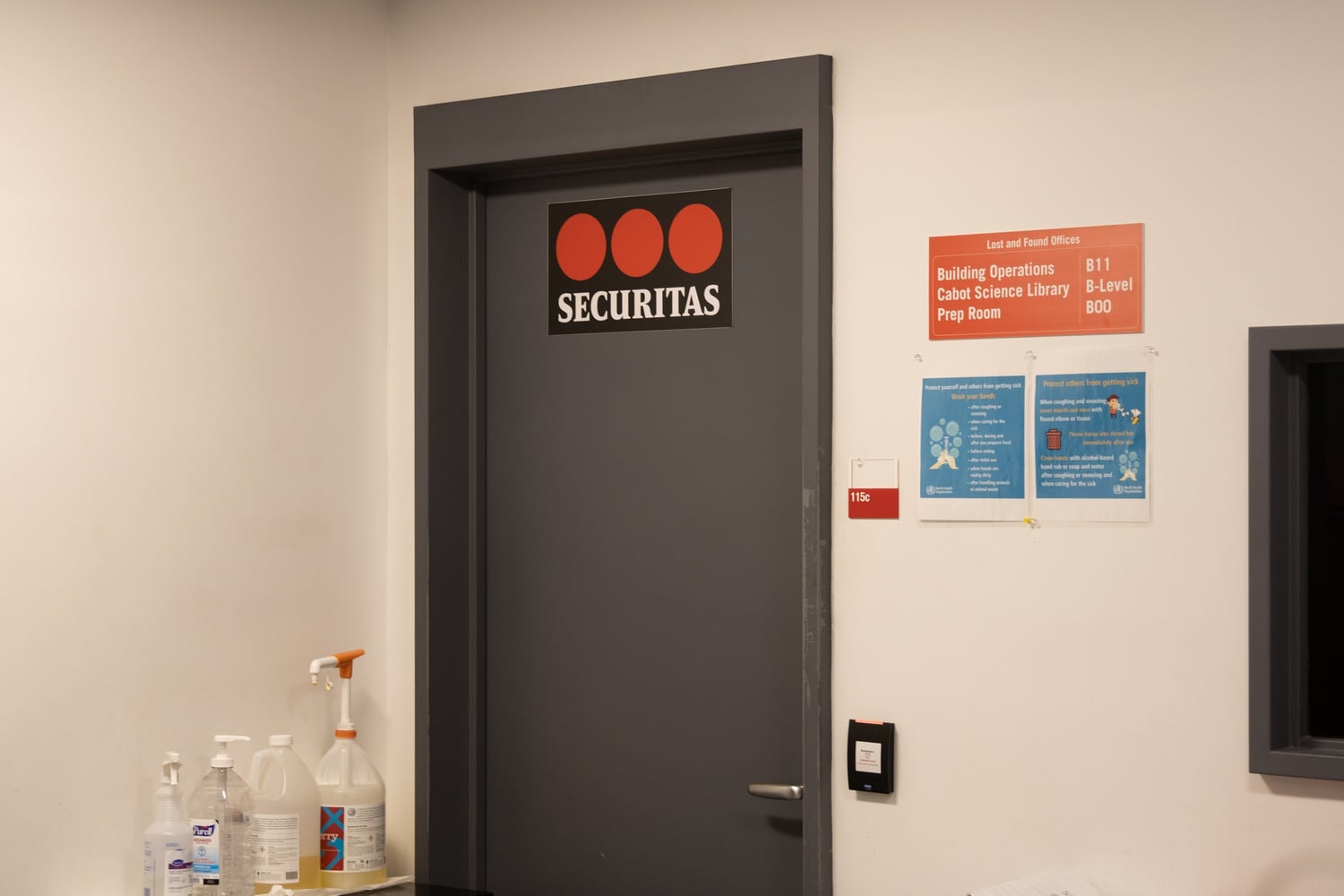
Most stunning of all was the one interaction I actually had with campus security. One late Wednesday night, the cold wind stinging my face, I finally relented. I called Securitas to let me in. I had found my HUID number in case they needed proof of my enrollment, but I was surprised yet again. Securitas didn’t ask for my HUID — or even my name. I was home free.
Within Harvard’s 2026-27 student handbook, the only information I could find about guest access is that “the hosts of repeated overnight guests who are not Harvard students must make their guests’ presence known to the Building Manager and security personnel due to safety considerations.”
According to Harvard’s website, the “express permission of your House Office or proctor” is technically required to host overnight guests, and students are instructed to contact said parties about a “guest registration process.” But in practice, this rule seems to go unfollowed: I have never registered an overnight guest, nor have any of my friends.
Our security system is uniquely lax compared to other Boston schools. At Boston University, guests are required to sign in and present a legal ID every time they enter or exit a residential building. Massachusetts Institute of Technology has a nearly identical policy. So does Emerson College.
To a certain extent, I appreciate Harvard’s more casual approach to security. It is convenient to navigate campus without constantly swiping my HUID and fun to have friends visit my dorm without forcing them to undergo oppressive security measures. Still, convenience and accessibility come at a cost, one I find myself unwilling to pay the full price of.
I don’t believe that Harvard’s security rules must be as draconian as those at our neighboring universities. Yet they must be stricter than their current, laissez-faire iteration. Harvard is, as HUPD puts it, “struggling with the appropriate balance of security and freedom of movement.” However, it seems the balance has shifted too far towards freedom.
Perhaps the only change in my HUID-less life was my inability to access any libraries. The three libraries that I frequent — Lamont, Widener, and Cabot — all have turnstile-type entrances that effectively prevent tailgating and a security guard on duty.
In a true commitment to recentering academics, Harvard’s libraries are, for the time being, much safer than its dorms.
Anna J. Guerrini ’29, a Crimson Editorial editor, is a Physics concentrator in Pforzheimer House.
Want to keep up with breaking news? Subscribe to our email newsletter
Have a tip for The Crimson? Share it confidentially