We're Physics Course Assistants. Here’s Why We’re Striking.
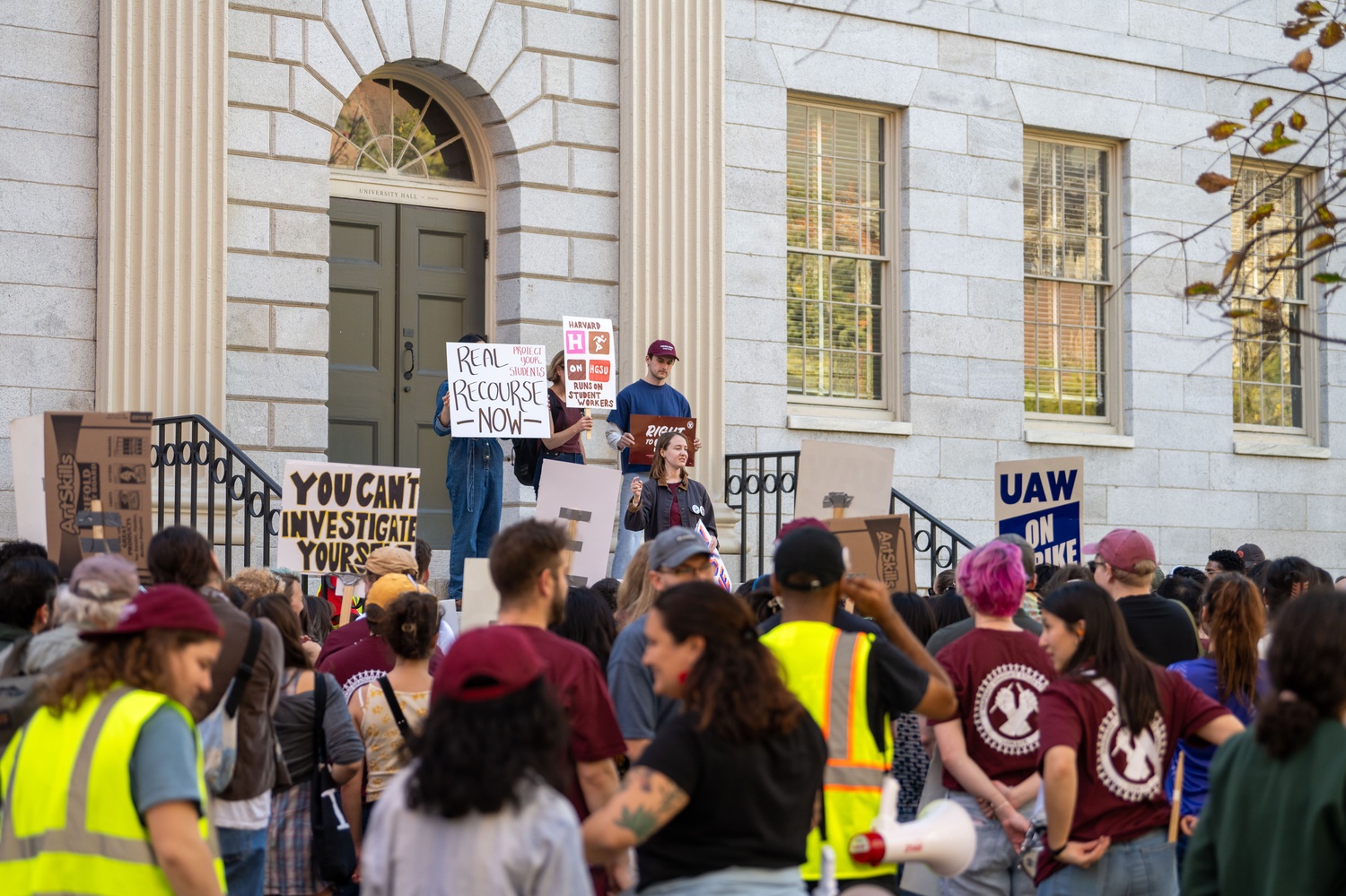
Union issues are student issues.
As undergraduate course assistants in the Physics Department, and as members of the Harvard Graduate Students Union-United Auto Workers, we know this firsthand.
As student employees go, we have it pretty good. Many of us didn’t take these jobs for the money; we love teaching, and being a CA is one of the best ways we can actively curate our department’s culture and pay forward the help we received as students. We see our jobs in this light because, unlike many graduate students, we largely don’t have to worry about food and housing.
Yet this is exactly why we believe undergraduates are some of the best positioned workers to strike: Our relative privilege allows us to fight — at low personal cost — for better learning and living conditions for both ourselves and our graduate student mentors.
For the same reasons, CAs who do not join the strike directly weaken HGSU’s strike power and reduce the pressure on Harvard to reach a contract. By continuing to work while our coworkers attempt to demonstrate the necessity of student labor, they weaken the material impact of the strike and make it easier for Harvard to continue ignoring us.
Collective action is powerful precisely because it is collective; it demonstrates our solidarity with one another. Whether or not we are personally affected by the core strike issues — financial strain, harassment and discrimination, and the threat of ICE on campus — we see it as a moral obligation to fight to protect and uplift the most vulnerable among us.
This is not to say that HGSU’s strike issues don’t affect us personally. Some of us plan to spend the majority of our lives in academia. Therefore, we are particularly motivated to fight for an academic culture in which everyone who teaches and conducts research is protected, fairly compensated, and has a meaningful voice in the conditions of their employment.
While money is not an acute concern for most CAs, it would not be fair to assert that the raises HGSU is currently proposing for us ($24 per hour) wouldn’t tangibly impact some of us, especially considering that inflation in Cambridge this past year was 3.8 percent. Incidentally, one of us recently paid a medical bill worth more than double her paycheck, making the impact of earning more feel particularly relevant.
More importantly, though, compensation is not the only thing HGSU is bargaining over. HGSU’s other core issues, including protections against harassment and discrimination and protections for non-citizen student workers, affect us all.
The national attention on the “Cornell Seven” lawsuit this fall has reminded us all of the pervasiveness of sexual harassment on college campuses, and critically, the systemic failure of university Title IX offices to adequately protect and provide justice for survivors. The Title IX system may seem reasonable on paper, but anyone who has gone through the grueling process of filing a complaint knows that it is broken. Survivors are scrutinized and interrogated, expected to gather their evidence and keep track of endless meetings without guaranteed lawyers or other support — and all this to be left with potentially no real consequences for those who hurt them.
In 2020, a Harvard Title IX coordinator allegedly told a Ph.D. student that going to the press would be more effective than going through Harvard’s complaint process. Jane Doe, Kendall Francis, and other survivors who have recently come forward across the country and at Harvard have emphasized the failures of our schools’ institutional Title IX offices.
Meanwhile, after months of HGSU members stressing the importance of this issue during bargaining throughout the fall, Harvard representatives at the bargaining table have maintained that Harvard will not move on harassment and discrimination. Harvard has lived up to this promise by declining to engage with the union’s proposals for a third-party investigation system.
Equally important to us are the non-citizen student worker protections that Harvard has so far refused to codify in a contract. This is especially concerning given that students have been targeted by ICE for mere political speech as close by as Somerville, where Rumeysa Ozturk was abducted last year. Requiring Harvard to commit to keeping ICE off campus would make all of us safer, but this is especially vital for the protection of our non-citizen friends and coworkers.
To any CA who cares about any of these issues: Harvard is refusing to take our concerns seriously. In doing so, the University has put us in a situation where the only tactic we have left is to strike and impede business as usual. Yes, this risks jeopardizing the academic interests of our students. But after twenty months of bargaining, disrupting education is the only remaining pathway to reach an agreement.
We hope that Harvard will make an honest effort to end the strike as soon as possible so that we can get back to doing the jobs we love. In the meantime, to our students and fellow CAs: We hope to see you on the picket line.
Helena M. Brittain ’27 is a Physics and Mathematics concentrator in Mather House, a Course Assistant for Physics 181: “Statistical Mechanics and Thermodynamics,” and an HGSU member. Leena Y. Iwamoto ’27 is an Astrophysics and Physics joint concentrator in Mather House, a Course Assistant for Physics 15C: “Wave Phenomena,” and an HGSU member. Jayanti N. Leslie-Iyer ’27 is a Physics and Mathematics joint concentrator in Adams House, a Course Assistant for Physics 15C: “Wave Phenomena,” and an HGSU member and organizer.
Want to keep up with breaking news? Subscribe to our email newsletter
Have a tip for The Crimson? Share it confidentially