HGSU Picketed My Course. Undergrads Shouldn’t Be a Bargaining Chip.
As the professor of General Education 1116: “Medical Ethics and History,” I would like to clarify the events that led to the disruption of my class on October 29.
On October 27, the Harvard Graduate Students Union emailed me to warn about a picket planned for October 29: “Based on the information we have, we expect that the picket line will interfere with your class. We are extending this communication in the hopes that you will choose to honor the picket line and cancel or relocate your class.” Despite some misgivings, I asked the Registrar if other spaces were available. None were — Harvard has few spaces that can hold 280 students.
My class had an in-person exam scheduled for October 29. Students had been working hard to prepare, and rescheduling the exam was not a good option. Changing an exam date is disruptive in any well-designed course. Moreover, the strike is open-ended: I had no idea when it might end, and I had no guarantee that any future date would be picket-free. Converting the exam to a take-home is pointless in our age of generative artificial intelligence. As a result, I concluded that it was not appropriate to cancel or reschedule the exam.
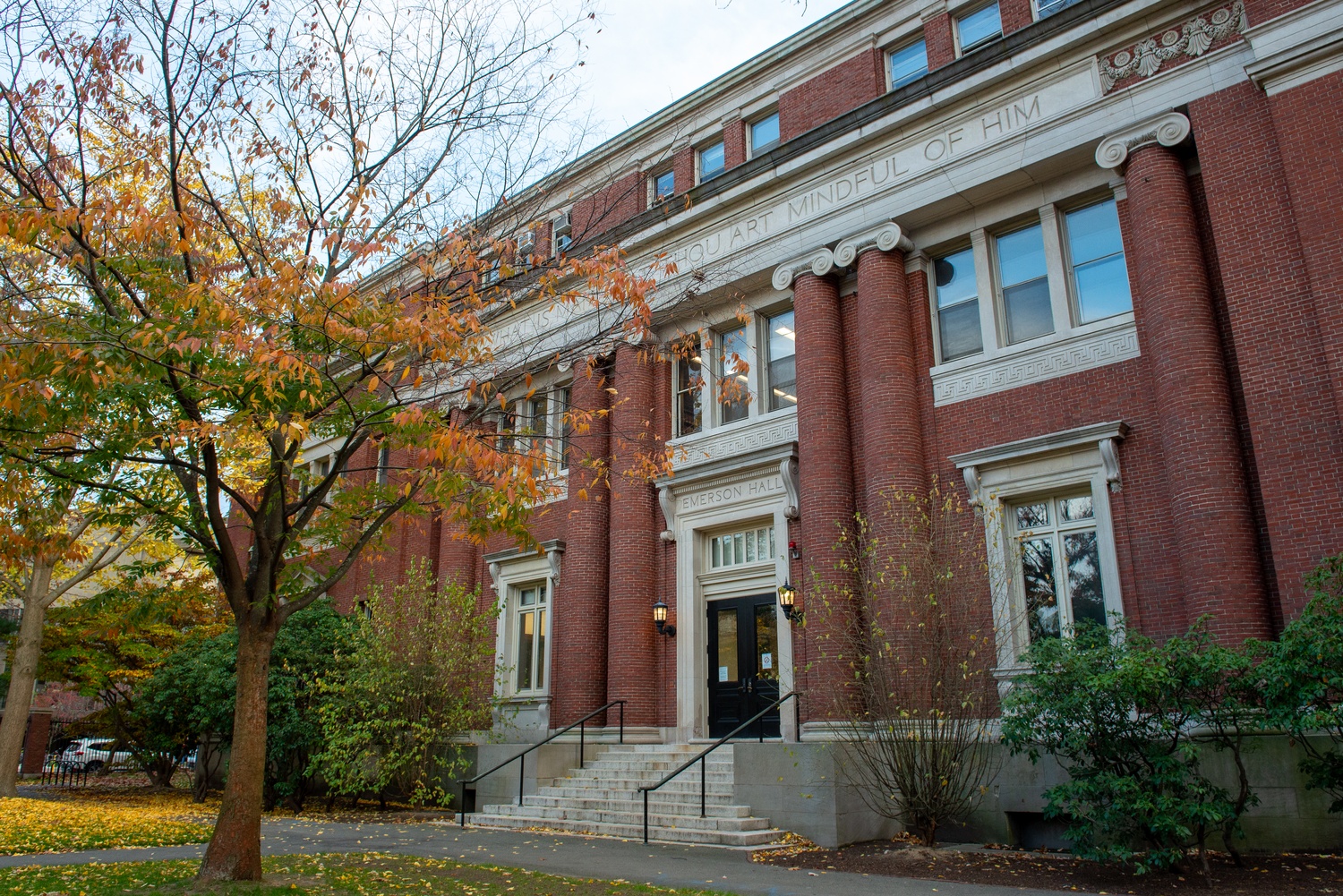
I believe that the union knew the Thursday session would be an exam. The planned interference proceeded, nonetheless. There was a picket outside Emerson Hall before the class began, but students were able to access the lecture hall. The exam started as scheduled at 10:30 a.m. The noise quickly escalated and continued, more or less, for 75 minutes.
Panopto captured the sound of air horns from the picket line as heard from inside Emerson Hall 105 during the GenEd 1116 midterm exam on Oct. 29. | Courtesy of David S. Jones
This was not the usual picket. This was a sonic assault: shouting through an amplified megaphone and sustained blasts from horns, sirens, and other noisemakers. At one point someone simply shrieked, incoherently, into the megaphone. Because of a scheduling glitch, the class session was recorded: Panopto captured it all.
Fearing the worst, I had purchased 100 pairs of ear plugs and allowed students to use noise-canceling headphones. Nothing worked. One student apparently could not stand the noise and walked out after 15 minutes. The other students endured the assault with an astonishing display of bravery, patience, and fortitude. When the shrieking began, some could only laugh. Students have asked how I will score these exams: Was it fair for them to take an exam under those conditions? A reasonable answer is “no.”
I believe that this was an unprecedented event in the 390-year history of Harvard College. One group of students orchestrated the deliberate disruption of another group of students taking an exam. Protesters might have sought to punish me; they only harmed my students.
At one point during the exam, someone on the picket line seemed to yell into a megaphone. | Courtesy of David S. Jones
I have had many conversations with students in the aftermath. Some shared screenshots from Sidechat that expressed considerable anger towards HGSU. The day after the exam, HGSU sent an email to my class that blamed me for what happened: “As fellow students, we recognize that exams are stressful enough without disruption. To avoid such disruption, HGSU leadership notified your instructor 48 hours in advance of our picketing plans and encouraged them to move the class. Unfortunately, they did not.” This seems disingenuous. HGSU could have avoided the disruption. They did not. Instead, they escalated their usual picket with horns, sirens, and amplified screaming.
To what end? The strike represents a labor dispute between HGSU and the University. Neither the faculty nor the undergraduates are parties in this dispute. HGSU has acknowledged this, reporting that there are no faculty on the University’s bargaining team. If HGSU thinks that faculty can call on the provost and demand that he settle the strike, they misunderstand where power resides in this University. I don’t see how the 75-minute assault brought the HGSU and Harvard any closer to a mutually acceptable resolution.
This is the second time I have taught this course during an HGSU strike (I also taught it in 2021). I have always supported the union and its right to strike. I have never hired replacement workers. Meanwhile, I have remained committed to graduate student education. I have long had many Ph.D. advisees and I have won graduate student mentoring awards from the Graduate School of Arts and Sciences and Harvard Medical School. I am also committed to undergraduate education, and have won awards for undergraduate teaching at both MIT and Harvard. HGSU presents faculty with a stark choice: You are with us or against us.
Where does that leave undergraduates? The union’s demands on faculty would compromise undergraduate education, whether in terms of the invaluable role of sections in a well-designed course or undergraduates’ right to receive prompt feedback on exams and papers. I hope that HGSU can find a way to make its voice heard and to achieve its goals without using undergraduates and faculty as pawns in their dispute with the University.
David S. Jones ’93 is the Chair of the Harvard History of Science Department, the A. Bernard Ackerman Professor of the Culture of Medicine, and a Professor of Epidemiology at the Harvard T.H. Chan School of Public Health. He currently teaches General Education 1116: “Medical Ethics and History.”
Want to keep up with breaking news? Subscribe to our email newsletter
Have a tip for The Crimson? Share it confidentially