Harvard Law School Students Stage Library ‘Study-In’ in Support of Clinical Instructors
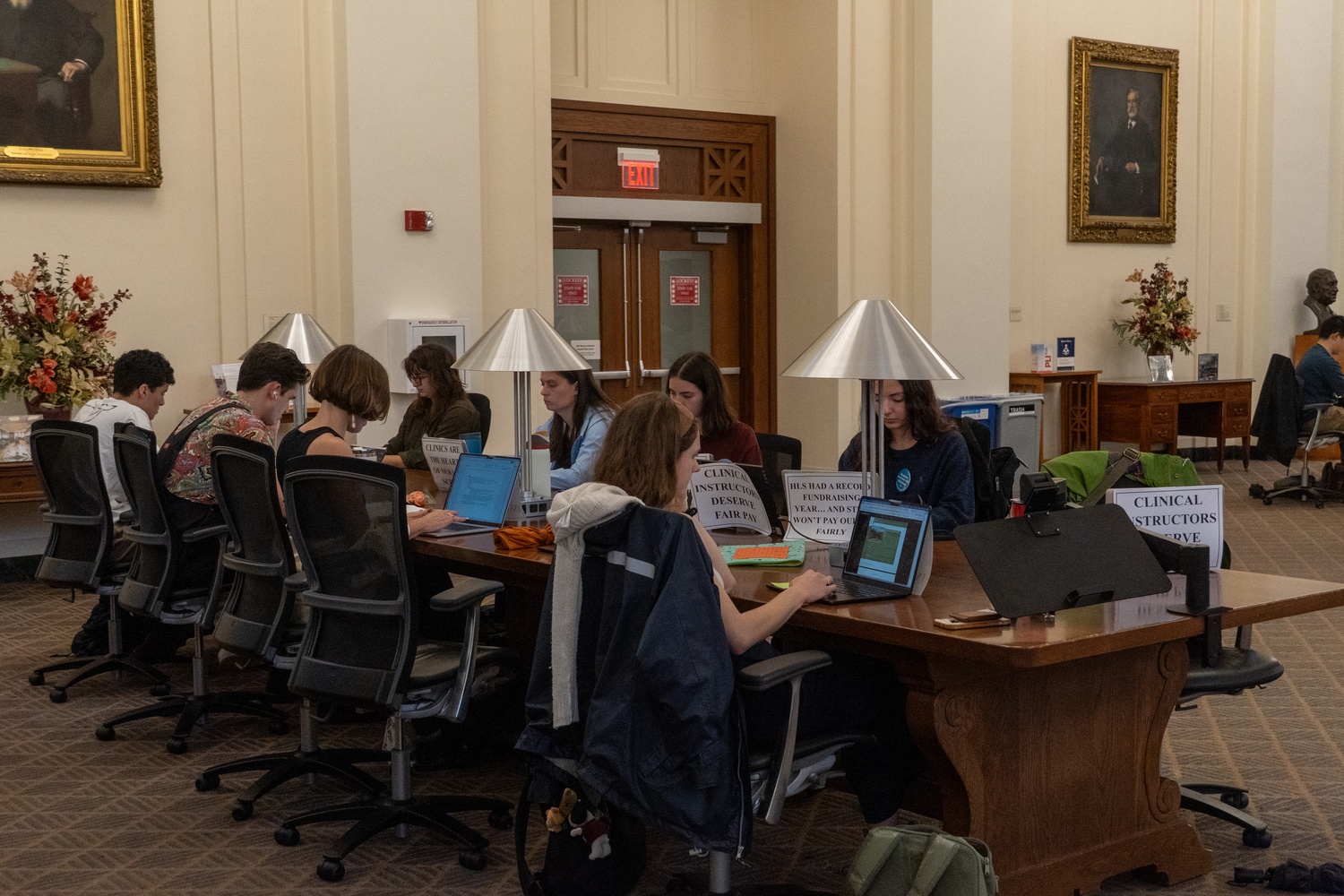
About 40 Harvard Law School students staged a silent, nearly hourlong “study-in” at Langdell Library on Friday afternoon, calling on the University to reach a contract agreement with the school’s clinical instructors.
Students wore blue badges reading “Students stand with HLS clinicians” and taped signs to their computers calling for fair pay and highlighting HLS’s record fundraising year.
Organizers — an ad-hoc coalition of students involved in clinics — distributed slips of paper linking to a petition in support of the clinical workers. More than 260 students across all class years who participate in the school’s clinics and student practice organizations had signed the petition by Sunday evening.
The Law School employs roughly 60 clinical instructors who help run 25 in-house clinics offerings and 11 student practice organizations, which offer noncredit opportunities to students beginning in their first year.
HLS spokesperson Lacey J. Rose declined to comment.
Harvard Legal Aid Bureau president Zahra A. A. Saifi, a third-year law student who helped draft the petition, described the study-in as a “metaphor” for the educational opportunities offered by clinics.
“Most of us were working on clinical work, that is what many of us work on often with our time, and we were doing that in a shared educational space,” Saifi said. “We were working on things directly relevant to our education, and we were having a conversation directly relevant to our education as well about what was happening with the clinical instructors and the lack of engagement from the University on the negotiations.”
The petition calls for the University to meet the union’s bargaining demands, “including compensating them appropriately, respecting their contributions to Harvard Law School and its students, and supporting their autonomy as educators.”
“Harvard Law School’s public celebration of clinical legal work during high-profile events from recruiting and admissions all the way through commencement stands in stark contrast with its refusal to provide competitive compensation,” the petition read.
Get The Crimson in your inbox.
It also pointed to clinical instructors who have left the school “rather than continue to be under-compensated.”
In April, HLS suspended its LGBTQ+ Advocacy Clinic for the 2026-27 academic year after both clinical instructors departed. The school is now currently conducting a national search for its next leadership, with a job posting open since early July.
HLS clinical workers — a unit of the broader Harvard Academic Workers-United Auto Workers — and the University have reached agreement on 11 of 46 contract articles after two years of bargaining. The union filed an unfair labor practice charge in July, alleging Harvard withheld annual raises and performance bonuses from unionized academic workers.
The two sides entered mediation in August, according to Anna Crowe, a bargaining committee member and associate director of the International Human Rights Clinic. Crowe said the University submitted its latest proposal on Oct. 5 and the union responded with a counterproposal on Oct. 18, but had not heard back since.
“We’re very frustrated at the slow pace,” Crowe said. “It seems like the unions that threaten to strike are the ones that get a lot of attention and priority from the University, and it’s really disappointing for our unit where we haven’t put that on the table, we’ve been trying to act in good faith and push as hard as we can.”
“We’re essentially punished for that choice,” she added, saying the union could consider a strike in the coming weeks.
The demonstration followed an October 2024 study-in at which HLS administrators scanned participants’ Harvard IDs. The Law School subsequently barred at least 60 students from the library library for several weeks after they protested the war in Israel and Gaza and what they described as “Harvard’s complicity in Israel’s genocide.”
The restriction prompted Harvard Out of Occupied Palestine to stage another study-in protesting the disciplinary action and the war in Gaza.
Rose declined to comment if the Law School would pursue disciplinary action against the study-in’s participants.
“The University sees this issue as something that relates only to clinical instructors and their union negotiations, and they think they can silo them,” Saifi said. “What students are trying to get across is this has everything to do with us when you marginalize our educators, and this impacts us directly when you do that.”
—Staff writer Uy B. Pham can be reached at [email protected] or on Signal at ubp.88. Follow him on X @uybpham.
Want to keep up with breaking news? Subscribe to our email newsletter
Have a tip for The Crimson? Share it confidentially