Harvard’s AAUP Set Out to Reform the University. Instead, It Went National.
Seven Harvard professors logged onto a Zoom call hoping to strengthen faculty governance. Less than a year later, their fledgling AAUP chapter was in federal court, challenging the Trump administration’s pressure on higher education.
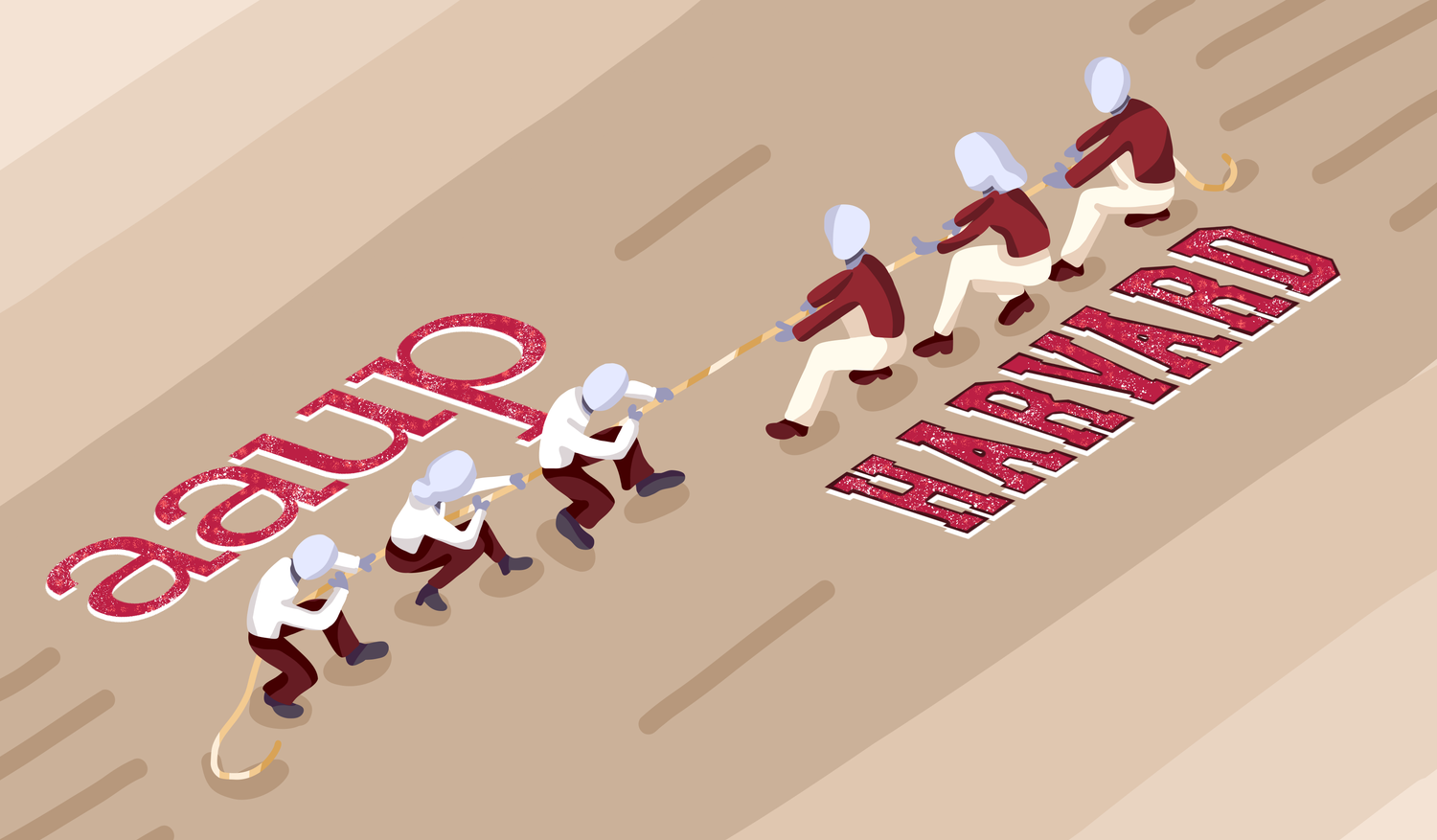
In the spring of 2024, seven Harvard professors logged onto a Zoom call with modest ambitions.
Harvard was under strain — rocked by leadership upheaval, campus protests over Gaza, and intensifying scrutiny from Washington — and the faculty on the screen wanted to talk about governance: who had a voice at Harvard, and who didn’t.
They were not planning to take on the federal government.
The meeting was an early step toward forming a campus chapter of the American Association of University Professors. For the professors on the call — among the most outspoken critics already of University policy in faculty forums — the appeal was straightforward. At a moment of crisis, they felt faculty perspectives were being sidelined by an administration making consequential decisions with little transparency.
Less than a year later, the group would be in federal court.
“Our becoming involved in two major lawsuits against the federal government was not on my bingo card,” Harvard AAUP President Kirsten A. Weld said. “We did not set out to become a litigating outfit, but you don’t always get to pick your circumstances.”
By the time the Trump administration moved in April 2025 to freeze billions of dollars in federal research funding to Harvard, the chapter had already launched a legal challenge, arguing the government was using financial leverage to impose political demands on the University.
The lawsuits escalated quickly. In September, a federal judge ruled the funding freeze unconstitutional, ruling in favor of the AAUP and Harvard. A month later, the group secured another victory in a separate case challenging the administration’s targeting of international students and faculty involved in pro-Palestine causes.
The rulings thrust the fledgling chapter into the national spotlight, transforming a group formed to amplify faculty voices inside Harvard into one suddenly speaking for them on a national stage.
As the lawsuits wind their way through the appeals process, AAUP leaders say the lawsuits were never the end goal. They were, instead, an extension of the question that united the seven professors: who gets to be involved in decision-making?
Get The Crimson in your inbox.
“Our one theory or thought behind the lawsuit is that standing up against the administration to protect federal funding for the University was meant to sort of model what shared governance would or ought to look like, right?” said law professor Ryan D. Doerfler, a member of the group’s executive committee.
“What sort of response would we want to see from a University where faculty had meaningful input in governance decisions?” he added.
‘One of the Leading Lights’
The lawsuits reshaped the Harvard AAUP chapter rapidly.
According to national AAUP President Todd Wolfson, Harvard’s chapter was among a clutch of AAUP chapters that “mushroomed” amid the Trump administration’s pressure campaign against higher education. But it quickly stood out.
“It’s one of the leading lights,” he said.
Membership ballooned after the group filed its lawsuits. The chapter grew from just over 40 members at the beginning of last year to 122 by April 2025. By February, the group had amassed 312 members, drawing faculty from across Harvard’s schools — tenured professors, non-tenure-track instructors, researchers, and a small number of graduate students.
In interviews, faculty said they were drawn to the chapter less by Harvard’s internal politics than by what they saw as an existential threat to universities.
“It seemed to me that the attacks on universities from Washington really were aimed at the basic principles of academic freedom and faculty involvement in university affairs, and I just feel those two principles are really important,” said Philosophy professor Richard Moran, who joined the chapter after Donald Trump was set to return to the White House.
“If there was actually an organized national chapter here that was dedicated to protecting us from attack, then I wanted to join that,” he added.
Others described their involvement as primarily national in scope.
Graduate School of Design professor Diane E. Davis — who represents the school for Harvard’s proposed faculty senate — said she viewed the AAUP as part of a broader effort to rebuff federal incursions.
“I'm really thinking there’s a larger issue, not just at Harvard, that makes me continue to be involved,” she said.
“I have other venues where I am dealing with my colleagues to think more about issues internal to Harvard, and it’s not necessarily the AAUP,” Davis added.
But as the chapter’s profile grew, the lawsuits also sharpened frustrations closer to home.
While Harvard mounted its own legal defense against the funding cuts, some faculty criticized decisions they saw as capitulations to federal pressure — including the dismissal of academic leaders of the Center for Middle Eastern Studies and the director of the François-Xavier Bagnoud Center for Health and Human Rights.
“The punitive measures that seem to be going along with peaceful protesting is not part of healthy democratic institutions,” said Nicole G. Campos ’01, a senior research scientist at Harvard’s School of Public Health.
“I think that in this environment there’s the need to do something to protect these larger ideals and do as much as we can to protect those around us, especially the most vulnerable. And that is something that I feel like the AAUP chapter has really resonated with me — the activism that they’re undertaking in that way,” she added.
Those concerns came to a head earlier this year, when Harvard’s governing boards indefinitely extended the appointment of University President Alan M. Garber ’76.
“I don’t recall any consultative process having unfolded with regard to the extension indefinitely of President Garber’s term,” Weld said.
Spokespeople for the Faculty of Arts and Sciences and School of Public Health did not respond to requests for comment.
‘A Bit More Nimble’
The tensions exposed by the lawsuits predated them.
Since Hamas’ Oct. 7, 2023 attack on Israel, faculty across Harvard’s schools have sought a greater role in decisions around student activism, academic freedom, and leadership selection.
In April 2024, a group of professors — including Weld and Doerfler — announced a push to create a University-wide faculty senate, arguing that existing governance structures failed to meaningfully represent them.
Since then, eight of Harvard’s nine faculty bodies have joined the effort, and draft bylaws have been released and reviewed by Garber and Provost John F. Manning ’82. Each school is expected to vote on the proposal this academic year.
Even as that process unfolds, AAUP leaders argue their chapter plays a different role.
“It's a bit more nimble of an organization,” Doerfler said. “It’d be surprising for the Harvard faculty senate to file a lawsuit.”
That flexibility has allowed the AAUP to move quickly.
In March 2025, the chapter alleged that Harvard administrators dismissed the leaders of the Center for Middle Eastern Studies because they believed the center’s programming on Palestine was insufficiently balanced — a characterization the University has disputed. The AAUP condemned the decision as an infringement on academic freedom and called for the reinstatement of the center’s directors.
The chapter has also taken its advocacy beyond campus. This spring, it partnered with the City of Cambridge to help organize a rally opposing the Trump administration’s actions, drawing crowds of hundreds to Cambridge Common to urge Harvard to resist federal pressure.
For Gretchen A. Brion-Meisels ’99, a lecturer at the Graduate School of Education, the chapter has flattened Harvard’s usual hierarchies.
“In the AAUP, I really don’t feel that,” she said. “It feels like a collective of people who believe that they have a responsibility to their students and to the broader communities around Harvard to make sure that Harvard is acting in ways that are in our best collective interest.”
Others joined seeking a counterweight to what they described as cautious leadership.
“Institutional leadership is always going to be fairly conservative and risk averse,” said C. Corey Hardin, an associate professor at Harvard Medical School.
“I think there has to be mechanisms for rank-and-file faculty to convey their views and lobby leadership,” Hardin added. “And I think AAUP is a great method to do that.”
Despite ongoing talks between Harvard and federal officials to resolve disputes out of court — which have only proceeded in fits and starts — AAUP leaders said they have not been involved in any negotiations to cut a deal.
“Regardless of any deal that the Trump administration cuts with Harvard’s administration, we as the AAUP would still maintain our lawsuit,” said Harvard Law School professor and secretary-treasurer of the Harvard AAUP Nikolas Bowie. “We still have our victory in district court, and we plan to try to vindicate what the District Court has recognized.”
For Wolfson, Harvard’s chapter now sits at the forefront of a broader push to reshape higher education.
“Faculty, through the engine of the AAUP at Harvard, in many ways, in my mind, reflected what is most inspiring and exciting about the future of higher ed,” Wolfson said. “We are waking up.”
—Staff writer Abigail S. Gerstein can be reached at [email protected] and on Signal at abbysg.97. Follow her on X @abbysgerstein.
—Staff writer Amann S. Mahajan can be reached at [email protected] and on Signal at amannsm.38. Follow her on X @amannmahajan.
Want to keep up with breaking news? Subscribe to our email newsletter
Have a tip for The Crimson? Share it confidentially