Harvard Can Afford Stability. It Just Chooses Not To.
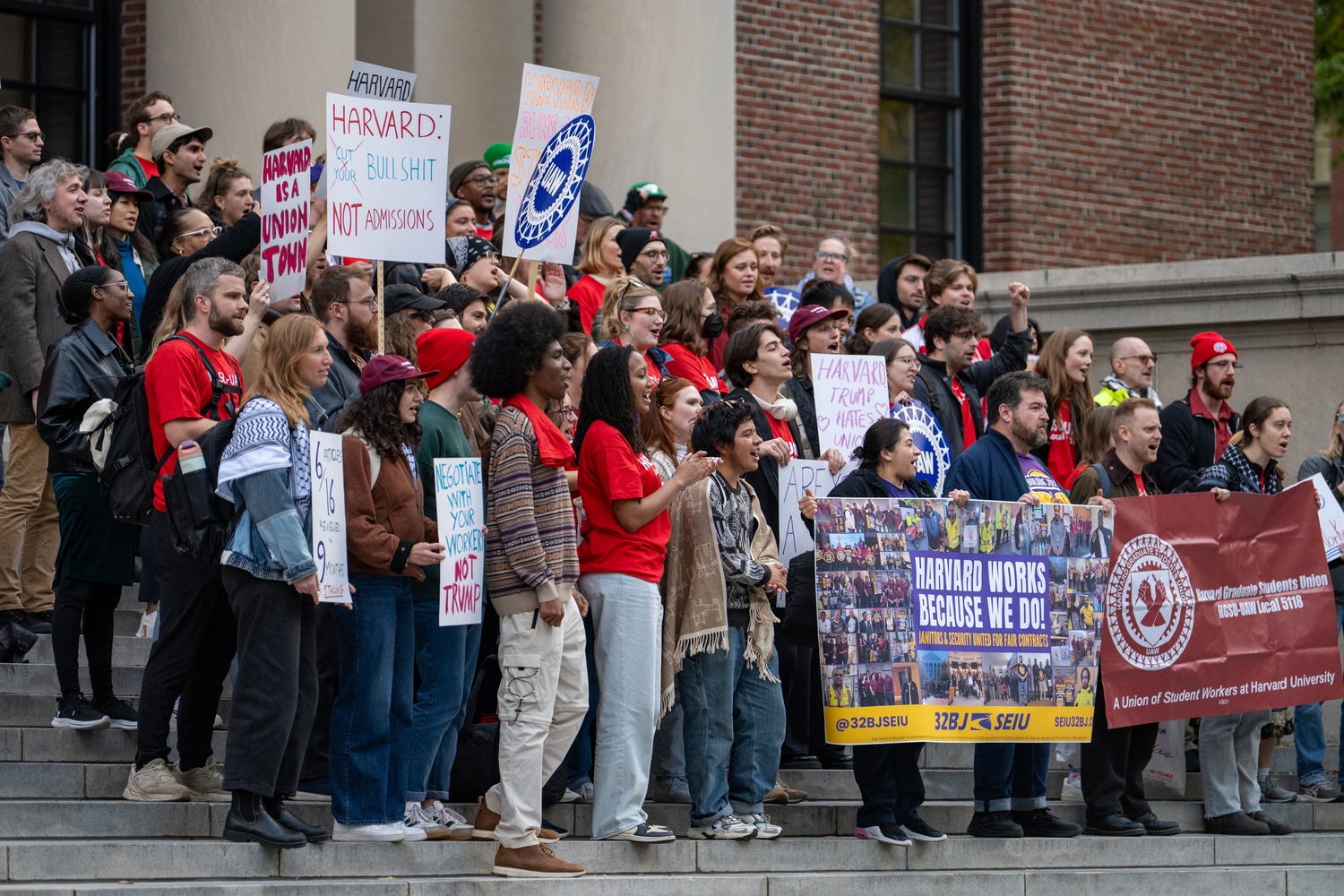
The recent dispute between Harvard and the academic workers’ union isn’t an anomaly; it’s an extension of the University’s years-long resistance to union demands for fairer pay and stabler contracts.
After more than a year of negotiations with Harvard Academic Workers-United Auto Workers, the University proposed removing time caps on non-tenure track faculty in exchange for increasing their workload. The proposal would grind even more labor out of the academic workers on some of the lowest-paid, least-stable contracts. But this is more than a common labor disagreement; in recent years, Harvard has repeatedly drawn on a neoliberal playbook when it comes to labor: undermine collective bargaining in coordinated efforts, and resist meaningful improvements in workers’ conditions.
Unions aren’t saintly actors whose every wish Harvard should grant, and the University has a right to act in its own interests. But Harvard has been more than willing to splurge on superstar professors and top administrators; it’s more committed, it seems, to catching the big fish at the top than it is to guaranteeing stability and fair compensation for academic workers.
It’s for these workers, in recent years, that Harvard has been most resistant to real (inflation-adjusted) wage growth.
In their 2012 negotiations, Harvard’s proposal to the Harvard Union of Clerical and Technical Workers would have kept real wage growth below one percent. Likewise, if its 2019 offer to the Harvard Graduate Students Union-United Auto Workers were implemented, real wages would have stagnated, fluctuating between slight gains and losses.
In other cases, the University has proposed real wage cuts. In 2023, the University offered HUCTW what amounted to a marginal decrease in the first year. And late last year, after walking back a wage freeze for custodians, Harvard offered them a one percent wage increase in July 2026. With inflation predicted to sit at 2.9 percent for most of 2026, according to a recent Blue Chip survey, that would result in a real wage cut of 1.9 percent in the first year.
More importantly, Harvard isn’t a tough but fair negotiator; it plays dirty.
In 2022, union members alleged that the University retaliated against Kevin Harrington and Karen O’Brien for their work with HUCTW. Harrington claimed that he was “targeted” and “singled out” for his union activity and that he “experienced even greater discrimination, retaliation, and harassment” when he contracted Covid-19. A union representative said that O’Brien’s boss had scolded her in front of her co-workers for working as a union representative; allegedly she was later demoted, her pay cut by 10 percent.
Cases of personal retaliation might be isolated, but they indicate a pattern of undermining unions’ strength and quieting their advocacy. HGSU-UAW has alleged that Harvard has dragged out negotiations unnecessarily and withheld critical information, and University representatives have insisted that all bargaining sessions be held in private. All of these tactics undermine collective bargaining power: Unnecessary delays push unions to cut undesirable deals for the sake of securing a contract, while withholding information and keeping negotiations private keeps union leaders in the dark and erodes public accountability.
In arguably its most explicit attack on unions, Harvard excluded 900 graduate students on research-based stipends from their bargaining unit last July, arguing that since they received stipends, they weren’t employees. This unilateral decision — which, according to some labor scholars at Harvard, is legally dubious — not only strips students of the protections granted by unions; it could cost HGSU-UAW between 25 and 40 percent of the dues automatically deducted from workers’ monthly paychecks.
As collective bargaining weakens, the burden of budget cuts falls squarely on less secure workers. Harvard’s latest proposal to increase workloads for non-tenure-track faculty might be framed as an unfortunate but necessary austerity measure. But it seems that the University’s highest-paid, most-stable employees rarely feel the squeeze; real wage increases have been concentrated overwhelmingly at the top.
Over the past four decades, the salaries of the highest paid professors and administrators have far outpaced those of junior faculty. By my estimate, while associate professors — who are among the highest paid of junior faculty — have seen real wage increases of roughly over 90 percent, the maximum salary for professors has increased by nearly 640 percent, from $80,000 in 1982 to over $1.9 million in 2023. It’s a similar story for top administrators, with the maximum salary increasing by more than 280 percent from 1982 to 2022.
The rising tide may have lifted all boats, but it lifted a select few much higher. And this represents a pedagogical shift as much as an economic one: High-profile talent is considered more important than the academic workers who do the heavy lifting in classrooms.
Sure, the big names might attract more talent among both professionals and students, and they bolster Harvard’s prestige. But exploiting non-tenure-track faculty to cope with budget cuts will only harm teaching quality, undermining the University’s renewed commitment to academic rigor.
Time caps, stagnant real wages, and weakened unions aren’t just isolated policies prompted by budget cuts. They’re the architecture of a university that protects prestige at the top by exporting precarity downward.
Luke D. O’Brien ’27, a Crimson Editorial editor, is a Social Studies concentrator in Eliot House.
Want to keep up with breaking news? Subscribe to our email newsletter
Have a tip for The Crimson? Share it confidentially