Healey Announces OpenAI Partnership at AI Coalition Launch Event
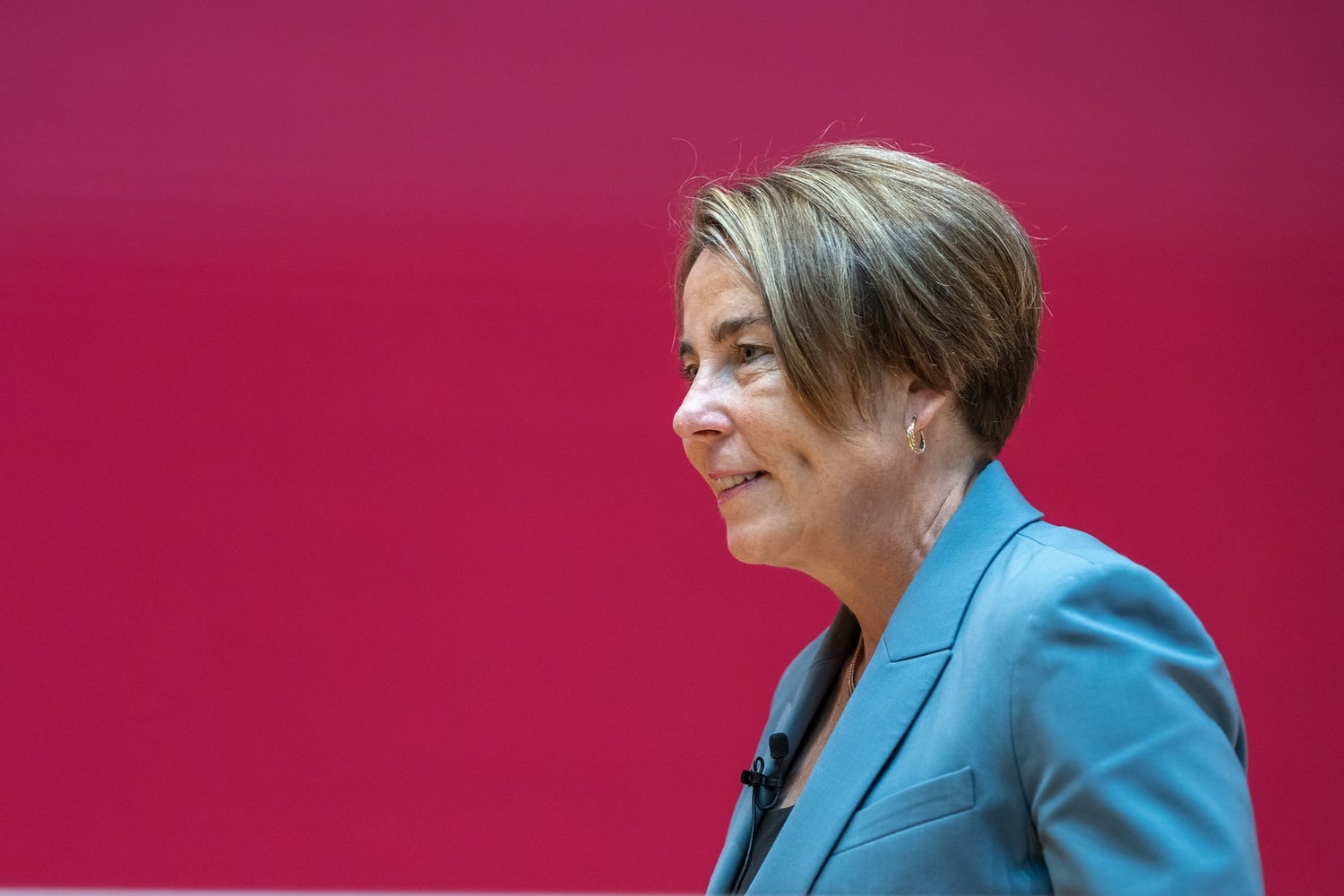
BOSTON — Massachusetts Governor Maura T. Healey ’92 announced Thursday that Massachusetts will partner with OpenAI to provide ChatGPT-powered artificial intelligence assistants to executive-branch state employees, marking one of the most expansive deployments of generative AI in state government to date.
The partnership will provide AI assistants to more than 45,000 employees, a move Healey said reflects the state’s effort to position itself as a national leader in artificial intelligence amid accelerating commercial and public-sector adoption of the technology.
Healey made the announcement alongside OpenAI Chief Executive Officer Sam Altman, who appeared virtually, at the launch of the Massachusetts AI Coalition, a private-sector industry hub founded by wearable biotechnology company Whoop. The Coalition includes DraftKings, Wayfair, and more than two dozen other partner companies.
The Coalition aims to strengthen collaboration among startups, established companies, investors, and policymakers in the Boston area — a region rich in AI talent but often criticized for fragmented industry coordination. Since its announcement last month, the group has emphasized in-person programming, with plans to host more than 100 AI-focused events this year.
According to Ryan W. Durkin, vice president of AI at Whoop, the Coalition’s strategy centers on retaining early-stage companies and attracting outside firms to Massachusetts.
“The first goal is: start here, stay here,” Durkin said in a Thursday interview. “If you come here, we can put in the hard work to make it a compelling reason to stay.”
Despite the state’s academic and research strengths, Boston has lagged behind peer cities such as San Francisco and New York in large-scale AI investment and company growth.
Andrew M. Lau, co-founder and chief executive officer of Jellyfish AI, one of the Coalition’s early-stage supporters, said collaboration remains a persistent challenge for the region’s AI ecosystem.
Get The Crimson in your inbox.
“I think there is a challenge, which is, we aren't always the most connected, and there is a desire for more of this,” Lau said.
Judah Phillips, a local entrepreneur and investor who founded the Boston Generative AI Meetups, said sustained collaboration is essential to maintaining competitiveness. His network, which counts more than 6,000 members, has drawn thousands of attendees to events such as Boston AI Week over the past two years.
“AI doesn’t grow in isolation. It grows in ecosystems. Boston already has the ecosystem. If we align research, capital, startups, enterprise adoption, and workforce development, Massachusetts doesn’t just participate in the AI economy, it defines it,” Phillips wrote in a Wednesday statement.
Calls for cross-sector coordination have been a recurring theme in the state’s AI strategy. When Healey announced the Artificial Intelligence Strategic Task Force in February 2024, she similarly emphasized collaboration as key to establishing Massachusetts as a global AI hub.
“I think if there's been anything that I would say about the past month, it's that people are ready to engage again,” Durkin said in an interview before the event.
The Thursday launch was the Coalition’s first event since the group was announced last month, drawing more than 250 startup founders , public officials, students and venture capital executives to the headquarters of Whoop.
“There's a lot of activity, and I think there's less of a community building habit. There's a lot of head down working, which is really important,” said Emily M. Spector ’21, head of business operations at Tutor Intelligence.
“The exchange of ideas that is second nature in places like New York and San Francisco is kind of easy to overlook in Boston,” she added. “I love this. I hope this becomes the new normal.”
—Staff writer Maahi A. Bose can be reached at [email protected] or on Signal at @maahibose.36. Follow her on X @BoseMaahi.
Want to keep up with breaking news? Subscribe to our email newsletter
Have a tip for The Crimson? Share it confidentially