“We Can Dance Too”: Harvard Crimson Dance Team Places in UDA Finals for First Time

Two years after taking the stage in Orlando with its iconic Legally Blonde-themed routine, the Harvard Crimson Dance Team (HCDT) snapped back into the national spotlight, showing it can dance alongside the best teams in the country.
In only its third year competing—and for the first time in program history—HCDT’s pom team qualified as finalists and finished in eighth place at the Universal Dance Association’s College Nationals competition, the country’s most prestigious collegiate dance championship, which features hundreds of college teams.
The dance team historically had only competed in the jazz category at UDA Nationals, meaning the pom team is a new addition to the Crimson’s routines.
“Harvard hadn’t yet had a name down at this competition. Legally Blonde helped our team kind of first put their name on the map, but we were trying to look for that next step,” first-year coach Emily Booth said.
And after this year’s success, the team certainly believes it has taken a step in that direction.
UDA Nationals hosts three different styles of competition: jazz, hip hop, and pom. To qualify for finals, a team must first compete in a preliminary round, where the top ten teams advance to the final round and vie for a spot on the podium.
While this year’s pom routine didn’t center around a theme, the routine did feature a medley of well-known pop songs, including Tate McRae’s ‘Sports Car’, PinkPantheress’s ‘Boy’s a Liar’, and Kendrick Lamar’s ‘DNA’.
Harvard’s team is smaller than most. Several Crimson dancers compete on both the jazz and pom teams, while other schools have dancers specializing in just one technique. Despite Harvard’s status as a relatively new contender in the pom category, the Crimson certainly took the steps this year to solidify its reputation as a competitive team.
“We kind of have a reputation of ‘Oh, they can’t really dance, but at least they’re smart—at least they have one thing going for them,’” junior co-captain Ciera Green said. “And I think it meant a lot to everyone, because, no, we can dance too.”
For this year’s routine, the team hired an external choreographer, which not only helped lift a burden off the team but also allowed it to tap into the expertise of a former and seasoned college dancer.
A pom routine is high-energy, involving sharp movements and turns while dancers hold pom-poms in their hands. The Harvard team increased the difficulty of this year’s routine with new tumbling skills, advanced turning combinations, and even a backflip by junior co-captain Haley Muñoz.
“Having that outside source who also knows how the competition works leveled up their choreography because they’re so talented,” Booth, who danced for 15 years and won the UDA Nationals three times with Endicott College, said. “Every dancer has their own talent, and it’s being able to take those couple of talents and put them all in one routine that helps the whole team as a whole.”
The team started learning its competition routines in October before finalizing preparations in a January ‘bootcamp’ involving five straight days of practice, 12 hours a day. Afterward, they headed to Orlando for the national competition, where the team performed its routines for the first time.
“That’s when we really attack these dances and make any major changes and really clean them,” Muñoz said. “Cleaning a dance means ensuring that every dancer is hitting the same position at every count, that way everyone looks as in unison as possible when dancing.”
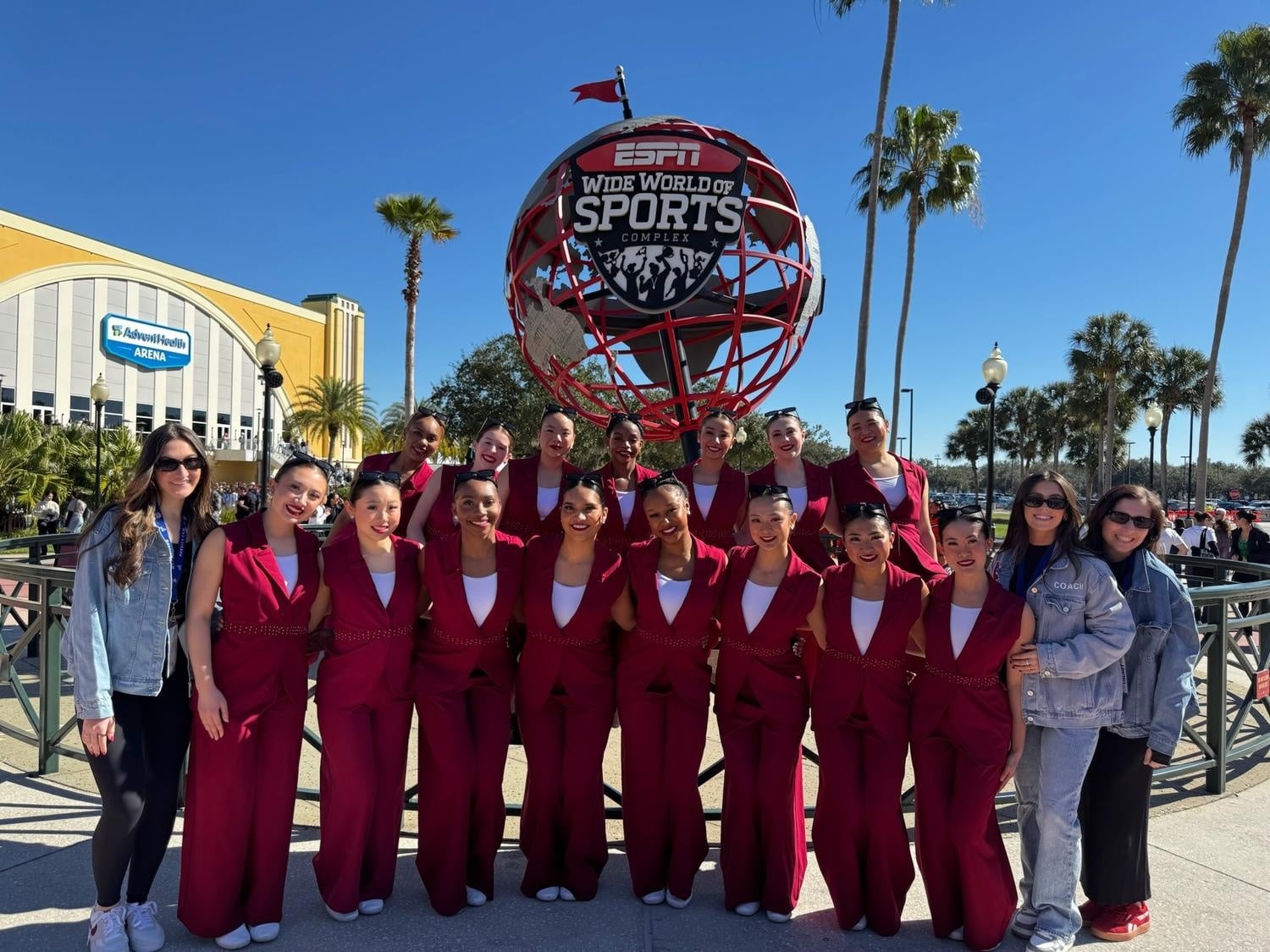
After COVID-19, the team suffered from a lack of participants. Green credits the team’s prior leadership for creating a “family-oriented environment” within the team, which not only enticed people to join but also motivated members to consistently improve and practice.
“From my experience in the last two years, I was like, I think we were ready. We are competitive. We’re capable of this,” Green said regarding her mindset this season. “I think it definitely came from being motivated over the years and watching the team and just how much we cared about each other. If you don’t do it for yourself, do it for your teammates. Do it for your seniors.”
When the team found out it had qualified for the finals round, Green said: “All the work we’ve put in and the sacrifices we’ve made built up to this moment."
“Our bodies were fatiguing. We had injured knees, injured this, injured that. When we heard our name being called, it really showed us that we were able to do it,” she added.
Muñoz said a mentality shift from all members helped improve the team’s determination this year, ranging from the physical workouts to refining the dance technique itself.
“Every year the mentality going in has been more like ‘Try your best out there, but whatever place we get, it is what it is,’” Muñoz said. “Last year, especially, we were so close to making finals, and we realized that we really had the potential to make it happen.”
“They wanted to be a team that was competitive, and the team prior to that was not as competitive. But they switched their mindset this year,” Booth added. “I told them, after we got home from nationals, that I gave them the tools, but they were the ones who really went out there and performed their best.”
The jazz team hopes to adopt the same strategies and achieve a finals berth of its own.
“Another goal is to also get the jazz routine to finals. Both of those dances in the finals routine makes them that much stronger of a program,” Booth said. “Jazz is very open for interpretation. Trying to find exactly what style of jazz works for them will help get them more consistent and get to that final placement.”
While other collegiate dance programs may receive support and funding similar to a varsity team, including the ability to host recruitment efforts, Muñoz said the work ethic and dedication of Harvard’s team—which is officially a club sport—made up the difference.
Outside of competition season, HCDT performs at varsity basketball and football games and hosts dance clinics for local youth groups and organizations.
“Anytime we get a call or email just asking us to come support something, whether it’s athletics or not, we normally do it,” Green explained.
“We just want to increase school spirit. We want to rally up the school, the students, and get everyone excited for whatever is going on,” she added.
The team’s next step is the UDA New England Dance Challenge, slated to take place on Feb. 15. HCDT has won four of the last six regional competitions.
“As a captain, I’m very, very proud of this team. I’m proud that we were able to make history, and that this has set the standard for us moving forward,” Green said.
Now, the team believes people can say Harvard doesn’t just have great academics.
“On top of them having that, now they have that ability to say, “You know what? Not only are we super smart, but we can also place really well in the athletic competitions,’” Booth said.
—Staff writer Uy B. Pham can be reached at [email protected]. or on Signal at ubp.88. Follow him on X @uybpham.
Want to keep up with breaking news? Subscribe to our email newsletter
Have a tip for The Crimson? Share it confidentially