We Need To Talk About Kevin
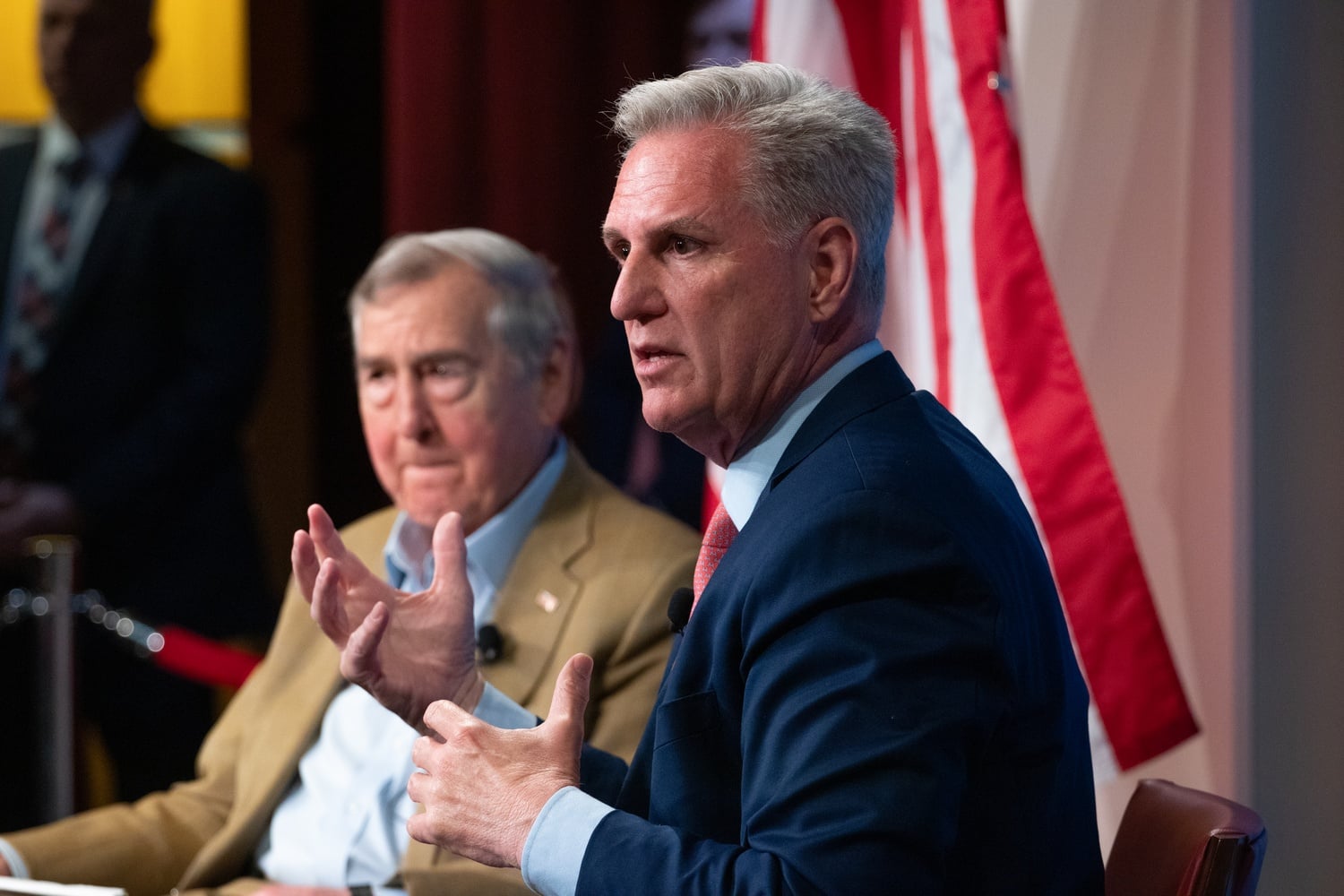
Despite government attacks on academic freedom that increasingly resemble 1950s anti-communist witch hunts, Harvard continues this semester to pursue open debate and “viewpoint diversity.”
Case in point: Kevin McCarthy, the former Speaker of the House, is now a visiting fellow at the Institute of Politics at the Harvard Kennedy School.
At first, I admit, I was puzzled by the selection of McCarthy. “Intellectual vitality” couldn’t mean “invite more Republicans to campus.” Quotas are the opposite of what critics such as Christopher Rufo wanted when they sought a wider “range of discourse” at Harvard and other universities.
Thus, I was curious: How does McCarthy expand our discourse? What does he bring to our community, beyond his party affiliation?
At first glance, this question proved hard to answer. In proportion to his long public career, McCarthy has successfully sponsored exceptionally few bills of national concern. His reputation derives mostly from his rapid climb to leadership.
But our commitment to intellectual vitality requires us to discard this kind of superficial judgment. And to my surprise, as I explored McCarthy’s biography, I grew increasingly convinced that his career actually exemplifies four virtues our campus discourse must cultivate: an openness to new views, an ability to unite opponents, a refusal to settle for the status quo, and care for people suffering persecution.
Consider first McCarthy’s tolerance. McCarthy helped expand the outlook of the Republican Party, accommodating ideas once considered unacceptable. As Minority Leader, the open-minded McCarthy helped elevate Republican outsiders such as former Representative Marjorie Taylor Greene (R-Ga.) and Lauren Boebert (R-Co.), prominent for their advocacy of antisemitic conspiracies and Islamophobia, respectively.
Despite much public outcry over their heterodox opinions, McCarthy stood by Greene and Boebert, thereby encouraging Republicans openly to embrace bigotry and conspiracy-thinking — and, for Harvard students, modeling viewpoint diversity.
McCarthy is more than a party-builder, however. At a time when Republicans and Democrats seemingly cannot agree about anything, McCarthy demonstrated a generational talent for uniting legislators across party lines. For instance, in 2023, 21 Republican members of Congress joined all Democrats in opposing McCarthy’s election as Speaker — an impasse that lasted for 15 ballots, setting a record in the modern House. While that vote eventually resolved along party lines, a mere ten months later, Republicans again joined Democrats to oust McCarthy from the speakership — a historic first.
As the Harvard community strives to maintain campus unity despite deep-seated differences, McCarthy’s ability to effect bipartisan consensus, particularly over such a contested subject as the House’s leadership, should inspire us all.
McCarthy is also resilient. Despite that there is no evidence of outcome-determinative fraud in the 2020 election, McCarthy supported the effort to overturn state results in the face of widespread condemnation. He lent early support to the claim that Trump had won when he hadn’t, was among the 147 Republicans in Congress who voted against certifying parts of that election, and backed a lawsuit filed by Texas that sought to invalidate results in four states. The majority of Republicans in Congress came around to supporting McCarthy’s objections.
(Notably, Harvard itself rejected those claims at the time. The IOP removed Representative Elise M. Stefanik ’06 (R-N.Y.) from their Senior Advisory Committee after she “made public assertions about voter fraud in November’s presidential election that have no basis in evidence,” according to then-Dean Douglas W. Elmendorf. That the IOP now welcomes a visiting fellow who has participated in election denialism signals Harvard’s positive commitment to change.)
Would such consensus — let alone the recently relaunched federal investigation of the 2020 election — have been possible without McCarthy’s stubborn skepticism? Harvard students take note: patience and persistence can turn your fantasies into reality.
Finally, we must consider McCarthy’s steadfast support for those whom society would cast out and punish. In the days and weeks after the insurrection, many Republicans, McCarthy included, expressed revulsion at Trump’s incitement of the mob and reluctance to suppress a violent assault on the legislature.
But where other leaders might have rushed to final judgment, McCarthy quickly swallowed his pride and extended a hand in friendship and forgiveness. Before Trump’s second impeachment trial had even begun, McCarthy broke ground by visiting Trump at his Mar-a-Lago resort. The indelible image of the two men standing together helped reconcile Republicans to their disgraced chief at the latter’s moment of greatest vulnerability.
I’m not going to pretend that Kevin McCarthy and I agree about the policies necessary to save our nation in this moment of crisis. But social and moral leadership often matters more than policy. McCarthy’s transformative openness, ability to bring opponents together, refusal to accept conventional wisdom, and zealous care for the persecuted shine out in an age of moral absolutes, partisanship, group-think, and selfishness.
We hear a lot these days about the “isms” threatening our democracy: ethno-nationalism, authoritarianism, fascism.
This semester, Harvard needs McCarthyism.
Derek Miller is a professor of English and the chair of the Standing Committee on Theater, Dance, and Media at Harvard.
Want to keep up with breaking news? Subscribe to our email newsletter
Have a tip for The Crimson? Share it confidentially