Maschmeyer ’16 and Team Canada Settle for Silver, Fall to the USA in an OT Thriller
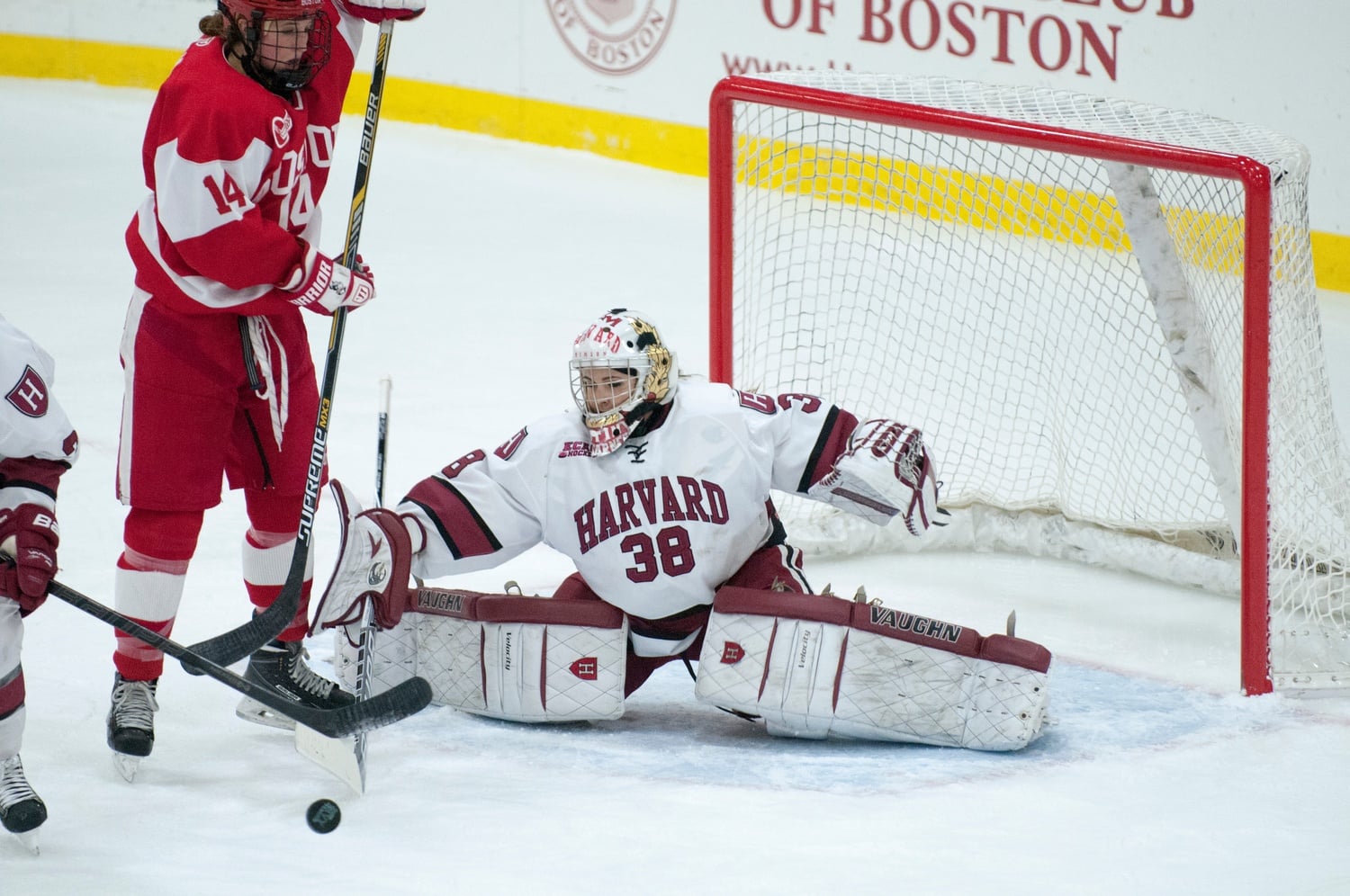
Emerance Maschmeyer ’16 was one win away from her second consecutive Olympic gold medal. Instead, the Harvard women’s hockey legend and Team Canada watched the latest chapter of the sport’s fiercest rivalry slip away in overtime. Canada’s rival, the United States, scored twice in the final minutes, first to tie and force extra play, and then to win and capture the Olympic gold medal with a 2-1 victory today at Milano Santagiulia Ice Hockey Arena.
For long stretches, Canada looked nothing like the team that had been routed 5-0 by the U.S. in the preliminary round. This time, the game was tight, tense, and decided by inches. After the first period, the score was 0-0, with Canada holding a slight edge in both shots (8-6) and faceoff wins (52-48). The U.S., the tournament favorite, spent more time than usual chasing the puck and navigating early penalty trouble. The Americans took two penalties in the opening frame, but their goaltender, Aerin Frankel, was sharp immediately, flashing a right-toe save during one kill to keep the game scoreless amid the early waves of pressure.
Canada finally broke through early in the second, and did it in the most deflating way possible for the U.S.: short-handed. With the Americans on a power play to start the period, Canadian forward Laura Stacey jumped a play and dished the puck to her teammate Kristin O’Neill on a breakaway. O’Neill buried the puck to make it 1-0, tallying a short-handed goal that shifted the momentum and gave Team Canada the early advantage in the rivalry matchup.
From there, the night turned into a goaltending and shot-blocking clinic. The U.S. began to find its legs, outshooting Canada 14-13 in the period and generating its best looks, including a sequence where starting Canadian goalie Ann-Renée Desbiens lost sight of the puck in front, glancing frantically behind her as the puck bounced through the blue paint and narrowly missed crossing the goalline. The Americans had multiple near-misses: a point-blank look that sailed high, another loose puck chance that somehow didn’t cross the line, and a stretch where they pinned Canada in the zone but couldn’t finish through layers of sticks and bodies.
Canada, meanwhile, had its own chances to double the lead, but struggled to convert on offense. Frankel robbed forward Sarah Fillier on a backdoor look after a cross-crease feed, then denied another Grade-A chance off the rush. Through two periods, Canada led 1-0 despite an almost even shot count (21-20), with Frankel deflecting Fillier on a backdoor chance and kicking out a right-pad save on a rush and Desbiens smothering rebounds and surviving scrambles in front of the net.
The third period turned into a grind, with intense puck battles along the boards as the two teams fought for an edge as time dwindled. Canada threatened to put the game away when center and captain Marie-Philip Poulin missed the net from the slot on a prime chance during a late power play. On another rush, the captain whizzed a shot just wide. The Americans, desperate for an equalizer, had their own golden chance when Desbiens momentarily lost her stick in the crease, but the U.S. couldn’t fire off a clean shot through traffic in time to capitalize.
Midway through the period, the temperature spiked again when American forward Abbey Murphy was called for boarding Canadian defender Jocelyne Larocque, putting Canada back on the advantage and drawing a roar from the red-and-white-heavy crowd. The U.S. penalty kill held again, but the traffic in front of Frankel hinted at danger.
With time bleeding out and the U.S. still blank on the scoreboard, the American Head Coach, John Wroblewski, pulled Frankel to add an extra skater. Suddenly, the U.S.’s zone time had teeth. With 2:04 left, captain Hilary Knight planted herself at the top of the crease and did what she has done for more than a decade: she found the opening in front, got her stick on a shot from forward Laila Edwards, and tipped it home to tie the game 1-1. The roar in the arena hit like a wave. Canada had been minutes from securing its sixth gold medal in women’s ice hockey. Suddenly, the game was all tied up and deafening chants of U-S-A rang throughout the rink.
The game moved to a sudden-death three-on-three overtime, opening up the ice after 60 tightly contested minutes. Keller ripped a shot that Desbiens fought off. Poulin had a look on the other end that slid just wide of the posts. Frankel kicked out a big save as Canada attacked down the right side. When the Canadians earned a breakaway, the U.S. recovered with a stellar backcheck that disrupted the chance just enough for the Americans to survive.
Then, it ended in a flash. U.S. forward Taylor Heise launched a stretch pass from behind the net that found American defender Megan Keller in stride. Keller beat a defender in open ice, cut toward the net, and finished a backhand, securing the goal that gave the U.S. its third Olympic gold medal.
Even in defeat, Maschmeyer leaves Milan with another Olympic medal and another appearance on the sport’s biggest stage. The former Crimson captain entered the gold medal game having logged 128 minutes across her three 2026 Olympic appearances, recording a 0.957 save percentage and a shutout over Switzerland on Feb. 7. While she did not see the ice in the gold medal game, the Harvard alum was again part of a stellar Canadian goaltending tandem built to handle Olympic pressure.
A cornerstone of Harvard’s program from 2012-16, Maschmeyer still stands as the Crimson’s all-time leader in career saves (2,538) and helped power a playoff run that included a trip to the 2015 National Championship Game and three consecutive NCAA tournament appearances. A decade later, she remains in Canada’s Olympic picture, serving as the kind of veteran that teams trust when pressure builds.
In the end, Canada fell against the U.S., concluding another chapter in a rivalry that continues to define the sport, even as rosters evolve and new names step into the spotlight. For Maschmeyer and the Canadians who experienced the empty stands in Beijing in 2022 due to COVID-19 restrictions, today’s silver medal may carry disappointment. However, this time she got to play in Milan with her family there to cheer her on. The medal may not be gold, but it is another impressive podium finish. With the PWHL season restarting after the games, Maschmeyer will return to Vancouver to don the Goldeneyes’ jersey, continuing her illustrious hockey career.
— Staff Writer Tamar H. Scheinfeld can be reached at [email protected].
Want to keep up with breaking news? Subscribe to our email newsletter
Have a tip for The Crimson? Share it confidentially