A Salient Search for Conservatism at Harvard
I dropped my bags in Thayer Hall and let it sink in: I was here. I was at Harvard. Just months earlier, I had seriously considered not coming at all.
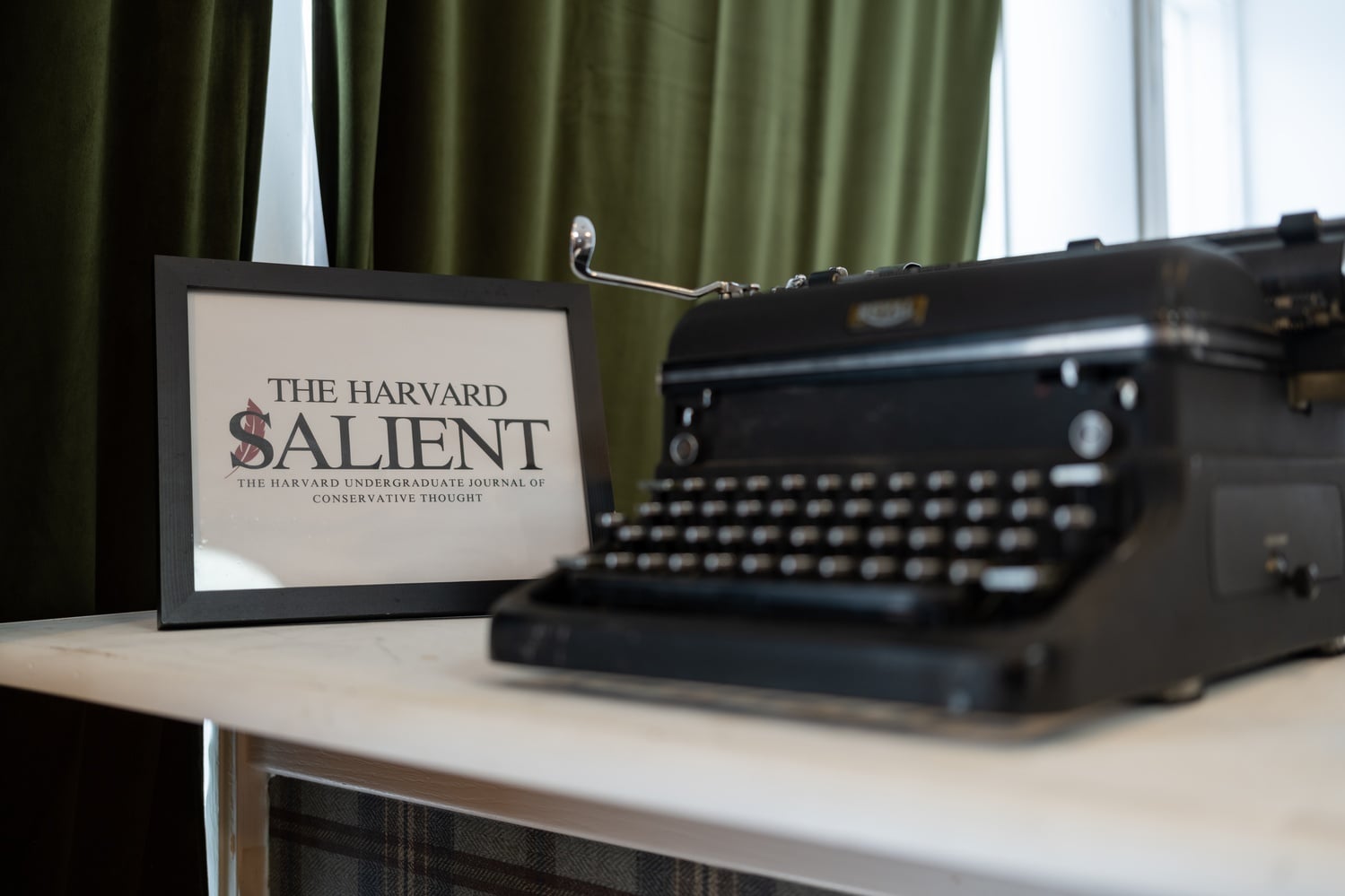
What changed my mind was the Harvard Salient. The existence of venues for dedicated, serious conservative inquiry at Harvard aren’t extraneous, fringe initiatives that benefit only a few; they are vital to the health and mission of Harvard College.
I know this now better than most.
When I told people back home that I was applying to Harvard, the reactions were rarely neutral. “You want to go there?” Some friends quietly confessed their parents had banned them from applying altogether. After I was admitted, enthusiasm was followed quickly by disbelief. “That’s incredible… but you aren’t actually going, right?”
I understood where the sentiment came from. In my years leading up to college, elite universities had come to feel less like places of open inquiry and more like ideological sorting mechanisms. Stories of shouted-down speakers, social ostracism, and the quiet narrowing of acceptable opinion circulated freely, especially among conservative students. Whether exaggerated or not, they shaped expectations. For someone like me, choosing Harvard felt like a gamble: that intellectual seriousness was still more important than political alignment.
That bet followed me to Visitas. When my host asked about my summer plans, I told her I would be working for Senator Ted Cruz (R-Texas). She leaned in and whispered, half-joking, half-serious: “Wait — are you a conservative?” I whispered back, equally conspiratorial, “Yes… are you?”
It was a small but meaningful moment. I asked her everything I had been afraid to ask: What was it really like to be conservative here? Was the campus as hostile as the headlines suggested? She assured me that, while Harvard certainly leans left, disagreement was not synonymous with ostracism — and that students here were far more thoughtful than the caricatures I had seen in the media.
So I committed.
Immediately, I began searching for a conservative community. I had chosen Harvard for an intellectual challenge, not ideological comfort. Disagreement was precisely what I sought. But I was uncertain of whether disagreement would be met with curiosity or contempt. Without a community, even confident convictions can be hard to express publicly. A place to land does not insulate students from challenge; it gives them the footing to engage in it honestly. I found four conservative organizations on campus and assumed I would naturally find my place among them all.
In practice, that proved harder than expected. One organization was effectively no longer open to women. Another existed mostly as an email list alongside occasional events. A third, to the best of my knowledge, only hosted one event of its own during the fall. By the time I arrived on campus, only the Harvard Salient remained as a consistent space for conservative engagement.
I am a classically educated writer but have no background in journalism; I had never written for a paper. But I joined anyway, comping for the business team, because I believed in what the Salient fundamentally represented: not outrage or provocation for its own sake, but conservative thought taken seriously.
Shortly after I joined, the Salient erupted into a governance crisis that led to a halt in publication, followed by the resignation of all the Salient’s executive officers. From the outside, the situation was framed as a political schism — a “right-wing civil war.” From the inside, it looked different.
Like conservative student groups across the country, the Salient was forced to reckon with its direction and purpose. Ultimately, we chose serious, thoughtful conservatism. We have committed to publishing writing that is rigorous, compelling, and grounded in a recognition of America’s fundamental moral principles. This purpose excludes rhetoric that demeans individuals or groups, not because such rhetoric is “unpopular,” but because it undermines the very possibility of civil discourse our journal was founded to promote. Traditions endure only when they are morally serious, and discourse collapses when it abandons respect for the individual human person.
I was not on the masthead when the Salient was shut down. But when the dust settled, I agreed to help lead the interim team because I believe Harvard cannot afford to lose its conservative voice. Harvard’s championing of intellectual vitality rings hollow if entire traditions of thought quietly disappear from campus life. Students cannot truly test their beliefs unless they are forced to defend them against principled opposition. Exposure to conservatism is not a threat to Harvard’s values; it is a fulfillment of them.
I came to Harvard unsure whether there was room here for someone like me. The Salient’s revival is about ensuring that civil discourse and intellectual rigor in search of truth remain central to what it means to be a Harvard student.
That, at least, is why I’m here.
Keri E. Collins ’29 lives in Thayer Hall. She is interim president of the Harvard Salient.
Want to keep up with breaking news? Subscribe to our email newsletter
Have a tip for The Crimson? Share it confidentially