After Shutdown and Scandal, The Harvard Salient Is Attempting a Comeback
After months of scandal and a board-imposed shutdown, the Harvard Salient is attempting a reset. With new leadership, new guardrails, and a promise to abandon pseudonyms and extremism, the conservative publication is betting it can bolster both its staff and its credibility.
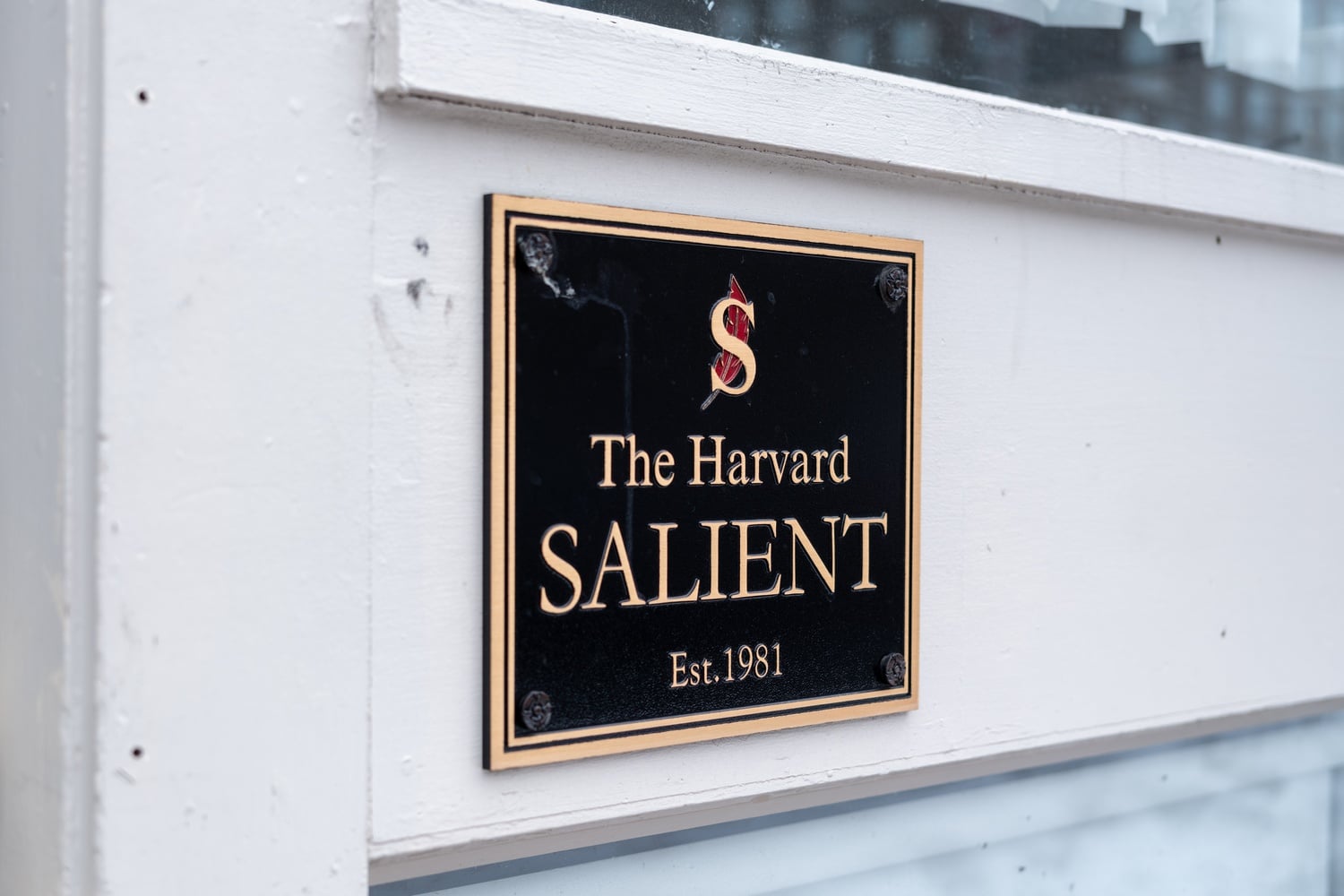
eri E. Collins ’29 spent her first day back from winter break cleaning the Harvard Salient.
The building was in “total upheaval,” she said: papers were everywhere, furniture was overturned, the toilet wouldn’t flush, and the fridge was full of black mold. The cleanup took hours — the physical remnant of the magazine’s abrupt collapse weeks earlier.
“To the extent of that that was intentional versus them being very messy, I can’t speak on,” Collins said. “But I do know that there was a lot to do when I came into the building to set back up.”
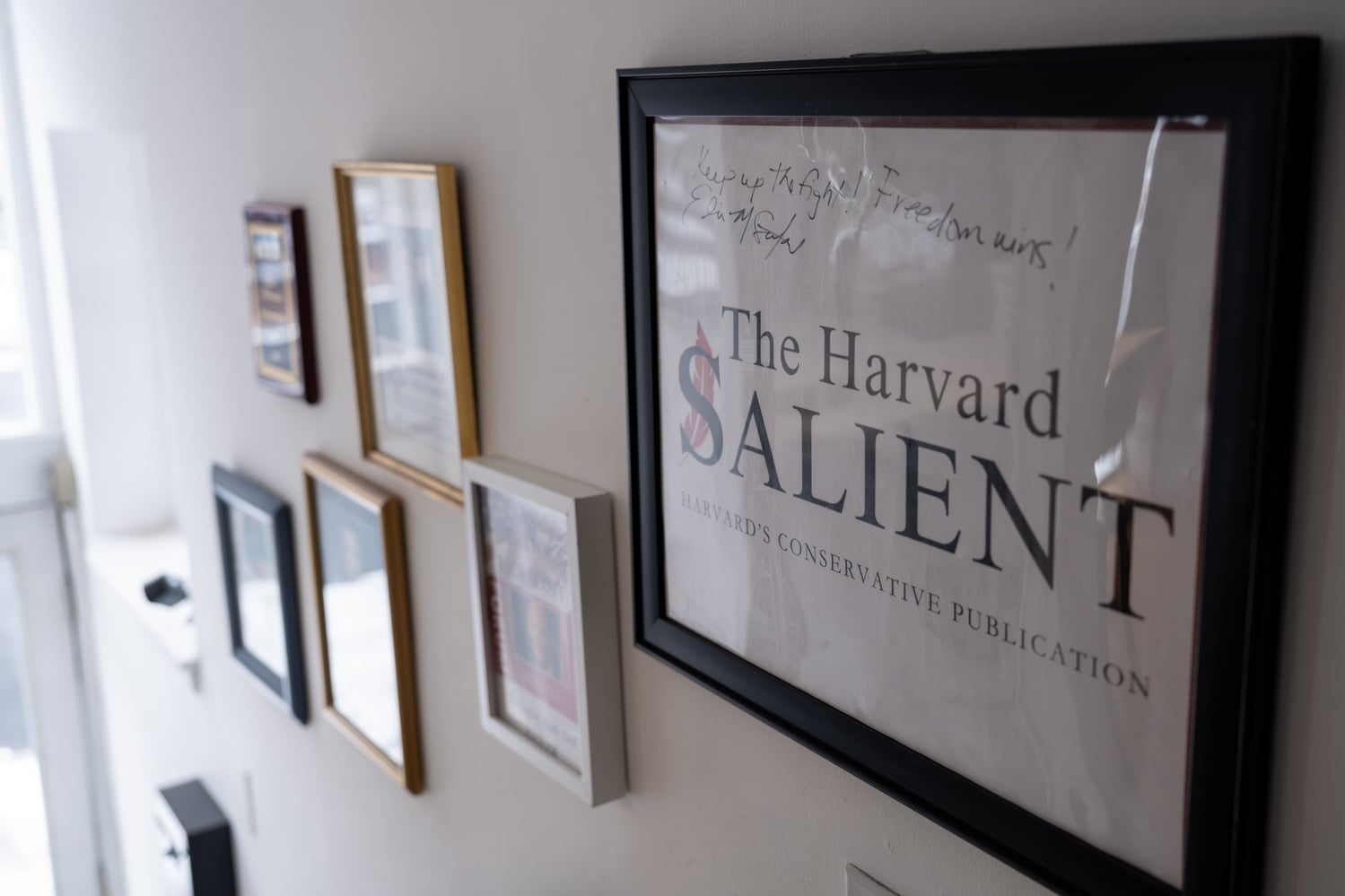
Collins was sworn in Sunday as the Salient’s new interim president, nearly four months after the magazine’s board of directors suspended the publication, citing material it deemed “reprehensible, abusive, and demeaning.”
The suspension followed a semester of escalating controversy — including a published article closely resembling language from an Adolf Hitler speech, racial slurs in an internal group chat, and draft article materials that included swastikas and Nazi slogans. Nearly all of the Salient’s roughly 25 members resigned in the fallout. Collins — who finished the comp process two days before the suspension — was one of only three members who remained.
“One other member who comped with me did not resign, and we did not resign for the exact same purpose,” Collins said. “We both thought what the board did was right. We were concerned.”
Now, the Salient is attempting a rebuild from near-scratch — dismantling its pseudonym system, restructuring its editorial process, and working out what belongs in the conservative magazine and what doesn’t.
‘People Who Are Not Like Us’
Before the shutdown, the Salient had functioned as one of the few spaces on campus that explicitly promoted conservative community. Collins — a self-described social conservative and devout Christian from Austin, Texas — said she arrived at Harvard worrying she would not find her people. She had grown up expecting to attend a Texas school — Texas A&M or the University of Texas — where she thought her world and culture would be “intact.”
Get The Crimson in your inbox.
“The first reaction was like, why would you even apply to this school?” Collins said of classmates’ responses when they found out she had gotten into Harvard. Harvard, they told her, was for “people who are not like us.”
During Visitas, Collins’ host — whom she said was also conservative and Christian — helped convince her otherwise, recommending four organizations: the Institute of Politics Conservative Coalition, the Harvard Republican Club, the Salient, and the John Adams Society.
Collins said she was “totally sold” — and committed as soon as she landed back in Texas.
“I was like, okay, yes, there will be pushback, but there is at least a small community to rely upon,” she said.
But by the start of her first semester, three of those options had effectively disappeared. After putting her name down at JAS’ club fair booth, Collins did not hear back; the organization had quietly begun excluding women from its ranks.
The Institute of Politics’ Conservative Coalition and the Harvard Republican Club, she said, offered limited programming and little sense of sustained community. (The HRC and the Conservative Coalition pointed to events they had held on campus when reached for comment. JAS did not immediately respond.)
That left the Salient.
“I put my name down for the Salient, not really thinking that I was going to do it,” Collins said.
At the organization’s first meeting, she was surprised.
“Everybody I met was charming,” she said. “I had a great time.”
She said she spent most of the meeting speaking with women, including several female board members and former president Julia G. Grinstead ’27. But she said that not all compers appeared to feel the same ease. Of the ten who attended the meeting, three later dropped the comp.
Collins comped the business board, keeping her largely removed from editorial decision-making. Even from that distance, she said, it was clear that internal tensions were mounting.

“There was a certain point where a lot of people who were members said, ‘Okay, this is too much. This is not what I’m here for. This is not what I want to be associated with,’ and left as a result,” she said.
As the semester progressed, Collins said she became increasingly troubled by what the magazine was publishing.
“The Salient and what they had been writing went off mission,” she said.
The content, she said, crossed from controversial into “bigoted,” “insulting,” and “demeaning” — so inflammatory that she worried students would not even pick it up, much less engage with it in good faith.
Quoting Hitler, and arguing that women should go back to Radcliffe, were beyond the pale, she said.
Former Salient editor-in-chief Richard Y. Rodgers ’28 disputed the characterization, writing in a statement that the charge levied against the previous leaders “functions as a substitute for both use of the mind and the soul.”
Rodgers also rejected the implication that his leadership team was responsible for the state of the Salient’s office, writing that former members were locked out of the building beginning Oct. 26 and that maintenance thereafter fell to those the graduate board allowed access.
But the Salient’s board of directors ultimately decided the organization could not continue on. Two days after Collins completed comp, the board shut down the Salient’s operations. The problems extended beyond the September issues: an unreleased October edition included a call for mass executions, and earlier drafts of the Hitler-adjacent article featured a Nazi subtitle and swastika imagery, a December Crimson investigation revealed.
‘All Hands On Deck’
In the immediate aftermath of the shutdown, Collins said she questioned what the collapse meant — both for the organization and for conservative life on campus more broadly.
What kept her involved, she said, was the belief that the Salient filled a gap no other student group occupied.
“If Harvard lost its only conservative publication without having other real conservative orgs that students can be a part of, I mean, that’s such a horrible thing, right?” she said.
18 days later, Sarah L. Steele ’18-’26 — who had served as the Salient’s president during the 2024-25 academic year and returned in an interim capacity — contacted Collins to ask whether she would help rebuild the organization.
“She said, ‘Hey, let’s sit down and let’s talk about what you believe, what your values are, and see if you’re somebody we would still want to be here, and if so, would you be on board to help us bring this back around?’” Collins recalled.
A month later, Steele offered Collins the role of business manager. Collins accepted. Jason Morganbesser ’27, who had previously pushed back against the fall leadership in internal communications, became managing editor. (The publication currently has no editor-in-chief, but Morganbesser fills a similar role.)
With an overall masthead of six, the group had roughly a month to repair frayed donor relationships, recruit new members, and write, edit, and publish a new issue. Much of that work took place over winter break.
“In between calls, I was writing emails to professors, writing emails to donors,” Collins said. “There was a lot to be figured out and sorted through. I know people were working on it every single day since the shutdown.”
The outreach soon paid off. Collins said that since the new leadership took over, most of the Salient’s donors have returned.
As the rebuild progressed, members reached out to students who had avoided the Salient during the fall.
“Having people come up and say, ‘Hey, like, I’ve heard the Salient has switched courses and is back in line with its mission statement and these goals, and we want to be a part of that,’ it’s just been so beautiful and so encouraging,” she said.
Kelly B. Lenox ’29, now an editorial writer for the Salient, initially chose not to continue with the organization after its first comp meeting, but returned under the new leadership.
“I see the Salient making these arguments in good faith,” he said.
Lenox added that he felt the Salient is now “more inclusive” and that “people can read it and actually feel like, ‘Oh, they’re actually speaking to me.’”
The organization now has 19 members, including a full business team, though it continues to recruit for its editorial staff. The membership now skews heavily toward freshmen, Collins said.
Collins said age imbalances within the organization, which in years past had included veterans, contributed to earlier problems.
“There is a problem when pretty much — most — members are significantly older than the students,” she said. “It’s really easy for them to take over, right? Because students look up to people who are older than them — that’s just natural.”
‘We’re Not Some Secret Society’
Alongside rebuilding its membership, the Salient has begun formalizing new internal guardrails around authority, accountability, and editorial control.
Collins said the organization is working to establish clearer checks and balances between leadership roles — particularly between the president and the managing editor.
“When that doesn’t happen — when you don't have the president having that check on ed, or you don't have the editor-in-chief instituting that check on the president — then there are opportunities for things to be written and published that one side has not approved of that can hurt the image of the Salient,” she said.
While Collins declined to detail specific dynamics from the fall semester, she said the imbalance was evident in the content itself.
“I think that if we look at what was being published, then that makes you assume that there’s probably one side that had a lot more influence over the other,” she said. “In the past, definitely, the president and editor-in-chief were supposed to be checks on each other, but that doesn’t mean that that always happens perfectly.”
Among the most immediate changes is the planned elimination of pseudonyms. In the fall semester, the practice allowed just three writers to dominate entire issues under multiple aliases, according to a person familiar with the Salient’s operations.
“We want proof that there are different people writing every article in our issue,” Collins said.
In the first issue under the new leadership, contributors could publish under their full names or initials. Collins said “hopefully” the publication will move away from initials, which are meant to address safety concerns for students who do not yet want to be “completely publicly out there as a conservative.”
Ending pseudonyms also serves another purpose, Collins added, demonstrating that no members from the previous leadership are still contributing.
“The people in student leadership, they’re all gone,” she said.
The Salient has also begun exploring collaborations with other campus groups, including the Institute of Politics, to host conservative speakers.
“We’re not some secret society,” she said. “We are a conservative publication.”
This semester, Collins said the Salient’s priority is producing work that is defensible and intellectually serious — while remaining firmly conservative.
“We are a conservative publication that produces intellectual thought,” she said. “I like to use this Quintilian quote, ‘the good man speaking well,’ right? You’ve got to be persuasive, but you also have to be good.”
“We’re here to write pieces that can actually be received by people,” Collins added. “We want to make sure that we’re not quoting Hitler.”
Still, the Salient does not plan to publish pieces that stray from conservative ideology or recruit members who do not identify as conservative, she said.
Collins pointed to claims that women should not have the right to vote — an argument raised in internal Salient communications during the fall — as an example of content the Salient would no longer print “because the Conservative Party has not stood for that.”
“First off, you’re wrong, but second, you need to actually have some sort of backing to your statement,” she added. “And I don’t think that you can reasonably find something to argue that point.”
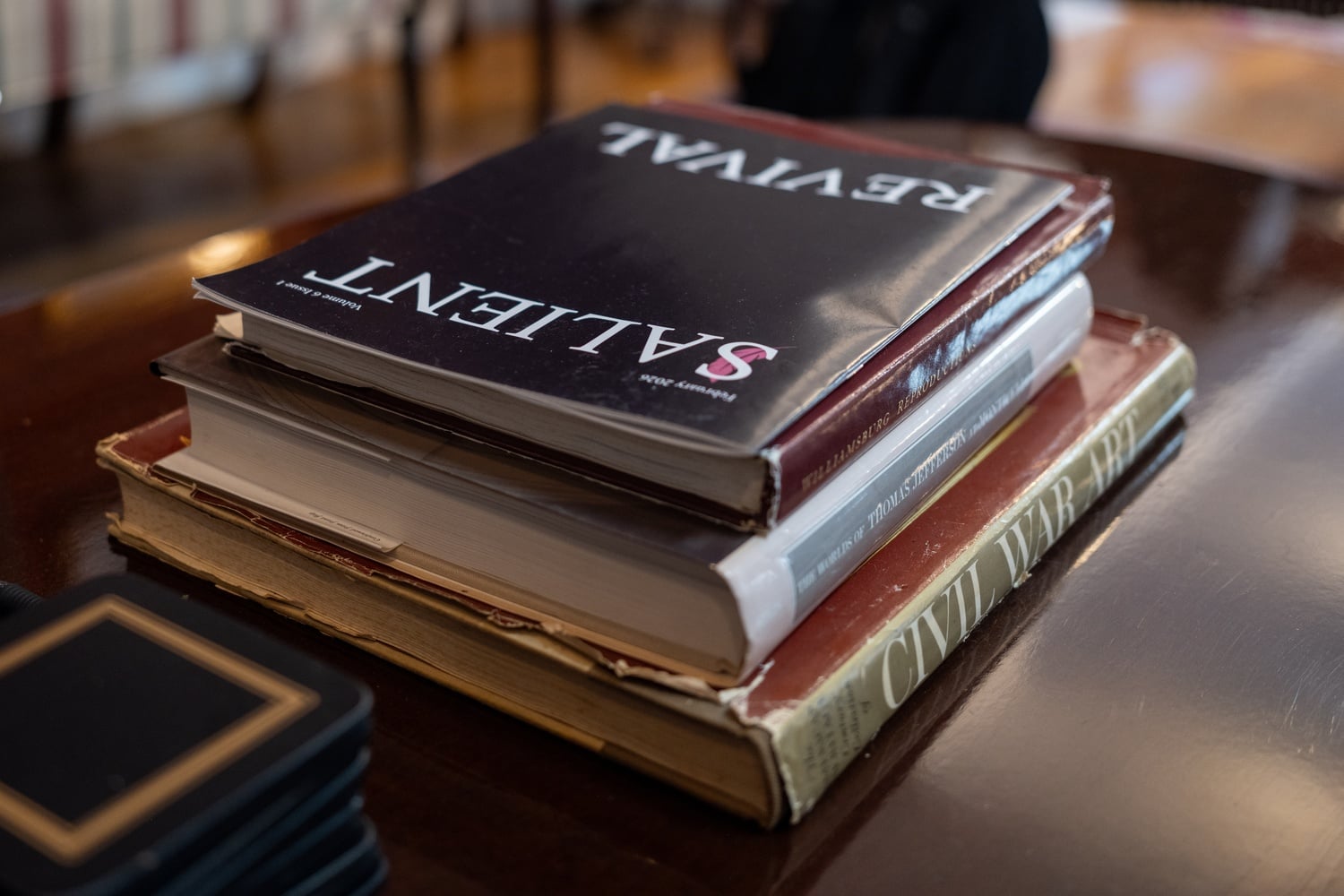
Last week, the Salient distributed its first issue since the suspension — a thin black magazine with “Revival” stamped across the cover.
In the days after distribution, Collins said she has heard from students who disagreed with the issue’s arguments but wanted to discuss them — a sign, to her, that the publication was back on track.
“As many times as possible, I can say, ‘Oh, we’ve changed. Oh, the student leadership is different. Hey, here are our goals for the future,’” she said. “But that has to be backed.”
“I hope that when people read our work,” she added, “they will believe that this has actually happened.”
Correction: February 27, 2026
A previous version of this article stated that Collins said the use of initials was temporary. In fact, Collins said the Salient “hopefully” plans to move away from the use of initials.
Clarification: February 27, 2026
This article has been updated to clarify that the Salient has 19 members today.
—Staff writer Alma T. Barak can be reached at [email protected] and on Signal at almabk.54. Follow her on X @almabk_.
—Staff writer Theresa F. Bartelme can be reached at [email protected] and on Signal at theresabartelme.15. Follow her on X @theresabartelme.
Want to keep up with breaking news? Subscribe to our email newsletter
Have a tip for The Crimson? Share it confidentially