Cutting Ties and Cutting Talent
Academic partnerships should not be political pawns — especially when national security is at stake.
Earlier this month, Secretary of Defense Pete B. Hegseth released a statement that, beginning next academic year, the Pentagon is cutting academic ties with Harvard University, specifically through discontinuing postgraduate professional military education, certificate-issuing programs, and fellowships. These programs will no longer receive sponsorship or funding, affecting service members who wish to further their education at Harvard with the government’s assistance.
The recent action is ostensibly motivated by sentiments articulated by Secretary Hegseth and heard throughout the current administration. Describing Harvard as “one of the red-hot centers of hate-America activism,” Hegseth allotted the criticism to what he sees as officers returning with “globalist and radical ideologies.”
This is an inaccurate characterization of our University, and one that reflects undue political prejudice and unfair federal overreach. National security should never hinge on partisan grievance — doing so endangers our nation both internally and externally.
Harvard is not the thoroughgoingly anti-military institution that Hegesth seems to think it is. The University has long demonstrated and still maintains its commitment to embracing military service, fostering a welcoming and robust environment for service members that now appears overlooked by the current administration.
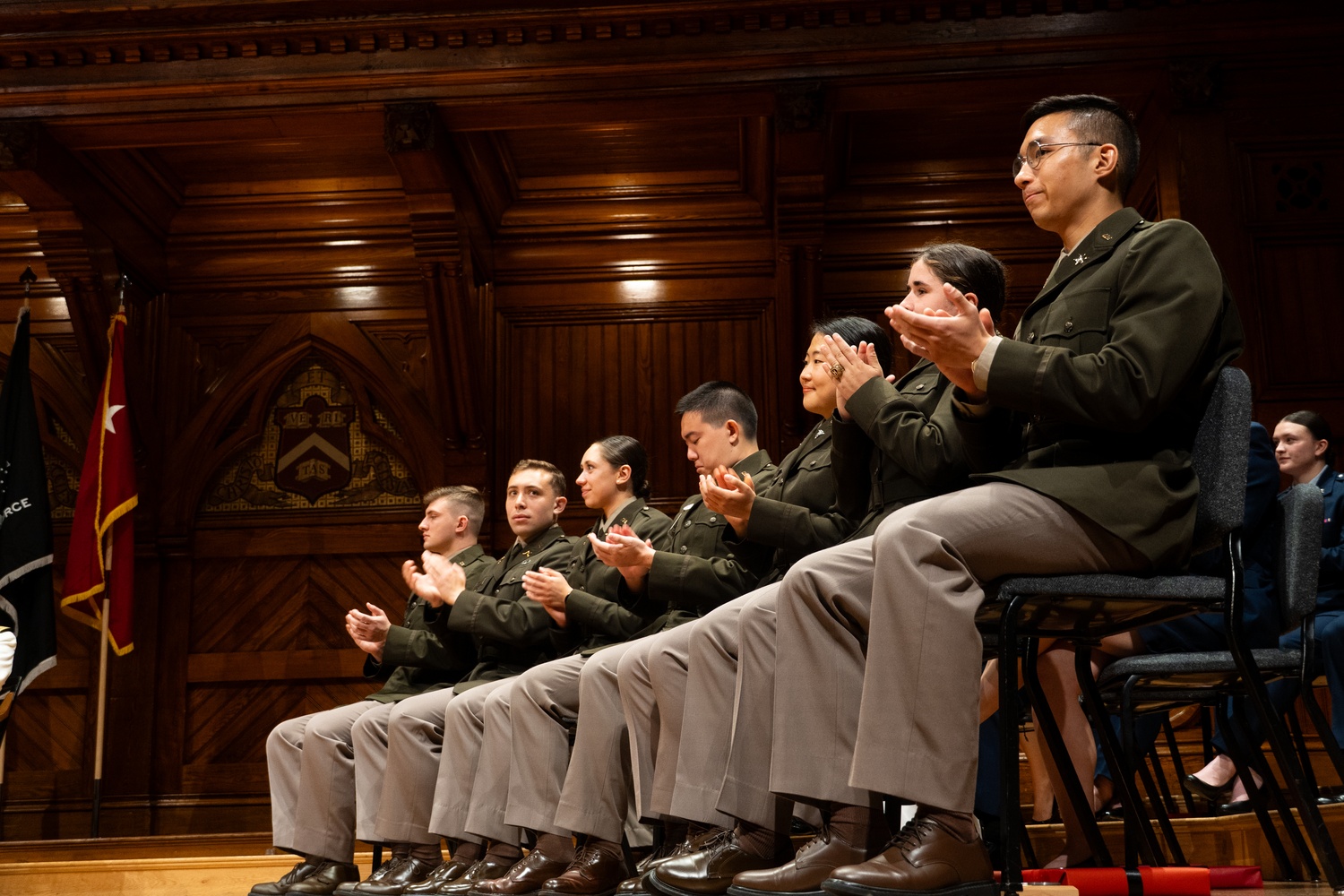
As home to one of the nation’s first Army Reserve Officer Training Corps established in 1916, Harvard reinstated ROTC in 2011 after decades of absence. As of this fall, Harvard ROTC maintains an active cohort of more than 100 cadets and midshipmen. Harvard Kennedy School has welcomed more than 500 U.S. active duty service members, reservists, and veterans over the past decade, while the College has significantly increased its veteran recruitment, admitting around 20 veterans annually in recent years.
Beyond enrollment, Harvard has made an active effort to expand military access. Just last summer, the Kennedy School announced the “American Service Fellowship” in the Mid-Career Masters in Public Administration program, open to veterans and public servants. It is the largest single-year program in the history of HKS.
It is clear that the portrait of Harvard as paradigmatically anti-military is, at best, misguided. Hegseth also makes clear that this policy is no more than a political maneuver through his hypocrisy: in his diatribes against the Ivy League, Hegseth claims to champion viewpoint diversity while pursuing the very federal overreach that undermines it. Safeguarding viewpoint diversity by the means of restricting a source of intellectual exchange is outright counterintuitive.
This policy is not in the interest of the American military — just ask the currently enrolled veterans at the Kennedy School. Politicizing government partnerships is a disproportionate and illegitimate response to a University that has actively sought to build kinship with military service. Harvard’s military affiliates should not become scapegoats in a culture-war dispute.
The harms of this policy extend beyond ideology and symbolism — academic innovation is at stake.
Cutting defense programs at top-tier universities like Harvard narrows collaboration with leading research institutions and knowledge hubs. For example, the HKS National Security Fellowships Program, the Recanati-Kaplan Foundation Fellowship, the Senior Executives in National and International Security program, and other professional military education programs for active-duty service members are likely to be affected for officers who wish to attend under Department of Defense sponsorship.
The national security benefits of university-military partnerships are apparent. Programs like the HKS National Security Fellowship foster a direct leadership pipeline, producing about 800 alumni since 1984. Some alumni veterans advance to senior DOD and government roles — including Secretary Hegseth himself. Beyond status, officers who attend gain analytical tools they can carry back into service, while their presence helps close the civil-military divide. Technologies, including GPS systems, explosive sensing devices, regenerative medicine for combat injuries, advanced radar systems, and AI-assisted drones are just a few examples of innovations advanced through University-federal research partnerships.
National security interests are now vulnerable to a loss in expertise, future breakthroughs are stifled, and a rather dim precedent has been set: that the government excludes any university deemed astray from the administration’s orthodoxy. More fundamentally, limiting civil-military knowledge exchange and optimization is a norm we should resist, whether imposed by administrations on the left or the right.
Of course, Harvard is still a predominantly liberal school, and officers will have their own political leanings. These ought not to be ones so extreme as to jeopardize our nation’s best interests. However, claiming that one-to-two year master’s programs are effectively re-socializing officers into anti-nationalist globalists is polemic and unfit. We should not restrict collaboration on the presumption that all those within Harvard’s hallways are so contrary to administrative priorities that they must be treated like adversaries contaminating federal functionalities.
Allowing such an idea to continue unabated only deepens the polarization that already internally plagues our country and distracts from substantive national security priorities, eroding the trust and viability of our most important federal institutions.
Ava M. Ribaudo ’27, a Crimson Editorial editor, is a Government concentrator in Leverett House.
Want to keep up with breaking news? Subscribe to our email newsletter
Have a tip for The Crimson? Share it confidentially