The Cost of Letting AI Decide
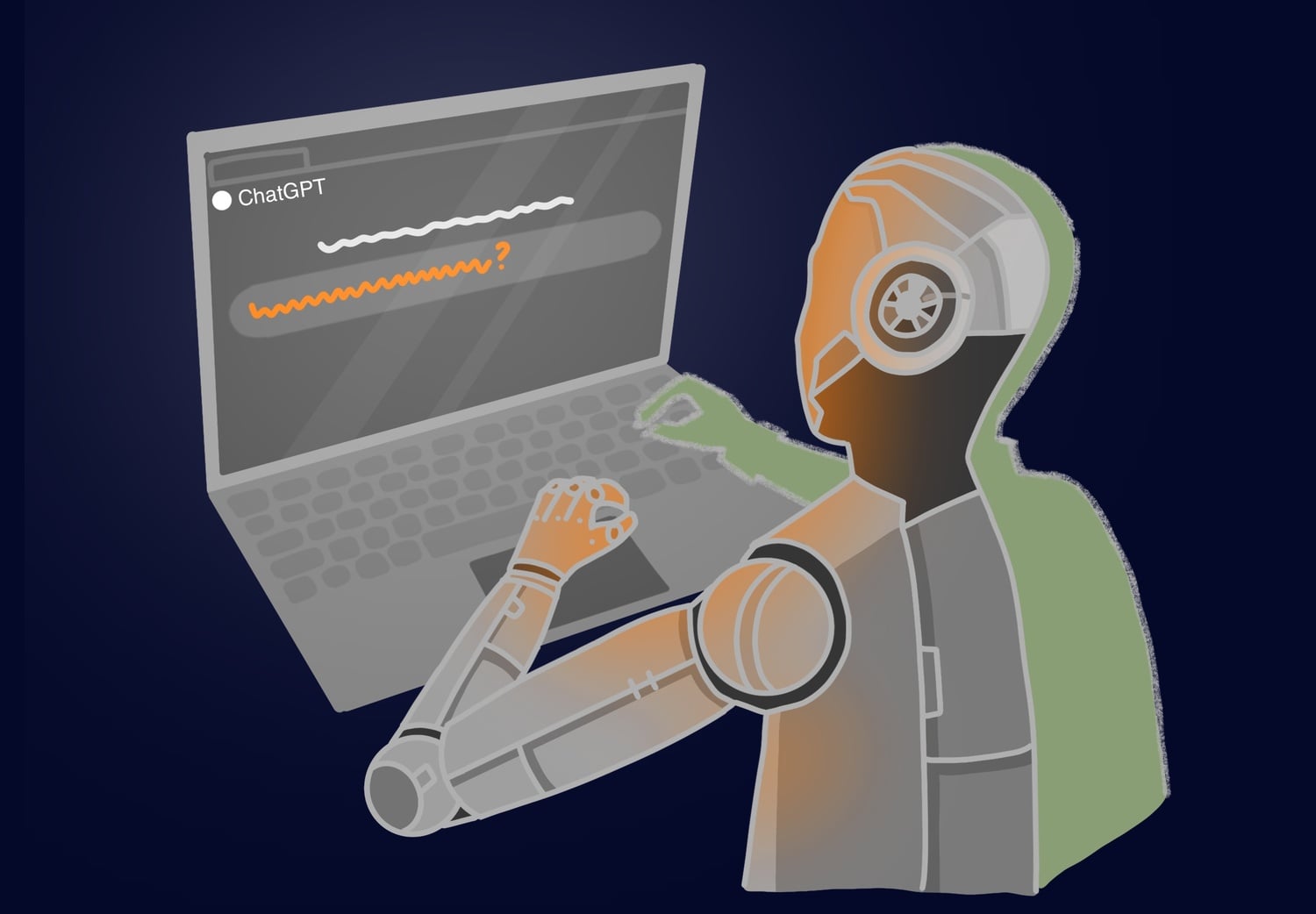
A trolley is speeding down a track toward five people. You can pull a lever to divert it, but doing so will send it down another path where one person stands. Do you pull the lever?
When one of my professors posed this philosophical question recently, I found myself at a loss. Would my conscience direct me to utilitarianism or deontology? Would fight-or-flight take over in the moment? Or, would I just give up and ask ChatGPT what the best choice is?
Today, we increasingly design systems to avoid making these kinds of tricky moral decisions — or any decisions — ourselves. As artificial intelligence becomes more embedded in our daily lives, it offers us an appealing future: a world where we no longer risk choosing incorrectly. But using technology to shape our judgments comes at a cost. Instead of avoiding difficult decisions, we must confront them and embrace the possibility of failure because both are essential to what makes us human.
Admittedly, I have used ChatGPT on more than one occasion. It’s there for me when I want “practice questions on the principles of economics” or am looking for “scholarly articles on The Iliad and The Odyssey.” Without missing a beat, I am presented with a concise and clear answer. When the algorithm gives me a detailed response instantly, it is easy to feel reassured by the machine’s words rather than try on my own and be met with failure.
This aversion to failure is deeply human. Making a decision ourselves opens the door to the possibility that we might choose poorly. Additionally, we are often biased by our personal opinions and experiences, which can cloud our judgment on important matters. Technology, on the other hand, seemingly provides a detached process that is more objective.
But this guise of impartiality can come at the expense of growth. Struggling through uncertainty is how we develop our judgment and moral compass. When we wrestle with challenging questions, make an ill-informed decision, or revise our thinking, we are gaining something much more valuable than the correct answer: we are learning how to think for ourselves. The replacement of this innately human experience with an inflexible algorithm strips away the ability for us to develop confidence in our own reasoning.
When I asked ChatGPT for its answer to the trolley problem, it generated multiple alternatives along with the pros and cons of each one. But it acknowledged that while it can explain existing moral frameworks, it doesn’t have its own beliefs. AI cannot feel the hesitation that comes from knowing a decision could harm someone or the satisfaction of arriving at a conclusion after genuine reflection. Being torn between our morals is not a flaw in human judgment — it is precisely what makes our thoughts meaningful.
I am not saying algorithms are always wrong or that we should completely abandon AI. In certain situations, systems that rely on data can help people make more informed decisions. For example, AI analysis of large data sets can sometimes reveal patterns that would be tough for humans to detect by themselves. When used thoughtfully, AI can be a beneficial tool.
But there is a vast difference between using technology as a tool and relying on it as a substitute for independent thought. In fact, a 2025 MIT Media Lab study found that overreliance on AI can diminish critical thinking abilities and lead to “cognitive atrophy.” Furthermore, even the most advanced technology can never truly replicate the moral courage and accountability that come from making choices or trying something new.
For students, this reminder is especially urgent. At an institution like Harvard, where intellectual curiosity and independent thinking are central to our education, it is tempting to use AI as a shortcut. But outsourcing the hardest part of reasoning to a chatbot undermines the very qualities that universities are supposed to cultivate.
Treat AI as a supplementary resource rather than a replacement for your own judgment and reflection. Grappling with uncertainty and experiencing failure are not obstacles to learning — they are the process itself.
The trolley problem doesn’t let us skip the choice. Neither should AI.
Tara G. Malhotra ’29, a Crimson Editorial editor, lives in Wigglesworth Hall.
Want to keep up with breaking news? Subscribe to our email newsletter
Have a tip for The Crimson? Share it confidentially