Four Teams, Three Games, Two Days, One NCAA Tournament Bid: Men’s Ivy Madness Preview
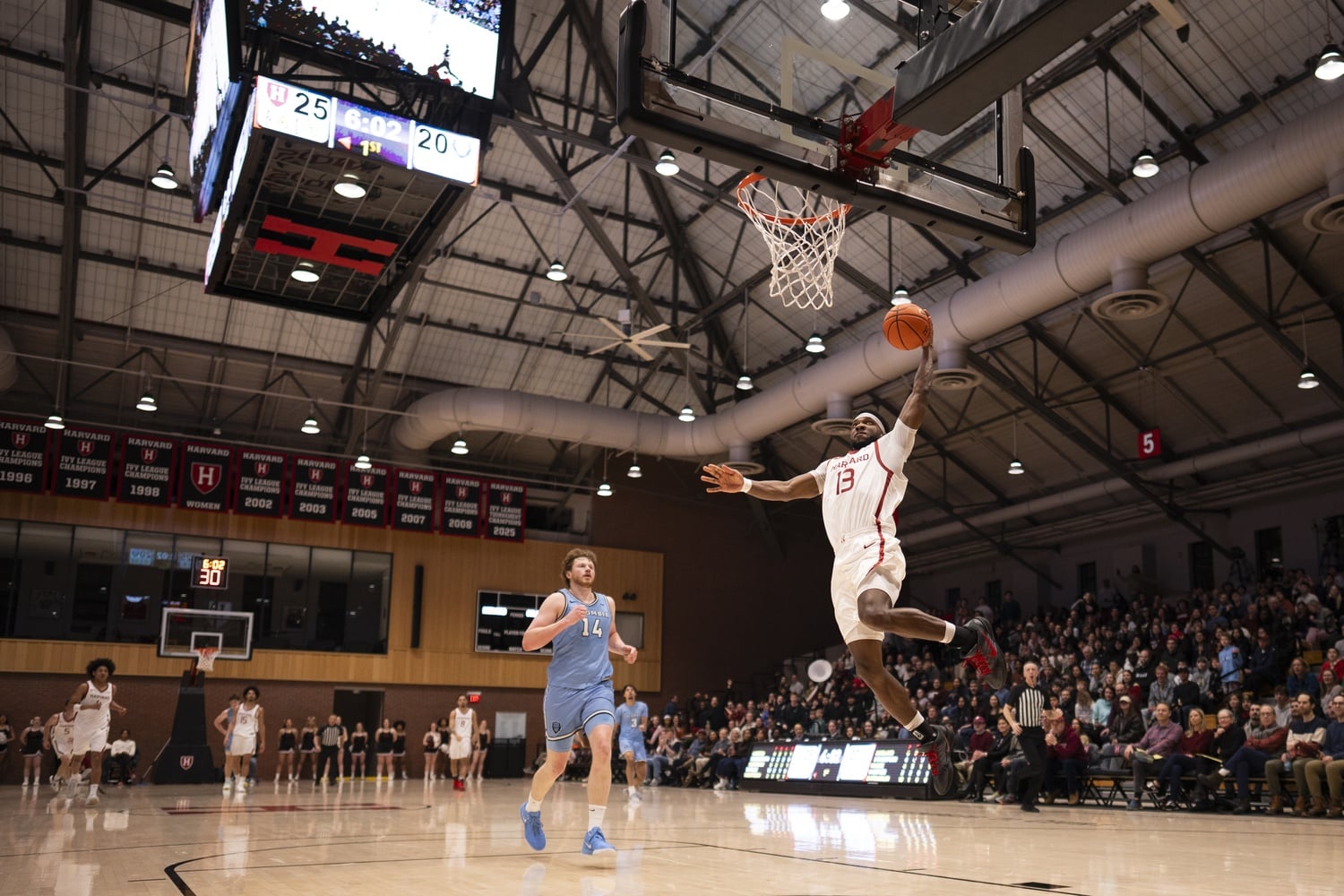
This weekend, the top four men’s basketball teams in the Ivy League will converge in Ithaca, N.Y., to compete in the Ivy League Tournament. After the single-elimination tourney, the victor will earn the chance to compete for a national championship, receiving the Ivy League’s automatic bid to the 68-team NCAA Tournament.
In a one-bid league, the stakes could not be higher.
The tournament’s semifinal games will be played on Saturday, March 14, with Yale facing Cornell at 11:00 a.m. EDT, and Harvard taking on the University of Pennsylvania at 2:00 p.m. The championship game will be broadcast on ESPN2 at 12:00 p.m. on Sunday, March 15.
The NCAA Tournament bracket will be released at 6:00 p.m. on Sunday, so the Ancient Eight champion will not have to wait long to discover where and when it will dance.
With mere days to go until a champion is crowned in the Ivy League, here is a quick rundown on all four participants, as well as The Crimson Sports Board’s predictions for the weekend.
No. 1: The Yale Bulldogs (23-5, 11-3 Ivy)
Yale enters the tournament as a -130 favorite on leading sportsbooks, which is no surprise as the Bulldogs search for their third straight Ivy Madness title. Harvard’s arch-nemesis is led by the Ivy League Player of the Year, Nick Townsend, a senior forward who leads the team in points (16.5 PPG), rebounds (7.5 RPG), and assists (4.1 APG).
Despite the seniors’ offensive dominance, the team boasts depth, with five different players averaging double-digits. The team also shoots the ball at an unreal clip, ranking third in the country in three-point percentage (40.1% 3PT). This is primarily thanks to the 6’7” Townsend (48.3% 3PT, 3.2 3PA) and junior guard Trevor Mullin (40.2% 3PT, 4.7 3PA).
On paper, the Bulldogs look difficult to beat. However, teams have had success when they have slowed Townsend down and forced other players to step up and score in isolation. If the 3-ball goes cold and Townsend is corralled, the Bulldogs are not a strong enough defensive team to avoid being outgunned by any of their three adversaries playing in Ithaca.
No. 2: The Harvard Crimson (17-11, 10-4)
After a seven-year drought, the Crimson is making its long-awaited return to Ivy Madness. Head coach Tommy Amaker — who led the league’s Co-Coaching Staff of the Year — has led the team to a strong in-conference performance, especially after a shaky start in non-conference play. Since the start of league play, Harvard has improved dramatically, and it hasn’t seen a loss by more than one possession since Jan. 24.
The Crimson’s greatest strength lies in its scrappy defense and ethical play, as it ranks top-four in the nation in both free-throw percentage (79.8% FT) and fouls committed (13.6 PFPG). In the halfcourt offense, sophomore guard Robert Hinton poses a potent threat off the dribble (17.1 PPG), while sophomore guard Tey Barbour (13.5 PPG, 40% 3PT) and junior forward Thomas Batties II (12.5 PPG, 45.9% 3PT) serve as top-tier catch-and-shoot options.
Harvard’s greatest shortcoming, though, is in its depth — all five starters have regularly been playing upwards of 34 minutes in meaningful league games. Nonetheless, if captain Chandler Piggé, the only senior in Amaker’s rotation, can step up and support the young lineup, then the Crimson is capable of winning the tournament and returning to March Madness for the first time in eleven years.
No. 3: The University of Pennsylvania Quakers (16-11, 9-5)
The Quakers might be the most consistent team in the Ivy League, and what you see on paper is largely what you will get from head coach Fran McCaffery’s squad. They play with the league’s signature tough style, and their one-two punch on offense from senior Ethan Roberts (16.9 PPG) and junior TJ Power (15.8 PPG) gives Penn a chance to win any game it plays.
Four of the team’s five losses in conference play have come by five points or fewer, and aside from the Quakers’ 77-60 loss to Yale in late January, they haven’t played any truly bad games in Ancient Eight play. Penn also enters Ivy Madness as the hottest team in the field. The Quakers have won seven of their last eight, with a narrow road loss to Yale as their only slip-up.
Despite being an underdog, expect Penn to put up a good fight against Harvard in what should be a close semifinal. If the Quakers make it to the championship, their consistency could just push them above Yale or Cornell, which would give the team its first ticket to the big dance since 2018.
No. 4: The Cornell Big Red (15-12, 8-6)
The Big Red is one of the scariest teams in the country during this time of year, as Cornell’s high-powered scoring paired with its nationally leading passing game (21.2 APG) can quickly shoot its way into leads that can be too large for opponents to overcome.
However, overreliance on its shooting has been a problem at times this season for the Big Red. Poor shooting nights led to losses such as its 34-point loss to Yale in January or its 19-point loss to Harvard just two weeks ago, in which the team scored a season-low 54 points. On the other hand, hot hands in other matchups have given Cornell five conference wins by more than 20 points, the most of any team in the tournament.
As the hosts of the Ivy Madness, the Big Red also has home-court advantage on its side, and if the team can continue to play as well offensively as it has since its home loss to Harvard, then the other squads in the tournament might have to watch out for the sneaky fourth seed.
Predictions from Our Editors
Compared to years past, the men’s bracket in this year’s edition of Ivy Madness is full of great teams that actually stand up to each other. Last year, Yale went into the tournament with a combined 6-0 record against other qualifiers and an overall 13-1 conference record. This year, however, every team in the tournament has taken losses to at least two other qualifiers, and nobody stands out as a heavy favorite.
Without a true number one team, I think we may need to turn our heads to the hosts, as the underdog fourth-seed could send shocks throughout the league if things go its way.
Cornell has played some of its best basketball of the season in its past few games, and with home-court advantage in the league’s biggest games of the year, it certainly has the opportunity to repeat its Feb. 27 upset of Yale and avenge last year’s championship game loss with a semifinal win against the top seed. If it can pull that off, the Big Red should be able to take that momentum into a matchup against either Harvard or Penn.
While the other three teams in the tournament are more traditional Division I conference tournament champions, in a league with as much history and surprise as the Ancient Eight, I have to go with Cornell to pull off the upset and surprise the country with its first NCAA Tournament bid since 2010.
— Staff Writer Connor Castañeda
Cornell is hosting the 2026 Ivy League tournament, and many sportsbooks and analysts are high on the Big Red to pull off a run of upsets and sneak into the dance (looking at you, Connor). Despite being the lowest-seeded team, Cornell’s high-powered offense gives the hosts the second-best betting odds at the title, with the team coming right off of a 111-point explosion against Dartmouth in the final game of the season, where it hit 19 threes.
But teams that live by the three can also die by it, and I think early-game jitters will lead to Cornell coming out cold. Yale jumps to an early double-digit lead and dominates Cornell, resting its starters for the final five minutes of its first tournament game.
In the late slate, Harvard takes on Penn in the semifinal. The teams have shared two down-to-the-wire clashes so far this year, and like two heavyweight prizefighters, have split their earlier battles in advance of a highly-awaited trilogy.
As the Crimson’s players enter the game with a salty taste lingering in the back of their mouths after Penn won the most recent meeting between the teams, this game is not as close as the other two. Piggé stars once more, going for 20+ points and 5+ assists, and the Crimson fend off the Quakers to earn their spot in the final.
It feels like fate that the top-seed Bulldogs and two-seed Crimson meet in the Ivy League Championship. After two thrilling finishes when the rivals met in the regular season, their final meeting will be no different.
The first half is slow-paced and low-scoring, as both teams lock down in the half-court set and restrict offense both ways. Nonetheless, the game remains deadlocked and within five entering the break.
In the second half, the game begins to open up, as shooters on both sides begin hitting threes. Despite numerous lead changes, both teams are separated by no more than one possession down the stretch.
In the end, stalwart defense in the final moments guarantees victory for Amaker’s side, who take down the Bulldogs by five after hitting late clutch free throws. Sophomore guard Ben Eisendrath stars in every category except for scoring, and shuts down Yale guard Mullin.
Amaker returns to March Madness for the first time in eleven years, pulling off his third win over Yale in the last two years. The Crimson cap off a strong regular season in conference play with its first Ivy Madness victory since the tournament’s inception in 2017.
— Staff Writer Samuel S. Rudavsky
Harvard is the only team in the tournament that truly boasts a very dangerous starting five lineup. Head coach Tommy Amaker knows that he can trust anyone on the court to shoot the ball when necessary, as four of the Crimson’s starters average double-digit points per game. If its roster can stay healthy during the tournament, I think that Harvard is well-positioned to make the championship and serve as a formidable opponent for either Yale or Cornell, both of whom the Crimson has already defeated once this season.
Although the Harvard squad is relatively young and lacks postseason experience, under the leadership of Amaker — the winningest coach in program history — the team is more than capable of winning Ivy Madness and punching a ticket to the Big Dance.
— Sports Chair Isabel C. Smail
Star players and coaches win games in March. Harvard and Yale win these categories.
Cornell is too streaky, and head coach James Jones, the longest tenured coach in the Ivy League, will have his Bulldogs ready for the Big Red’s breakneck attack.
Beating the Crimson at the Cathedral of College Basketball will prove costly in the long-term for Penn, as Harvard will be hungry and prepared for revenge.
The Game Part III will be the highest stakes matchup between the Ivy League’s most hated foes since the rivals met in the 2019 Championship Game, a Yale win. Two key matchups will determine the winner: Piggé vs. Townsend and Hinton vs. Simmons.
Piggé and Townsend are both physical forces. If the Crimson’s senior leader gets into foul trouble, the Bulldogs can take advantage of Harvard’s thin bench. Hinton has been one of the prominent scorers in the Ancient Eight all year, torching Yale for 26 in the first go-around. But Bulldog senior guard Casey Simmons used his length to slow down Hinton in the second matchup. Hinton will have to dominate for the Crimson to win.
I believe in Harvard’s terrific trio, and Coach Amaker has had Yale’s number in the recent matchups. The Crimson wins another thriller as Hinton becomes one of March’s early stars.
— Sports Chair Reed M. Trimble
Want to keep up with breaking news? Subscribe to our email newsletter
Have a tip for The Crimson? Share it confidentially