Harvard Narrowly Misses Ivy Tournament Final with Overtime Loss to Penn
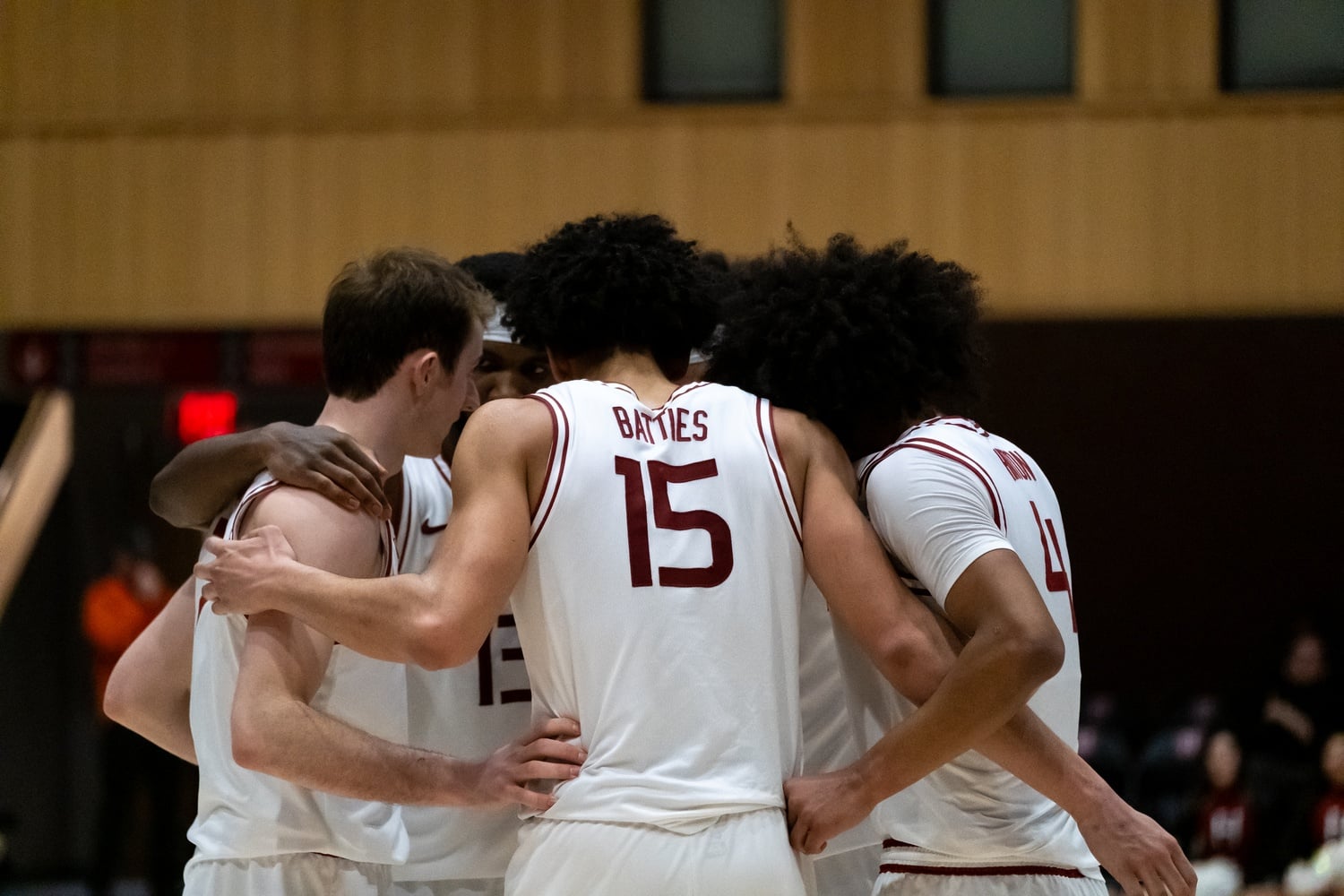
ITHACA, N.Y. — The Harvard men’s basketball team fell 62-60 to the University of Pennsylvania in overtime on Saturday, ending its season with a heartbreaking loss in the Ivy League Tournament semifinal after qualifying for the event for the first time since 2019.
The Crimson (17-12, 10-4 Ivy) relinquished a five-point second-half lead to send the game to an extra period, and a dreadful five minutes for Harvard put the Quakers (17-11, 9-5) in the tournament final for the first time since they won the event in 2018.
In overtime, Penn made up for its disastrous second half and quickly opened up with a five-point lead, forcing the Crimson to scramble over the next few minutes of play to tie the game with 20 seconds remaining. Unfortunately, after the Quakers made a layup with six seconds left, a missed three from sophomore guard Tey Barbour did not fall, and Harvard walked away with the narrow loss.
“Both teams competed very hard and played tough defense, and I just give all the credit in the world to their team and their coaching staff,” head coach Tommy Amaker said. “It’s a tough one for us.”
For the third time this season, Harvard and Penn could not be separated by more than one possession. After losing to the Crimson 64-63 in January before winning 64-61 in the penultimate game of the regular season, the Quakers clinched another tight victory over the Crimson in style.
“I just think it goes to show how talented the Ivy League is,” captain Chandler Piggé said about repeated competitive matchups against Penn. “Across the board, over the years, you just see the talent continue to grow and grow.”
The second-seeded Crimson failed to join its female counterpart in the tournament finals after the women’s team advanced with its win over Columbia on Friday night. Harvard was the only school that sent both of its basketball teams to the conference tournament.
Penn’s senior guard and leading scorer, Ethan Roberts, was ruled out of the game due to a concussion, forcing the Quakers to turn to other players to rack up points on the scoreboard.
Luckily for Penn, the Crimson’s shots were simply not dropping in the first half. Barbour, who is Harvard’s three-point specialist, opened the game with a triple, but was otherwise held relatively quiet in the first period. The Quakers’ defense also did an excellent job of keeping sophomore guard Robert Hinton cold during the first 20 minutes of play, holding him to just two first-half points.
With 6:54 left in the half, Harvard was down 21-14 and had recorded a few uncharacteristic turnovers, not helping its effort to close the deficit.
Freshman forward Ryan Sullivan provided the necessary spark for the team from Cambridge, coming off the bench and quickly making a huge block that caused the Crimson faithful to erupt into cheers.
Sullivan then capitalized on the other end, gaining positioning in the low post against a smaller defender, corralling an entry pass from Piggé, and laying the rock in for two.
Another sloppy turnover from Harvard enabled the Quakers to tally two more points, but Piggé quickly responded with two of his own off a stellar drive through the paint.
Barbour then ripped a shot from way downtown, swishing it home to bring the Crimson within six points.
Junior forward Thomas Batties II followed in Barbour’s footsteps, draining a three of his own to close the gap to 27-24.
Penn’s senior guard Cam Thrower retaliated with a layup and one to extend the Quakers’ advantage back to six.
Piggé closed out the half with a resounding statement, slamming a dunk home. At the break, Penn led 30-26, but the game was far from over.
In the first half, both Batties and Sullivan had great consecutive defensive and offensive plays. Batties picked up two blocks and led the Crimson in scoring at the break with his eight points.
Despite trailing by four, Harvard should not have been displeased with its performance. After Penn had gone five-for-12 (42%) from beyond the arc in the first, holding the Quakers to only 30 points in twenty minutes was a testament to the Crimson’s physicality and defensive superiority inside the arc.
Harvard came out of the half with an increased defensive intensity, forcing turnovers from Penn and going on a nice 7-2 run. After Barbour drilled a right-corner catch-and-shoot three to give the Crimson a 33-32 lead, Penn’s head coach, Fran McCaffrey, had seen enough and spent a timeout with 15:47 to go.
The Quakers did not lead again in regulation after this shot.
After only scoring two points in the first, Piggé swished a three, extending his point total to seven. McCaffrey, upset at his defense for providing the captain with a wide-open scoring opportunity, burned another timeout.
The teams traded blows over the next few minutes, with each squad crashing the glass and trying to find room to give its school a workable lead. Down the stretch, three ties came, though Harvard managed to hold off a deficit through the end of regulation.
With less than three minutes to go, the Crimson had a slight 51-49 lead. Penn’s freshman Jay Jones quickly evened the score.
Sophomore guard Ben Eisendrath regained the advantage for Harvard, slipping through defenders in the paint to nail a rebound. The Los Angeles, Calif., native went on a hot streak late in the game and scored a career-high-tying 15 points.
“[Ben] hasn’t had a great offensive year, but today he certainly cashed in on some chances to finish at the rim and made a big 3 in the corner,” Amaker said. “Very proud of his effort.”
A quick response from the Quakers deadlocked the score at 53 with less than a minute left. Although Penn had a chance to ice the game in the final few seconds, Jones was unable to capitalize. The buzzer rang to signal the end of regulation play, and, for the second time this weekend, a Harvard semifinal game headed into overtime.
Jones — who exited shortly afterward with an ankle injury — tallied the first basket of extra play for the Quakers, drawing a foul as he nailed the shot. The senior swished the free throw to put his team ahead by three.
After Harvard failed to score on its resulting possession, Penn extended its lead to five thanks to a quick layup by junior forward Augustus Gerhart.
Barbour answered for the Crimson with a three, but then fouled Gerhart on the other side of the court, as he grabbed Penn’s junior around the waist in an attempt to steal the ball. Luckily for Harvard, Gerhart only capitalized on one of the free throws. Regardless, the Quakers clearly had fostered momentum.
Sophomore guard Austin Hunt — who hasn’t played for the Crimson since Jan. 17 — then got fouled on the offensive end. The Marlborough, Mass., native drained both free throws, bringing the score to 59-58.
Ahead by just one point, Penn got the ball with 58 seconds remaining in overtime. As he drove to the hoop, junior forward TJ Power drew a foul. Power missed the first free throw, but hit the second.
After a long broken possession, Barbour, realizing that Harvard’s shot clock was dwindling, drove through contact to hit a layup and even the score at 60.
With just 20 seconds left in extra play, the Crimson’s head coach Tommy Amaker called a timeout to prepare his team for a critical defensive stand.
Despite Amaker’s preparation, Penn sophomore guard AJ Levine was able to glide through Harvard’s defenders and hit a layup with six seconds left.
The Crimson was unable to respond, as Amaker shockingly did not call a timeout to prepare a last-chance offensive play. Some confusion ensued, and Harvard did not appear to run an actual play, forcing Barbour to fire a deep three at the buzzer, which was unsuccessful.
With their win over the Crimson, the Quakers will stay in Ithaca for one more day to face Yale in the tournament final on Sunday. The Bulldogs swept the season series against Penn and have not lost to the Quakers since a road matchup in the 2023 season.
The championship — whose winner will qualify for the NCAA Tournament as the conference’s automatic bid — will take place in Newman Arena in Ithaca, N.Y., on Sunday at 12:00 p.m. EDT, and will be broadcast on ESPN2.
With the loss, Harvard extends its March Madness drought to 11 seasons, having only qualified for the Ivy League Tournament four times since its 2014 NCAA Tournament appearance.
“There’s always a lesson in loss, and our job is to find it, embrace it, learn from it, and then feel like we moved on from it,” Amaker said.
While the Crimson will lose captain Piggé next year, no other players in the main rotation will graduate.
“I’m quite confident that these young guys will embrace some of the lessons that come with this great opportunity we’ve had to be here this weekend,” Amaker added.
— Staff writer Connor Castañeda can be reached at [email protected].
— Staff writer Samuel S. Rudavsky can be reached at [email protected]. Follow him on X at @samrudavsky.
Want to keep up with breaking news? Subscribe to our email newsletter
Have a tip for The Crimson? Share it confidentially