Hillel Debuts ‘People’s Plate’ Installation Highlighting Jewish Experiences at Harvard
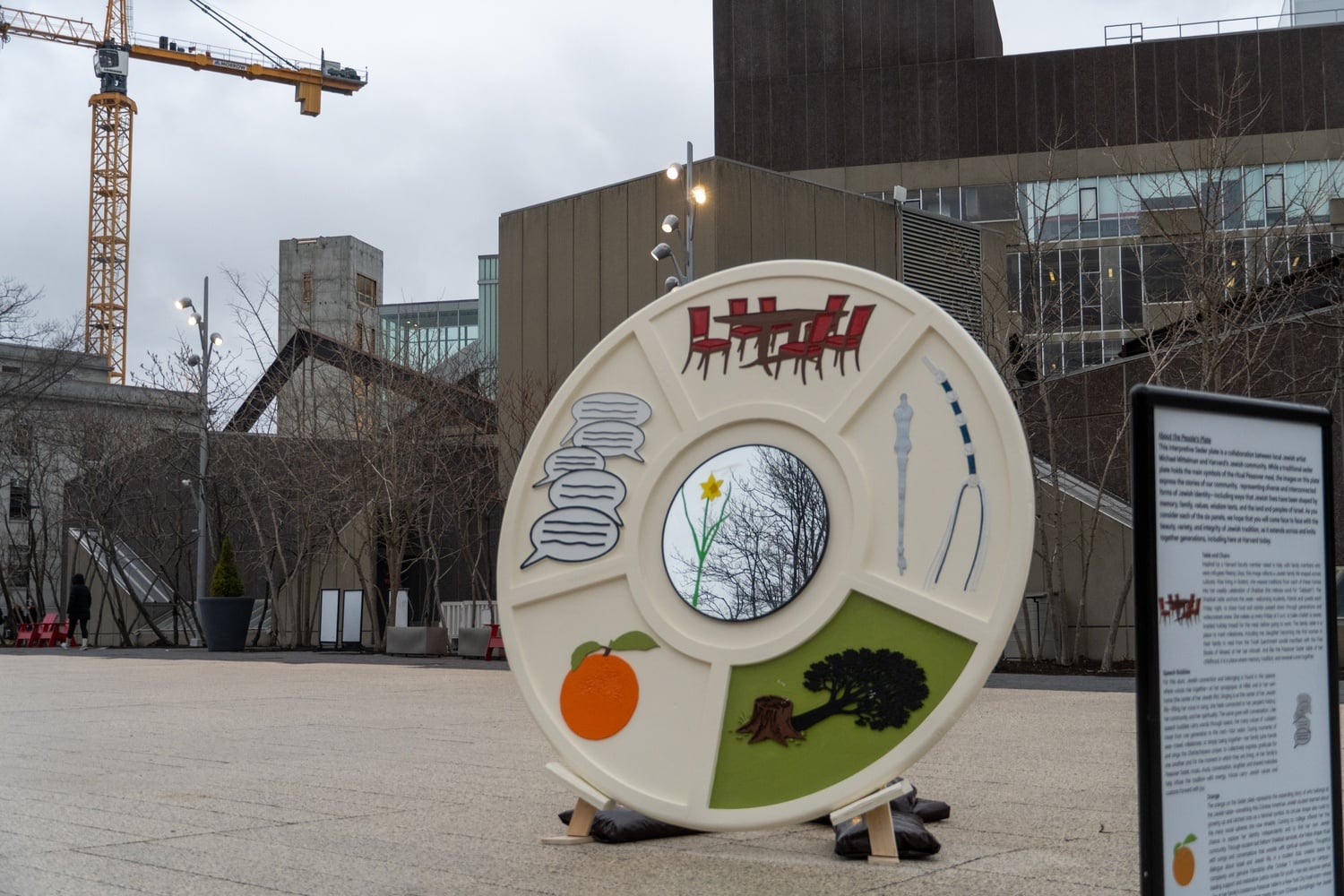
Around 40 Harvard Hillel members, Harvard administrators, and Cambridge residents gathered Monday evening to celebrate the unveiling of “The People’s Plate,” a public art installation on the Science Center Plaza exploring diverse Jewish experiences.
The Plate — a 9-foot Seder plate made of painted styrofoam — was created by local Jewish artist Michael Mittelman in collaboration with Harvard Hillel. It will be on display through Thursday.
The installation draws on the Seder plate, used on the first night of Passover — April 1 this year — when Jewish families arrange symbolic foods to retell the Exodus from Egypt.
Mittelman and Elisha Gechter, Hillel’s senior director of community engagement, said they interviewed six Jewish students and faculty members about how they found belonging at Harvard. Each story is represented by a painted element on the Plate.
Mittelman said that early interviews surfaced concerns about safety. By incorporating six distinct panels, he said, he hoped “no one element” would dominate or provoke backlash tied to any single issue.
Those concerns come as Jewish life at Harvard continues to face federal scrutiny. Last Friday, the Trump administration sued the University on the grounds that it had failed to protect Jewish and Israeli students from harassment on campus.
Jason B. Rubenstein ’04, executive director of Harvard Hillel, said he hopes the installation will shift conversations beyond safety.
“For so much of the last two and a half years, the question has been, are Jewish students safe at Harvard?” Rubenstein said. “That’s a very low bar to clear.”
Instead, he said, Harvard should lean into its “aspirations” and “swagger” to cultivate Jewish leaders who can expand access to Jewish life and tell Jewish stories with “depth.”
Get The Crimson in your inbox.
Susannah Heschel, a visiting professor who spoke at the event, helped popularize the now widespread practice of placing an orange on the Seder plate during the AIDS crisis. She encouraged her family to eat orange slices and spit out the seeds as a symbolic act of “spitting out homophobia.”
“It doesn’t matter your gender identity, your sexuality, or your political views, or even how observant you are,” Heschel said. “It doesn’t matter, we stick together.”
Several Harvard administrators in attendance said the Plate underscored the importance of engaging across difference.
Dean of Students Thomas G. Dunne said in an interview that the Plate prompted him to reflect on what he has learned about Jewish faith and traditions through conversations and Seders with Jewish students over the past two years. The Plate, Dunne said, “really does align with a lot of the other work we’re doing at the College around enhancing a sense of mattering and belonging here at Harvard.”
Sherri A. Charleston, Harvard’s chief community and campus life officer, said she hopes students will “take advantage” of the conversations the Plate invites.
“It’s an incredible opportunity for us as a community, if we allow it to be,” she said.
Gechter said she hopes the Plate will encourage students to “let go of” what she described as a pattern of “social shunning” on campus, in which students assume a set of beliefs about one another based on a single identity.
Instead, she said, she hopes students reflect on how they “can be in relationship with each other in a lot more authentic and kind and graceful and compassionate ways.”
The event concluded with a performance by Apichorus, Harvard’s premiere Jewish a capella group. The group’s third song was “One Day” by Jewish-American composer Matisyahu, which organizers said reflects the Plate’s goal of helping each person see themselves in another’s story.
“One day we’ll all be free,” they sang, “and proud to be, under the same sun, singing songs of freedom.”
—Staff writer Mark C.Z. Snekvik can be reached at [email protected] and on Signal at marksnek.62. Follow him on X at @markcsnekvik.
Want to keep up with breaking news? Subscribe to our email newsletter
Have a tip for The Crimson? Share it confidentially