Harvard Graduate Student Union to Close Strike Vote After Four Weeks
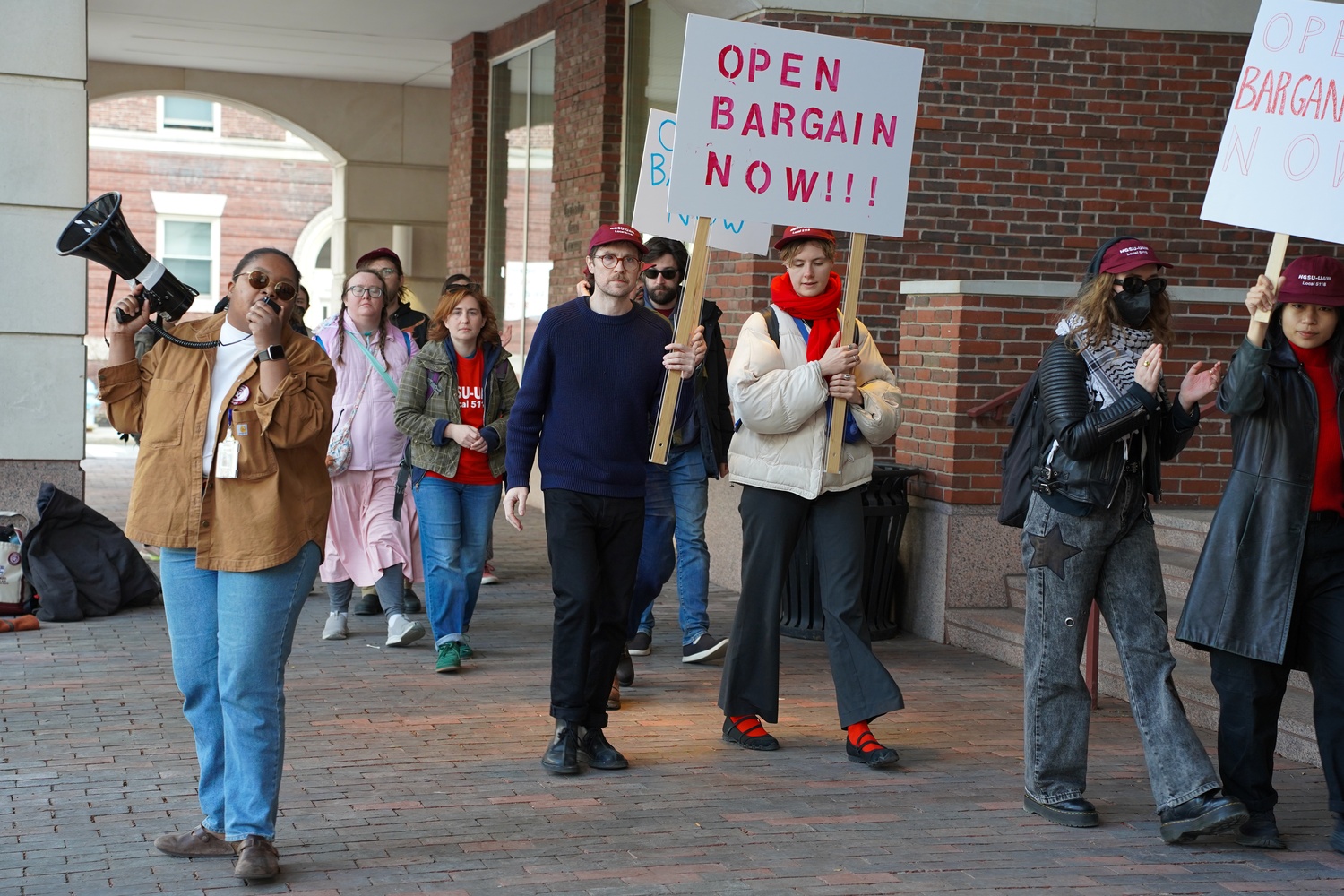
Harvard’s graduate student union will close its strike authorization vote after four weeks — a significantly longer voting period than in previous years as bargaining continues with limited progress.
The Harvard Graduate Student Union-United Auto Workers opened voting on March 3 and plans to close the ballot next Tuesday at 11:59 p.m., keeping it open for 28 days.
The vote will determine whether union leadership is authorized to call a strike if contract negotiations stall. Under union bylaws, a strike authorization requires a two-thirds majority of ballots cast.
The timeline marks a sharp departure from past strike votes. The union’s 2021 authorization vote lasted about two weeks, while its 2019 vote lasted about one week. Both closed with more than 90 percent of voters in favor of striking.
Under the union’s election rules, its elections committee determines how long the vote remains open and must provide at least 48 hours’ notice before closing it.
Denish K. Jaswal, a member of the union’s bargaining committee, said the extended timeline was due in part to Harvard’s spring break, which fell in the middle of the vote. The two previous strike votes were held during the fall semester.
Jaswal said a strike remained a last resort for graduate workers, but added that some members saw it as necessary amid ongoing disagreements with Harvard.
“A strike is a last option, and no one wants to strike. But I do think that members frankly don’t know how else to make the University understand that they care deeply and will fight for what they deserve,” she said.
Negotiations between Harvard and the union have stretched for more than a year with limited agreement on key issues, including wages, non-citizen worker protections, procedures for handling sexual harassment, and agency shop.
As the vote has remained open, both the union and Harvard have separately contacted faculty to outline their positions.
Get The Crimson in your inbox.
The day before voting began, union president Sara V. Speller urged faculty in an email to support the union’s proposals and advocate on behalf of graduate student workers.
“We hope that the Harvard community will help us encourage the Corporation to reach an agreement with our proposals, all of which take into account the uncertainty of both employees and the employer during these unprecedented times,” she wrote.
Speller criticized the pace of negotiations and encouraged faculty to speak with graduate workers and raise concerns with academic deans.
But Harvard officials painted a more optimistic assessment of the bargaining process.
In a March 13 email to Faculty of Arts and Sciences Dean Hopi E. Hoekstra, Deputy Provost Jessica Soban and Managing Director of Labor and Employee Relations Paul Curran wrote that “despite progress made at these sessions,” the union had opened a strike authorization vote.
“We remain committed to reaching a reasonable and mutually agreeable collective bargaining agreement with HGSU-UAW,” they wrote. “However, if the union initiates a strike, we also have a responsibility to maintain continuity in teaching, learning, and research for our students, faculty, and other researchers.”
Less than an hour later, Hoekstra forwarded the message to FAS faculty and urged departments to “begin actively planning for the practical implications of a potential work stoppage.”
“Advance preparation will be critical to minimizing disruption to teaching and learning, particularly as we approach the close of the academic year,” she wrote.
Hoekstra asked faculty to consider how a strike could affect courses, research, and other responsibilities.
“It is our intention to proceed with clarity, steadiness, and respect for all members of our community while ensuring continuity of our academic mission,” she wrote.
Jaswal said the message was “jarring” to union leaders, arguing that it undercut the union’s focus on “doing everything that we can at the table to try and stop the possibility of a strike.”
She added that the union has invited Harvard to hold additional bargaining sessions during the voting period.
“We are willing to make ourselves available to bargain virtually whenever, because we want to reach a fair deal for our workers — and ideally we would do that without striking,” she said.
Harvard spokesperson Jason A. Newton said both sides are working to schedule additional sessions, in addition to three bargaining meetings already planned before the end of April.
Despite the drawn-out negotiations, Jasawl said she remains confident in union members.
“These conversations are difficult, but I think our workers are meeting the difficulty of the moment with bravery,” she said. “We are a fighting union.”
—Staff writer Taylor M. Bierwerth can be reached at [email protected]. Follow her on X @tmbierwerth.
—Staff writer Noah A. Ferris can be reached at [email protected]. Follow him on X @noahaferris.
Want to keep up with breaking news? Subscribe to our email newsletter
Have a tip for The Crimson? Share it confidentially