Paul Ryan Critiques Harvard’s Approach to DEI, Links It to Broader Conservative Backlash at IOP Forum
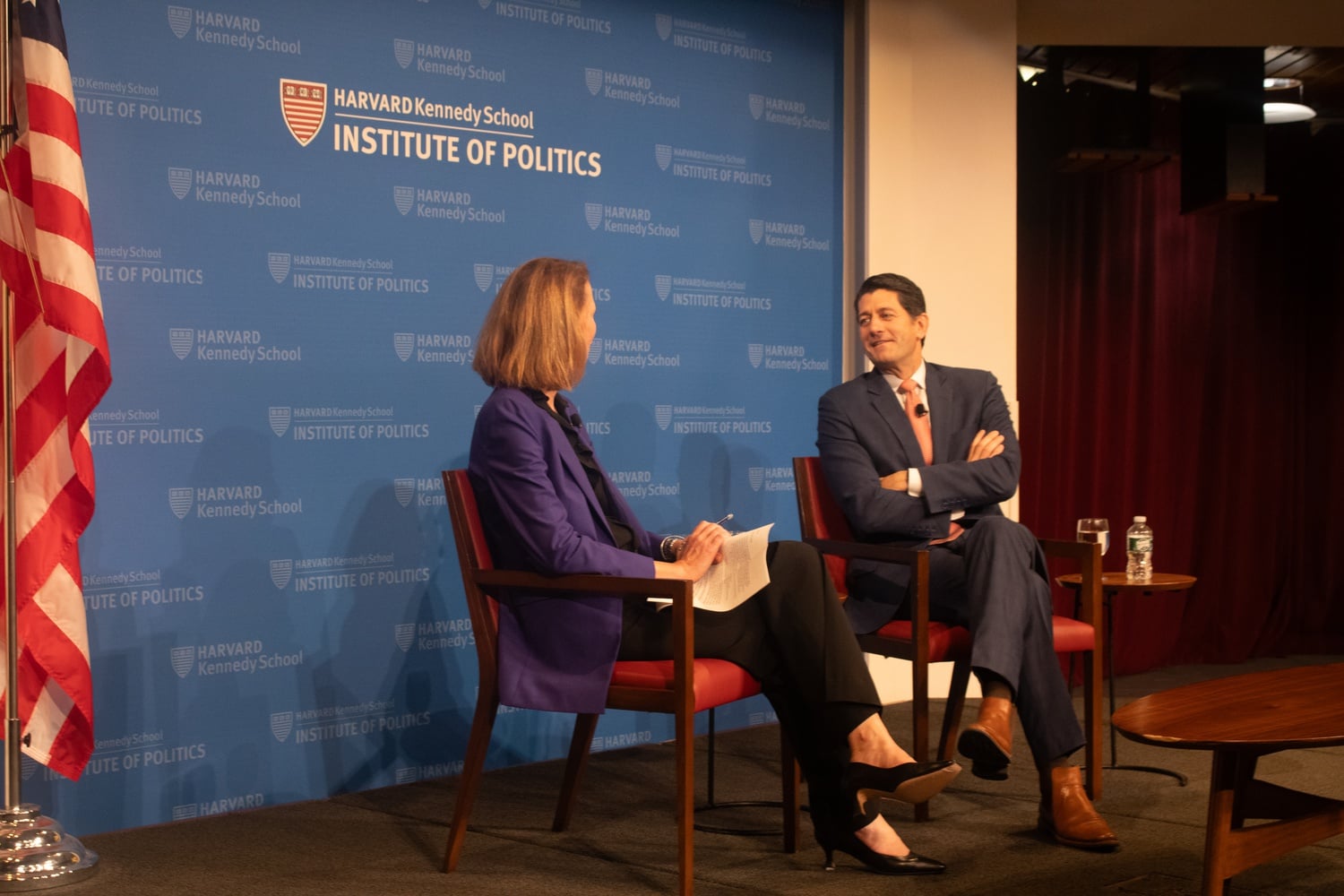
Former U.S. House Speaker Paul D. Ryan argued Thursday that Harvard has become a cautionary example for conservatives, accusing the University of “hijacking” diversity and inclusion ideals with an “ideological” equity agenda.
Speaking at an Institute of Politics forum, Ryan said recent controversies at Harvard — particularly surrounding accusations of campus antisemitism — reflect what he sees as a broader shift in how institutions approach diversity, equity, and inclusion.
“And so what conservatives see happen in all of this, and what conservatives saw Harvard doing, especially when it comes to antisemitism, is they see these really important ideals — ending racism is really important, including people in the society who historically have not been included is really important,” Ryan said. “We’re for all of that.”
“But we’ve been told by this idea that if we’re for that, we got to buy the equity agenda. We got to buy a collectivist ideology,” he added.
A University spokesperson did not respond to a request for comment.
Ryan, who served as speaker from 2015 to 2019, framed his critique as a distinction between widely supported goals and what he described as their politicizations.
“Diversity and inclusion are wonderful things. These are really important aspirations, ideals and principles,” he said. “It’s the equity in the middle which gets really ideological.”
Ryan argued that conservatives increasingly view DEI — along with related frameworks like environment, social, and governance — as embedding a “collectivist, progressive ideology” into institutions that once centered more narrowly on opportunity and inclusion.
“So it’s the ideology,” he said, “telling us that if we want to be good on these two really important issues, we got to be this,” he said. “We see a hijacking of these principles in service to an ideology.”
He added that such approaches risk deepening division rather than resolving it.
Get The Crimson in your inbox.
“You don’t fight discrimination with other discrimination,” Ryan said. “You’re just going to end up with a bunch of ticked off people.”
Ryan delivered the remarks in a wide-ranking conversation with Anthony R. Foxx — the director of the Center of Public Leadership — at the John F. Kennedy Jr. Forum, where he also addressed the future of the Republican Party, immigration, and foreign policy.
He urged students not to view current tensions between universities and political actors are purely partisan.
“It’s easy to say red versus blue, Harvard versus Trump. End of story,” Ryan said. “It’s more complicated than that.”
Ryan also reflected on the state of the Republican Party, arguing it is currently defined less by traditional conservatism than by a form of populism tied to U.S. President Donald J. Trump.
“This is a populism tied to a guy, the culturality of Donald Trump,” Ryan said. “So that populism, by its own definition, has a shelf life of two and a half more years.”
“I don’t even really want to call it conservatism,” he said. “It's much more big government, it's much more illiberal, it's less market, and it premises itself on this blood and soil nationalism, which I just don't think works.”
He contrasted that with what he described as the core principles of conservatism, emphasizing individual rights and limited government.
“We strive for a society that promotes equality of opportunity, not equality of outcome,” he said. “The government’s job is to protect those rights so that we can pursue happiness for ourselves.”
Ryan also turned to foreign policy, pointing to recent tensions with Iran as an example of what he described as a pragmatic approach shaped by his time in office.
“Everybody knows I’m not a Trump guy,” he said, but added that after two decades of Iran the threat had not improved.
“So it is prudent to say, if you know this threat is coming and it’s getting worse, deal with it while they’re the weakest they are,” he said.
He urged students interested in public service to prioritize preparation over visibility, criticizing what he described as a culture of shortcuts.
“Develop good habits. Work really hard. Know your subject matter, let the game come to you and rise to a meritocracy,” he said. “A lot of people these days in the Tiktok culture we’re in, think you can sort of just fake it till you make it.”
—Staff writer Jen L. Phan can be reached at [email protected] and Signal at jenphan.74. Follow her on X at @jenllphan.
Want to keep up with breaking news? Subscribe to our email newsletter
Have a tip for The Crimson? Share it confidentially