Funding Disparities Are No Fun
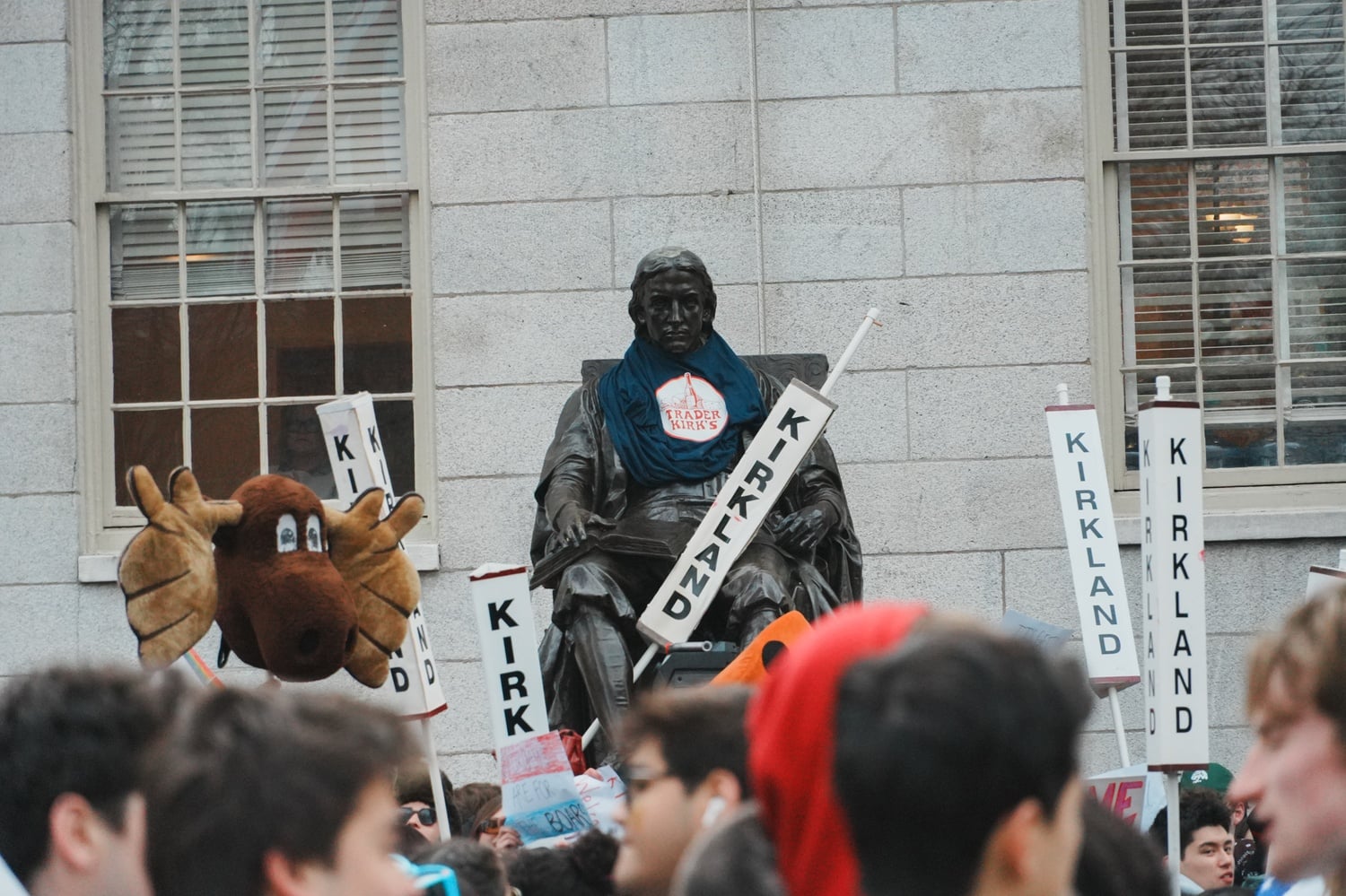
When Housing Day rolls around each year, freshmen are told that every House has its charm. What they’re not told is that some can afford more “charm” than others.
Last week, the College announced that alumni will be able to donate directly to individual Houses this Housing Day. This campaign is a marked departure from past years, when alumni donations went through the College before reaching the Houses.
As harmless as this initiative may seem, it fails to address a problem which has plagued the inter-House dynamic for years — namely, glaring resource disparities. If anything, this campaign only exacerbates the divide, sending the message that some Houses just get to have more money — and more fun — than others.
House funding and student life are closely intertwined. House Committees are charged with organizing some of the College’s most famed formals, from Lowell’s Yule Ball to Eliot’s Fête. Events like these drain HoCo coffers year after year, depending on a steady supply of funding to support them.
The issue of financial inequities among Houses isn’t anything new. A 2014 Crimson analysis revealed striking financial inequities across different Houses. Eliot House, for example, planned to spend nearly twice as much per student as Adams House in the 2014-15 academic year. For the fall semester, Dunster and Cabot had projected revenues of about $20,000, eclipsing Mather and Pforzheimer’s estimated $10,000 each.
Since 2014, not much has changed. Interviews with HoCo members in 2025 suggested that budgetary differences from House to House remained an ever-present problem for HoCo members to work around. That year, Lowell House reportedly outspent other Houses by a margin of $10,000, pointing to a drastic gap in the resources available to individual Houses.
It’s important to note that, at least on paper, the University isn’t to blame for the varying sizes of HoCo budgets — all HoCos receive the same semesterly grant directly from the Dean of Students Office. When individual HoCos organize fundraisers of their own, however, some start to edge out others.
Differences between House budgets can largely be attributed to this capitalistic approach to funding House life rather than the DSO itself. However, this doesn’t change the fact that the budgetary variance between Houses has been firmly rooted at the College for quite some time.
Following the announcement, College Dean David J. Deming admitted the potential risk such a fundraising policy could entail. Though he recognized that it could further contribute to budgetary inequalities, he ultimately concluded that “all Houses will have more than they had before,” which he deemed “a better outcome, even if it means that some Houses will have more than others.”
Deming directly cited improving student life as a consideration behind the campaign, saying it was borne out of a perceived desire among students to make Harvard “more fun.” To that end, there appear to be relatively few restrictions as to how students and House Committees can use the influx of funds.
And, up to this point, Deming has been taking steps in the right direction. The decision to raise the Student Activities Fee to $450 starting in fall 2026, for example, will go a long way in expanding the funds that the College can distribute evenly to Houses.
That same vision is reflected in this latest fundraising attempt. The campaign is likely to rake in donations from alumni House loyalists which wouldn’t be made under the standard system of College disbursement. Moreover, it’s hard to argue against fundraising in whatever form it may take — donations do, after all, serve only to the benefit of students.
To this end, the campaign makes sense — what doesn’t is the fact that the University has openly acknowledged financial disparities among Houses while promoting an initiative which perpetuates that very issue.
There are other means to rake in alumni donations without exacerbating existing budgetary divides. For example, alumni could indicate their House affiliation when donating. The House that generates the most alumni participation could then earn an exclusive social funded by the DSO. Fundraisers within this vein — ones which incentivize alumni donations while equally distributing them — can, and should, be the blueprint for future campaigns.
The longstanding nature of this problem demands a far more complex solution than what we can glean from what little budgetary information we have. However, this doesn’t mean that it’s not a problem worthy of attention — that is, if the University wants to make good on the vision of a “more fun” Harvard.
Part of the beauty of living in the Houses is coming to terms with all of their quirks. Budgets shouldn’t be one of them.
Thomas C. Walder ’29, a Crimson Editorial editor, lives in Wigglesworth Hall.
Want to keep up with breaking news? Subscribe to our email newsletter
Have a tip for The Crimson? Share it confidentially